
Indonesia Climbs to Second in Global Muslim Travel Ranking, Halal Certification Remains a Challenge
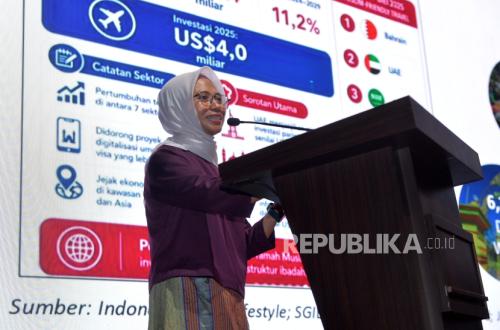
The Ministry of Tourism has announced that Indonesia has climbed to second place in the world for Muslim travel destinations according to the Global Muslim Travel Index (GMTI) 2026 report. However, strengthening the halal ecosystem and certification for tourism businesses remains a major challenge.
Masruroh, Expert Staff for Digital Transformation and Tourism Innovation at the Ministry of Tourism, stated that Indonesia’s position this year shows significant progress after previously being ranked fifth. “According to GMTI 2026, Indonesia is the second-ranked Muslim travel destination in the world after Malaysia,” Masruroh said at the Indonesia Sharia Forum (ISF) 2026 in Jakarta on Wednesday.
She explained that the GMTI assessment covers four main aspects: access, communication, environment, and services. Therefore, Indonesia’s improved ranking depends not only on the tourism sector but also on support from various ministries and institutions. Masruroh noted that Indonesia needs to continue learning from Malaysia, which consistently holds the top position in the GMTI. According to her, strengthening cross-sector coordination is key to improving Indonesia’s score on each assessment indicator.
Nevertheless, she acknowledged that Indonesia still faces several challenges in developing Muslim-friendly tourism. One of the most pressing is strengthening the halal ecosystem, especially certification for hotels, restaurants, and tourism businesses. “We still have homework regarding halal certification, especially for hotels and restaurants, which are key to ensuring halal guarantees at tourist destinations,” she said.
The Ministry of Tourism is cooperating with the Halal Product Assurance Agency (BPJPH) to accelerate halal certification for MSMEs and the creative economy. As of May 2026, 31,548 halal certificates have been issued to businesses in 116 tourist villages across 34 provinces. In addition to certification, the government is also encouraging the provision of sanitation and worship facilities that meet the needs of Muslim travellers. Masruroh cited several airports in eastern Indonesia, including Papua Pegunungan, which have provided Muslim-friendly facilities for visitors.
Another challenge is public understanding of the concept of Muslim-friendly tourism. According to her, the term is often misinterpreted as an effort to turn cultural or natural destinations into religious destinations. “What we hope is that Muslim travellers can still come and enjoy the uniqueness of a destination without abandoning their religious obligations,” Masruroh said.
To strengthen promotion, the Ministry of Tourism has developed a special Muslim-friendly tourism page on the indonesia.travel platform, featuring information on attractions, Islamic cultural heritage, places of worship, halal culinary zones, and Muslim-friendly travel packages. The government is also organising the Indonesia Muslim Travel Index (IMTI) with Bank Indonesia and Bappenas to measure regional readiness to receive Muslim travellers based on indicators of access, communication, environment, and services. Masruroh expressed hope that strengthening the halal ecosystem and improving destination quality will enable Indonesia to become not only a market for Muslim tourism but also a centre for tourism development.