
Indonesia Besieged by Volcanic Eruptions — Which Year Was the Worst?
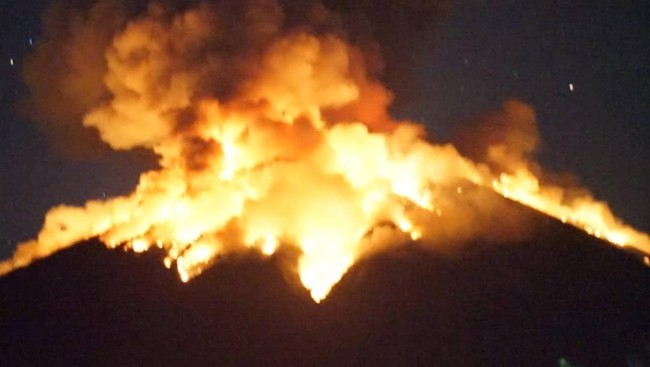
Jakarta, CNBC Indonesia — Volcanic eruption disasters have besieged Indonesia almost every year. Several volcanoes even erupted or showed increased activity simultaneously in September 2026.
Five Indonesian volcanoes are currently at Level III/Standby status, namely Mount Anak Krakatau in Lampung, Mount Merapi on the border of Central Java and Yogyakarta, Mount Sinabung in North Sumatra, Mount Semeru in East Java, and Lewotobi Laki-Laki in East Nusa Tenggara (NTT).
Mount Anak Krakatau, which has been erupting since Friday (4/9/2026), has even had a major impact, particularly the disruption of flight routes.
This volcanic activity serves as a reminder that the threat of volcanic eruptions still looms over various regions of Indonesia.
Between 2011 and 2026, hundreds of volcanic eruptions have been recorded with varying impacts, ranging from deaths, missing and injured residents, to tens of thousands of people forced to leave their homes and evacuate.
According to data from the National Disaster Management Agency (BNPB), the number of eruptions does not always correlate directly with the scale of the impact caused.
The data shows there were periods when eruption frequency surged, but casualties and the number of displaced people were relatively limited. Conversely, a single eruption in a year could cause casualties and displacement on a massive scale.
2018 Saw the Most Eruptions, 2017 the Most Displaced
2018 was recorded as the period with the highest number of eruption events, reaching 63 incidents. This figure far exceeded 2017, which recorded 14 incidents, and 2015 with 13 incidents.
Notably, several volcanoes that erupted in 2018 included Mount Anak Krakatau, Mount Merapi, Mount Agung, Mount Sinabung, Mount Soputan, Mount Gamalama, Mount Ibu, Mount Dukono, Mount Semeru, and Mount Kerinci.
However, the high frequency of eruptions did not automatically make 2018 the year with the largest number of casualties or displaced people. 2017 was the period with the most displaced people, reaching 72,114 individuals. This large figure was primarily due to the eruptive activity of Mount Agung in Karangasem, Bali.
The next position was held by 2014, with 64,169 people displaced. In the same year, damage to houses also recorded the highest figure for the period, reaching 17,833 damaged homes.
Meanwhile, for fatalities, the pattern was once again different.
In 2021, 64 people died, 9 went missing, and 863 were injured, even though only one eruption event was recorded in the annual data.
This picture shows that eruption frequency is not the sole indicator for measuring the scale of a disaster.
2018 is the clearest example. Although the number of eruptions reached 63 incidents, the impact on fatalities and displacement was not as great as in several years with far fewer eruptions.
The Impact of Eruptions Goes Beyond Fatalities
The threat of eruptions is also reflected in material damage and the scale of population displacement.
2014 was the period with the highest number of damaged houses, reaching 17,833 units. This figure far exceeded 2024, which recorded 2,983 damaged houses, and 2021 with 1,027 damaged houses.
On the other hand, the number of displaced people is an important indicator for seeing how greatly eruptions force communities to leave their places of residence.
In 2017 and 2014, for instance, the number of displaced residents each exceeded 64,000 people.
This data shows that the scale of an eruption’s impact cannot be judged solely by how frequently volcanoes erupt.
The location of the volcano, the characteristics of the eruption, the condition of the affected areas, and population density in vulnerable regions are all factors that determine the scale of the impact on communities.
For this reason, monitoring volcanic activity, early warning systems, and rapid evacuation are key to reducing casualties when volcanoes show renewed activity.
Source: jawawa.id (https://jawawa.id/newsitem/indonesia-besieged-by-volcanic-eruptions-which-year-was-the-worst-1788781909)
Originally published by CNBC Indonesia (https://www.cnbcindonesia.com/research/20260907162145-128-765915/ri-dikepung-letusan-gunung-berapi-kapan-tahun-paling-parah), translated from Indonesian