
Indonesia Begins New Era of Military Modernisation with BrahMos and Rafale Acquisitions
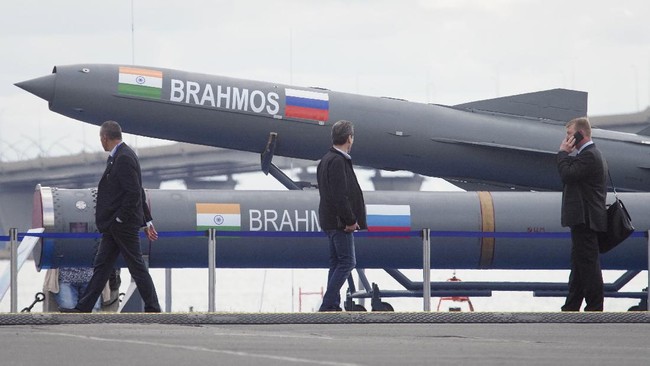
Indonesia has officially added to its strategic weapons procurement list by approving the purchase of BrahMos supersonic cruise missiles and Astra missiles from India. The move is part of the government’s effort to strengthen and modernise the national defence force.
The agreement was reached during Indian Prime Minister Narendra Modi’s official visit to Jakarta, where he met President Prabowo Subianto. The deal for the BrahMos and Astra missile systems is valued at approximately US$630 million.
BrahMos is a supersonic cruise missile jointly developed by India and Russia, known for its capability to be launched from land, sea, and air platforms. Meanwhile, the Astra is an Indian-made air-to-air missile designed to enhance the combat capability of fighter jets.
This procurement extends Indonesia’s list of strategic defence acquisitions in recent years. Since 2019, when Prabowo served as Minister of Defence, the government has aggressively pursued military modernisation by partnering with various countries, including the United States, France, Italy, Turkey, South Korea, and India.
The policy aligns with the defence modernisation agenda consistently pushed by Prabowo, both during his tenure at the Ministry of Defence and now as President. The strengthening of capabilities spans all branches, including transport aircraft, fighter jets, drones, radar systems, warships, submarines, and missile systems.
Among the defence equipment already ordered by Indonesia are C-130J Super Hercules transport aircraft, Airbus A400M Atlas, Rafale fighter jets, and TAI Anka-S drones. The list also includes Thales Ground Master 403 air defence radars, Merah Putih frigates, and the Bung Karno Class presidential vessel.
In the strategic procurement sector, Indonesia has ordered 42 Dassault Rafale F4 fighter jets from France worth approximately US$8.1 billion. The country has also acquired two Scorpène Evolved submarines with an estimated value of US$2 billion, as well as two Brawijaya Class warships from Fincantieri Italy worth around US$1.39 billion.
Beyond the BrahMos and Astra missiles, Indonesia is strengthening its weapons systems through the procurement of Khan short-range ballistic missiles, Hisar-O medium-range air defence missiles, and Roketsan Atmaca anti-ship missiles. This strategy demonstrates the government’s intent to diversify its sources of defence equipment while enhancing national defence capabilities amid increasingly complex regional security dynamics.
Financing for these modern defence systems requires substantial capital. Most major contracts are denominated in foreign currencies, making the required budget sensitive to fluctuations in the rupiah against the US dollar and the euro.
Within the Ministry of Defence budget, particularly for the modernisation programme, funding sources include the state budget (APBN), foreign loans, domestic loans, Sharia Government Securities (SBSN), and Non-Tax State Revenue (PNBP). For 2026, the Ministry of Defence budget has been set at Rp187.1 trillion, according to Presidential Regulation Number 118 of 2025.
The largest portion of this budget is allocated to the Modernisation of Primary Weapon Systems, Non-Weapon Systems, and Defence Infrastructure programme, which accounts for Rp84.48 trillion, or approximately 45.1 percent of the total Ministry of Defence budget for 2026. Notably, the largest source of funding for this modernisation programme comes from foreign loans, amounting to Rp46.5 trillion, followed by pure rupiah funds of Rp33.44 trillion, domestic loans of Rp3.69 trillion, SBSN of Rp800 billion, and Non-Tax State Revenue of around Rp60 billion.
This composition indicates that Indonesia’s military modernisation does not rely solely on direct spending from the state treasury. For large-scale procurements such as fighter jets, warships, radars, and missile systems, the government also utilises alternative financing schemes, particularly foreign loans.
In recent years, the Ministry of Defence budget has steadily increased. In the 2024 state budget, the ministry received an allocation of approximately Rp139.26 trillion. This rose to around Rp166.26 trillion in the 2025 state budget, before undergoing a significant adjustment to Rp364.1 trillion. The increase was directed towards modernisation, improving soldier welfare, achieving independence for the domestic defence industry, and organisational validation.
Looking ahead to 2027, Defence Minister Sjafrie Sjamsoeddin has proposed an additional budget of approximately Rp195 trillion. The proposal arose because the national defence budget requirement is said to reach Rp667 trillion, while the indicative ceiling provided by the government is only around Rp139 trillion. If the additional funds are approved, the Ministry of Defence budget for 2027 could rise to around Rp334 trillion.