
Indonesia Begins Exporting 1,000 Tonnes of Rice to Malaysia, with Potential of 200,000 Tonnes
Indonesia has begun reopening its rice export taps after confirming that national food stocks are in a safe condition. This time, Indonesian rice will be sent to Malaysia with an initial volume of 1,000 tonnes. The agreement marks a new momentum in rice trade relations between the two countries. Sarawak, Malaysia, has a potential rice requirement of up to around 200,000 tonnes per year, which could be met gradually from Indonesia.
Minister of Agriculture and Head of the National Food Agency (Bapanas) Amran Sulaiman said that rice exports to Malaysia are good news for Indonesia after achieving rice self-sufficiency. “I would like to express my gratitude that today there is good news for Indonesia, where we have achieved rice self-sufficiency, our stock is 5.2 million tonnes as of today. We have even rented warehouses for 2 million tonnes, we are in surplus according to BPS data,” Amran told reporters in Jakarta on Friday evening (14/8/2026).
According to him, the strong national rice production and stock conditions open up room for Indonesia to once again supply foreign markets. Previously, Indonesia had also exported rice to a number of countries, such as Palestine and Egypt. “Last year the surplus was 4 million tonnes, meaning that 2026 production combined with 2025 is a surplus of 8 million tonnes. Meanwhile, our warehouse capacity is only 3 million tonnes. Therefore, we previously exported to Palestine and Egypt, and now we are exporting to Malaysia,” he said.
Amran said that exports to Malaysia will be carried out in stages. For the initial phase, Indonesia will send 1,000 tonnes of premium rice to Sarawak. Meanwhile, Sarawak’s requirement is said to reach around 200,000 tonnes per year. “If possible, this export of 1,000 tonnes will be dispatched this week in stages, because Sarawak’s requirement alone is 200,000 tonnes. And for the whole of Malaysia it is 1.5 to 1.7 million tonnes per year,” said Amran.
The plan has been discussed by Amran with Malaysia’s Minister of Agriculture and Food Security, Datuk Seri Mohamad Sabu. The Malaysian government is said to appreciate the plan and has opened up opportunities for increasing rice exports from Indonesia. “We have just spoken with the Malaysian Minister of Agriculture, Datuk Seri Mohamad Sabu. He appreciates it and will accelerate and increase exports from Indonesia to Malaysia,” he said.
In terms of price, the traded rice was agreed at around 3.9 Malaysian Ringgit or Rp17,000 per kilogramme. At that price, the initial shipment of 1,000 tonnes has a value of around Rp17 billion. Meanwhile, if the potential Sarawak requirement of 200,000 tonnes per year is realised, the trade value could reach around Rp3.39 trillion.
Amran also assured that the exports would not be carried out at the expense of domestic rice needs. The government continues to place domestic needs as a priority before opening up export space. “Remember, friends, that data is from BPS, there is no data at the Ministry of Agriculture, and the one that declared self-sufficiency is the FAO,” said Amran.
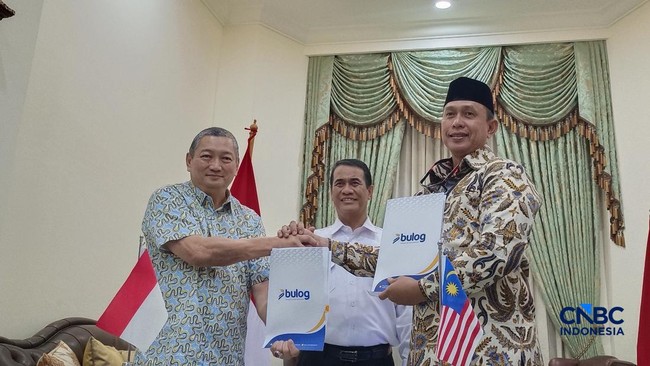
President Director of Perum Bulog Ahmad Rizal Ramdhani said that Bulog has signed a memorandum of understanding (MoU) with the Malaysian side to realise the rice exports. He confirmed that the initial shipment will be 1,000 tonnes, with potential needs of up to 200,000 tonnes for Sarawak. “Alhamdulillah, on this blessed Friday evening, Bulog has signed an MoU with Malaysia to carry out rice exports. God willing, as a start, we will export a total of 1,000 tonnes, and the potential for Sarawak alone is around 200,000 tonnes,” said Rizal.
According to him, of the total initial shipment, around five containers will be sent via the Entikong border crossing. Meanwhile, the remaining approximately 950 tonnes will be sent by sea from Tanjung Priok Port to Kuching Port, Malaysia. Rizal said that the realisation of larger export volumes still depends on demand and permits from the Malaysian government. Thus, exports will not immediately be carried out at a volume of 200,000 tonnes. “We are waiting for demand. So we cannot push to the maximum because we have to wait for demand, just as until now we are also waiting for certainty of import permits from the Malaysian government, namely from the Malaysian Ministry of Agriculture, as well as from Bernas, which is Malaysia’s Bulog,” he explained.
He assured that Bulog’s stock is still sufficient to support the exports. According to Rizal, Bulog’s current stock has even reached around 5.25 to 5.26 million tonnes. “As directed by the Minister of Agriculture, we continue to prioritise domestic needs first. However, we have calculated that with the potential of only 1,000 tonnes for this initial export, even up to 200,000 tonnes, our stock is still plentiful. Because Bulog’s stock is 5.25 million tonnes, and could even reach 5.26 million tonnes as of today. So there is no problem,” he said.
Meanwhile, General Manager of Padi dan Beras Borneo Sdn Bhd, Jumaat bin Ibrahim, said that the first shipment of 1,000 tonnes is an initial step to introduce Indonesian rice to the Sarawak market. He said Sarawak’s rice requirement reaches around 200,000 tonnes per year. Therefore, the initial shipment will be part of efforts to expand the Indonesian rice market in Malaysia. “For Sarawak, we need approximately 200,000 tonnes per year. And we will work on this through promotion, where the first 1,000 tonnes serves as our promotional step to promote Indonesian rice to Sarawak,” said Jumaat.
He said that Malaysia’s overall rice requirement reaches more than 1.5 million tonnes per year. Thus, there is a larger market opportunity if the Indonesia-Malaysia export cooperation can continue to be developed.
Source: jawawa.id (https://jawawa.id/newsitem/indonesia-begins-exporting-1-000-tonnes-of-rice-to-malaysia-with-potential-of-200-000-tonnes-1786805483)
Originally published by CNBC Indonesia (https://www.cnbcindonesia.com/news/20260815204850-4-759712/ri-mulai-ekspor-1000-ton-beras-ke-malaysia-potensinya-200-ribu-ton), translated from Indonesian