
Indonesia Begins Building Advanced Rockets Independently, Test Flight in Three Years
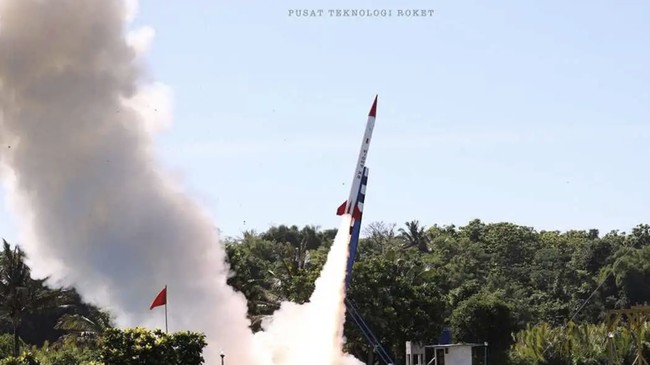
The National Research and Innovation Agency (BRIN) is developing a two-stage rocket targeted to conduct a test flight in 2029. Head of the Rocket Technology Research Centre (PRTR) at BRIN, Arif Nur Hakim, said that under the latest roadmap, a number of key technologies are being prepared in stages, from the RX 450 rocket motor, separation systems, control systems, to telemetry.
The development is supported through the Strategic Invitation Research Programme (PRIS). This funding scheme provides room for researchers to carry out research stages in line with targets set out in the two-stage rocket development roadmap.
“The presence of PRIS is very helpful and makes fellow researchers more enthusiastic in carrying out research. This support also opens space for researchers to focus on achieving key technologies. One of them is the development of the RX 450 rocket motor, which is an important part of the two-stage rocket development roadmap,” said Arif, quoted from an official statement on Tuesday (25/8/2026).
He explained that the adjustment of stages was carried out as part of the research maturation process so that the roadmap is more solid and realistic, especially in mastering key technologies such as control systems and telemetry.
“The roadmap was prepared based on assumptions and the level of technological mastery at that time. After evaluation, each stage needs to be ensured to be well mastered, especially in supporting the achievement and acquisition of the required data,” he said.
This year, the team will complete the overall design of the two-stage rocket as well as the separation system design, with PRIS budget support to develop the RX 450 rocket motor with a range of 100 km. This will be followed by a Critical Design Review (CDR) of the two-stage rocket, static testing of a high-performance rocket motor, and a separation system flight test in 2027.
The stages continue in 2028 with separate flight tests of the first-stage and second-stage rockets. These tests are part of preparations before the full two-stage rocket flight test in 2029. This achievement will be an important milestone in national rocket technology independence.
In addition to the rocket programme, BRIN is also building a spaceport as mandated by law. To accelerate its realisation, BRIN is now partnering with strategic investor partners, with two partners currently actively moving. One focuses on the large rocket segment, and the other on the small rocket segment.
This collaboration is now entering the stage of consolidating agreements between BRIN and the partners. This year, the team is targeting the completion of the basic design of the spaceport, which will be followed by land fencing and construction of basic facilities in the following year, along with the completion of regulations and cooperation agreements with partner countries.
Both initiatives demonstrate BRIN’s efforts to strengthen the rocket research roadmap and spaceport development. These efforts are in line with the strategic agenda of strengthening national defence and space technology independence.