
Indonesia Awaits Fit and Proper Test for Central Bank Governor, Critical News from America
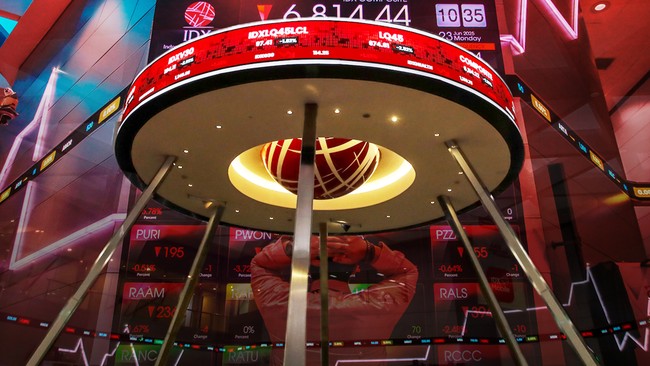
The Jakarta Composite Index (JCI) and the rupiah ended in negative territory. Pressure also occurred in the government bond market, marked by an increase in the yield on Government Securities (SBN).
The JCI closed down 0.37% or 24.02 points at 6,501.67 on Monday. The index reversed direction after having re-entered the psychological level of 6,500 over the weekend.
The JCI had opened trading at 6,544. Throughout the session, the index reached a high of 6,551 and a low of 6,474.
The index decline was accompanied by falls in 367 stocks. Meanwhile, 259 stocks rose and 166 others were unchanged.
Transaction value reached Rp14.29 trillion with trading volume of 35.88 billion shares. Transaction frequency was recorded at 2.19 million times.
Only three sectors ended in positive territory: raw materials, technology, and primary consumer goods.
Specifically, shares of PT Bayan Resources Tbk. (BYAN), PT Bank Rakyat Indonesia (Persero) Tbk. (BBRI), and PT Bank Central Asia Tbk. (BBCA) weighed on the index.
Turning to the foreign exchange market, the rupiah reversed to weaken against the US dollar in the last trading session before the Prophet Muhammad’s birthday holiday.
The rupiah had opened up 0.03% at Rp17,680 per US dollar. However, the Garuda currency then reversed direction and weakened by 25 points from the opening to the close.
The rupiah’s weakness came as the US dollar strengthened again. US services activity recording its strongest growth in nearly two years was one factor holding back selling pressure on the dollar.
The dollar also received support from still-high US government bond yields. Long-term bond yields remained around their highest levels in decades due to concerns about government debt, inflation, and rising financing needs.
However, the dollar’s strengthening remained limited as the market monitored the US Treasury Department’s plan to increase buybacks of long-term government bonds. The policy raised concerns that efforts to suppress yields could instead weigh on the dollar.
Meanwhile, pressure also occurred in the government bond market. The yield on 10-year SBN rose 8.1 basis points from 6.960% to 7.041% on Monday.
The rise in yields indicates that government bond prices moved lower because the relationship between the two is inverse. This position also brought the 10-year SBN yield back above the 7% level.
From the US stock market, Wall Street closed higher on Tuesday, or early Wednesday Indonesian time.
The market rose as US government bond yields fell for a second consecutive day. Gains in semiconductor stocks also lifted the Nasdaq index.
The S&P 500 rose 0.32% to 7,677.28. The Nasdaq Composite gained 0.66% to 26,151.30.
The Dow Jones Industrial Average also rose 160.24 points, or 0.30%, to 53,577.40. This gain marked a three-session winning streak.
In the bond market, the yield on 10-year US Treasuries fell more than 7 basis points to 4.625%.
The yield decline also occurred on Monday after reports emerged that the US Treasury Department could potentially use US$1 trillion from its General Account to finance bond buybacks.
Meanwhile, West Texas Intermediate (WTI) crude oil prices plunged more than 3%.
Semiconductor stocks were in the spotlight ahead of Nvidia’s earnings release on Wednesday after market close.
Nvidia shares, led by CEO Jensen Huang, jumped about 2%, ending a seven-session losing streak.
Advanced Micro Devices (AMD) shares surged 4.9%, while Micron Technology gained 2.5%.
Conversely, the consumer sector weighed on the market. Dick’s Sporting Goods shares plunged about 30% after the company reported disappointing performance. The decline was the worst in the company’s trading history.
Pressure also hit several other major retailers. Walmart shares fell 1%, while Target slumped nearly 4%.
US Consumer Sentiment Deteriorates
Market sentiment was also pressured by US consumer confidence data that was worse than expected, amid worsening trade conflict between the US and Canada.
The Consumer Confidence Index released by the Conference Board fell 0.8 points to 89.4 in August. The figure was below the Dow Jones consensus of 90.2.
The condition shows US consumers are increasingly pessimistic about economic prospects, especially for the coming months.
Canada on Tuesday also announced retaliatory tariffs against the US. The Canadian government said it would match the 50% tariff imposed by President Donald Trump on Canada on a “dollar for dollar” basis.
However, the deteriorating consumer sentiment has not been fully reflected in spending patterns.
“So far, company reports still show resilient consumers. So even though sentiment is deteriorating, consumer spending is still holding up,” said Bret Kenwell, investment analyst at eToro US, to CNBC International.
According to him, the market can still ignore negative sentiment as long as consumers keep spending. This is because consumption is the main determinant of corporate earnings performance.
Investors Await Economic Data and Fed Speech
Market participants are now turning their attention to several important economic data releases scheduled for Wednesday.
One of them is the Personal Consumption Expenditures (PCE) price index for July, which is one of the main inflation indicators watched by the Federal Reserve.
Investors are also awaiting a speech by Federal Reserve Chair Kevin Warsh on Friday at the central bank’s annual symposium in Jackson Hole, Wyoming.