
Indonesia-Australia Unite: Chocolate and Halal Products Become New 'Weapons'
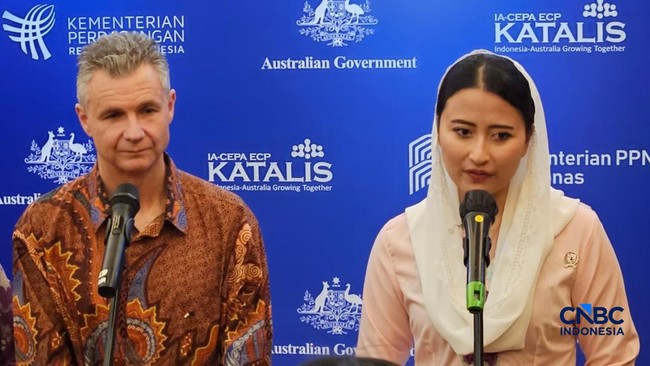
Jakarta, CNBC Indonesia - Indonesia and Australia have officially launched Katalis 2.0, the next phase of an economic cooperation programme intended to accelerate implementation of the Indonesia-Australia Comprehensive Economic Partnership Agreement (IA-CEPA). The programme is expected to strengthen economic cooperation between the two countries.
Deputy Minister of Trade Dyah Roro Esti Widya Putri said Katalis 2.0 is not merely the launch of a new programme, but a form of joint commitment to turn the opportunities within IA-CEPA into tangible economic benefits.
“Today is not simply the launch of a new programme. It is a reaffirmation of our joint commitment to turn the opportunities created by IA-CEPA into real economic outcomes that benefit businesses, workers and communities in both countries,” she said at the launch in South Jakarta on Monday (13 July 2026).
According to Roro, Katalis 2.0 will strengthen IA-CEPA implementation through collaboration between governments, the business community and development partners. She noted that Indonesia and Australia are now not only geographic neighbours, but also strategic partners in building a more resilient Indo-Pacific economy amid shifting global supply chains, digital transformation and global economic uncertainty.
Since IA-CEPA came into force on 5 July 2020, trade relations between the two countries have shown a consistently positive trend. The value of goods trade has grown an average of 10.68% per year, rising from around US$7.2 billion, equivalent to Rp128.9 trillion, in 2020 to around US$13 billion (approximately Rp232.7 trillion) in 2025.
Roro added that the two countries have also agreed to begin a review of IA-CEPA to ensure it remains relevant to future economic needs.
“We are also discussing sectors that can be strengthened going forward, including the labour market and services, where Indonesian human resources can make a greater contribution in Australia,” said Roro.
She also highlighted the importance of micro, small and medium enterprises (MSMEs), which contribute more than 60% of Indonesia’s gross domestic product. According to her, the majority of these MSMEs are run by women, so training programmes, knowledge transfer and capacity building are key to enabling businesses to enter both the Indonesian and Australian markets.
Roro said the success of the first phase of Katalis provided an important foundation for developing the new programme. Over the past five years, Katalis has been credited with expanding market access, strengthening business partnerships, improving workforce skills and encouraging cooperation in strategic sectors such as agrifood, health, digital services, tourism, advanced manufacturing and the green economy.
“Through the launch of Katalis 2.0, we are learning from what worked before. This is a moment to look at what we can do better and what opportunities we can seize together,” she said.
Chocolate Becomes a Symbol of the New Partnership
Meanwhile, Australia’s Assistant Minister for Foreign Affairs and Trade, Matt Thistlethwaite, used the cocoa commodity as a symbol of the close economic ties between the two countries. He revealed that chocolate consumption among Australians is very high, while domestic cocoa supply is very limited, making the country dependent on imports.
“Australia loves chocolate. We want to import more cocoa from Indonesia because Indonesia is one of the largest cocoa producers in the region and the sixth-largest producer in the world. We should be doing much more of this, because we are neighbours, partners and friends,” said Matt on the same occasion.
He explained that the first phase of Katalis had helped Indonesian cocoa businesses enter the Australian market through market research, workshops and exporter visits to Australia. As a result, the value of Indonesian cocoa exports to Australia tripled between 2022 and 2025.
Beyond the cocoa sector, Matt said Katalis has also supported various other strategic projects, including the expansion of companies into Australia and the training of Indonesian nurses through education partnerships that open up employment opportunities in Australia.
In the second phase, Katalis will focus on more inclusive economic growth by strengthening MSMEs, women-led businesses and underrepresented groups so they can take advantage of bilateral trade and investment opportunities.
“We will continue to connect businesses, encourage investment, support skills development, and build partnerships that deliver real impact for both countries,” said Matt.
Strengthening Trade Through Halal Product Cooperation
Ahead of the Katalis 2.0 launch, Indonesia and Australia also strengthened economic cooperation through the signing of a memorandum of understanding (MoU) on halal product assurance. The agreement was signed by the Halal Product Assurance Organising Agency (BPJPH) and the Australian Embassy in Indonesia to support the smooth flow of trade in halal-certified products between the two countries.
The MoU was signed by BPJPH Head Ahmad Haikal Hasan and Australia’s Chargé d’Affaires in Indonesia, Gita Kamath, witnessed by Matt.
BPJPH Head Ahmad Haikal Hasan said the cooperation marks an important step in strengthening the halal ecosystem of both countries.
“This MoU marks an important step in strengthening halal cooperation between Indonesia and Australia. Through deeper technical dialogue, capacity building and information exchange, we can increase consumer confidence, support Indonesia’s halal ecosystem and help high-quality halal products reach the markets of both countries,” he said.
Meanwhile, Matt said Indonesia is one of Australia’s closest economic partners and a key market for Australian food and agricultural products, particularly meat and dairy. According to him, the agreement will strengthen two-way trade while deepening the implementation of IA-CEPA and the Comprehensive Strategic Partnership (CSP).
Source: jawawa.id (https://jawawa.id/newsitem/indonesia-australia-unite-chocolate-and-halal-products-become-new-weapons-1783939950)
Originally published by CNBC Indonesia (https://www.cnbcindonesia.com/news/20260713155052-4-750451/ri-australia-bersatu-cokelat-dan-produk-halal-jadi-senjata-baru), translated from Indonesian