
Indonesia Attends 2026 BRICS Forum in India to Boost Global Trade Flows
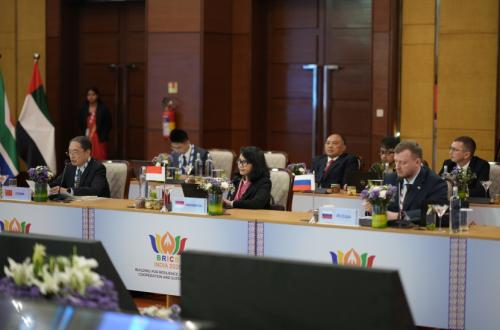
Indonesia, represented by Customs, attended the series of BRICS Customs Experts Meetings and BRICS Heads of Customs Administrations Meetings for 2026, held from 17–19 August 2026 in Chandigarh, India.
In 2026, BRICS is under the Indian presidency, carrying the theme “Building for Resilience, Innovation, Cooperation and Sustainability”. BRICS cooperation encompasses three main pillars: Political and Security, Economy and Finance, and Culture and People-to-People. Customs cooperation falls under the Trade, Investment, and Finance agenda within the Economy and Finance pillar.
“The involvement of Customs in this forum is not only a form of participation in international cooperation but also an effort to advocate for Indonesia’s interests through customs cooperation relevant to trade, cross-border supervision, technology, and capacity building,” said Budi Prasetyo, Head of the Sub-directorate of Public Relations and Community Service at Customs.
BRICS is an intergovernmental organisation comprising 11 member states: Brazil, Russia, India, China, South Africa, Egypt, Ethiopia, Indonesia, Iran, Saudi Arabia, and the United Arab Emirates. Indonesia has been a full member of BRICS since 1 January 2025, following directives from the President of the Republic of Indonesia to strengthen Indonesia’s global role, elevate the shared interests of the Global South, and utilise concrete BRICS cooperation for national interests and Indonesian development.
During the BRICS Customs Experts Meetings and BRICS Heads of Customs Administrations Meetings, Customs, alongside the customs administrations of member states, discussed several strategic agendas through the BRICS AEO (Authorised Economic Operator) Working Group, BRICS Law Enforcement Working Group, BRRICS Digitalisation and Intellectualisation Working Group, and BRICS Capacity Building.
Customs’ participation in this forum holds strategic relevance for Indonesia’s interests. Discussions regarding the development of AEO programmes and Mutual Recognition Arrangements (MRA) could open opportunities to support trade facilitation for businesses that meet compliance and supply chain security standards, allowing for easier customs processes in partner BRICS nations. Meanwhile, law enforcement cooperation, including the implementation of BRICS Joint Operations and information exchange, can strengthen efforts to combat illegal cross-border trade, thereby supporting efforts to protect the public from its impacts.
Discussions on digitalisation and artificial intelligence also provided a space for exchanging experiences in developing more effective customs services and supervision, while capacity building cooperation supports the enhancement of competence and knowledge exchange between customs administrations. Both areas offer opportunities for Customs to study the use of data and technology to support more efficient and targeted services and supervision.
“The development of international trade requires customs administrations to become increasingly adaptive to technology and data. Through BRICS cooperation, Customs has the opportunity to continue learning, sharing experiences, and developing competencies so that services to users become more efficient, while supervisory functions can be carried out more accurately and precisely,” said Budi.
Indonesia’s participation in BRICS 2026 thus serves not only as part of Indonesia’s economic diplomacy but also opens concrete space for strengthening customs cooperation. Through trade facilitation, the strengthening of AEO, law enforcement cooperation, as well as the utilisation of technology and competency development, Indonesia contributes to building a cross-border trade ecosystem that is smoother, safer, and more responsive to global trade challenges.