
Indonesia and Singapore Forge Cooperation to Strengthen Equitable Carbon Market Governance
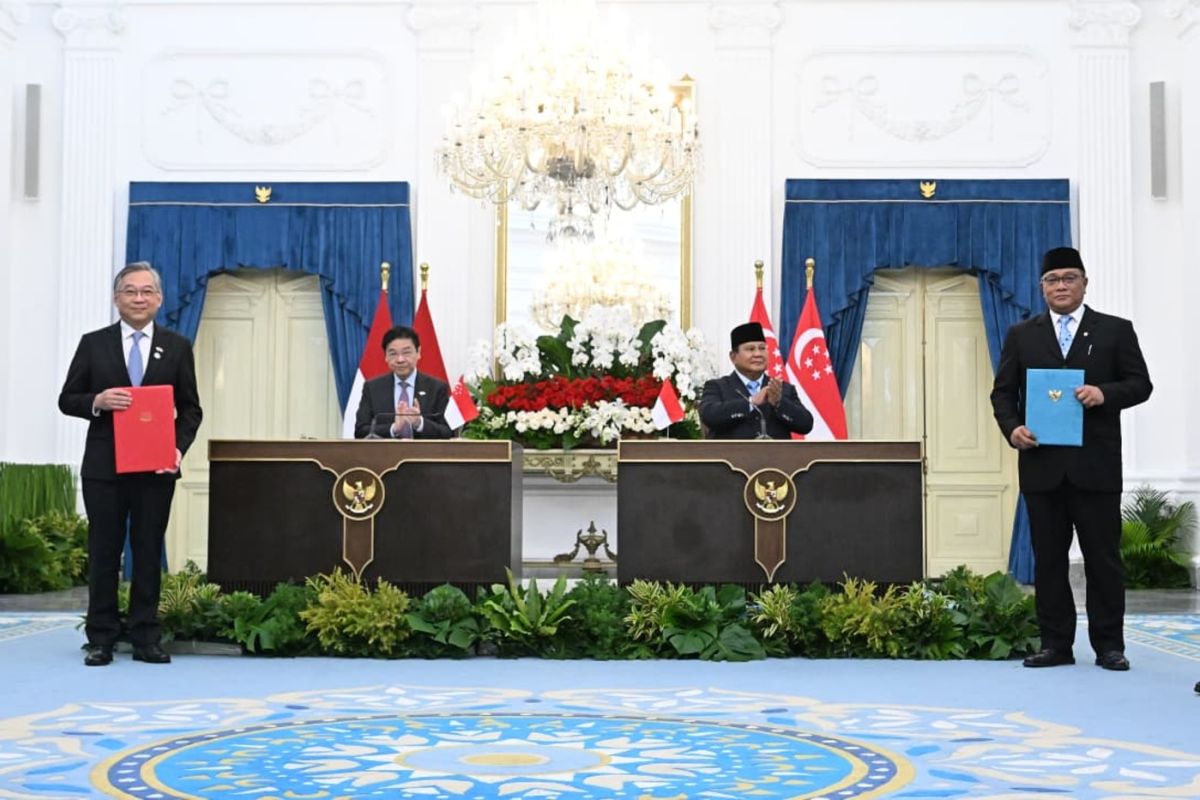
The Indonesian and Singaporean governments have cemented cooperation for equitable carbon market governance to strengthen efforts in controlling climate change and preserving the environment. The collaboration on carbon governance and environmental protection was marked by the signing of two memoranda of understanding (MoU) in Jakarta. The first, an MoU on Environmental Protection Cooperation, was signed by Indonesia’s Minister of Environment, Hanif Faisol Nurofiq, and Singapore’s Minister for Sustainability and the Environment, Grace Fu. The second, an MoU on Carbon Credit Collaboration under Article 6 of the Paris Agreement, was signed by Minister Nurofiq and Singapore’s Deputy Prime Minister and Minister for Trade and Industry, Gan Kim Yong. Minister Nurofiq stated that the MoU serves as an umbrella for cooperation that will be followed up through various more operational collaborations, ranging from climate change, waste management, and air pollution control to the circular economy and the development of carbon governance. He expressed hope that the cooperation would provide tangible benefits for both nations while strengthening joint efforts to tackle global environmental challenges. The minister noted that the strategic step aligns with President Prabowo Subianto’s Asta Cita vision for realising a green economic transformation. The twin agreements lay an essential foundation for Indonesia and Singapore to protect cross-border ecosystems while accelerating climate change mitigation through carbon credit governance that is both with integrity and fair. To realise the cooperation, both countries will synergise to strengthen operational instruments through enhancing the capacity of civil servants, initiating joint research, exchanging technical experts, and creating innovative pilot projects to build environmental resilience in the Southeast Asian region. Responding to the collaboration, Deputy Prime Minister Gan Kim Yong conveyed a similar vision regarding the integrity, climate financing, and social impact generated by the agreements. He explained that the MoUs signify the determination of Singapore and Indonesia to work together in formulating a framework for channelling climate finance into high-integrity projects, from forest conservation and coastal ecosystem restoration to the implementation of clean technology solutions that reduce emissions while creating new economic opportunities. He added that these projects will support livelihoods and provide direct benefits to local and indigenous communities most affected by climate change. As an operational follow-up to the strategic commitment, both governments will immediately formulate an Implementation Agreement. This framework will strictly regulate the mechanisms for authorisation, verification, and the transfer of Internationally Transferred Mitigation Outcomes (ITMOs), as well as the application of corresponding adjustments to prevent the double counting of national greenhouse gas emission reductions. For Indonesia, the success of this green diplomacy is expected to strengthen the credibility of carbon economic value implementation on the global stage. The carbon market must be ensured to guarantee the creation of welfare and climate justice, and be designed to be fair and with integrity for all its participants.