
Indonesia and Portugal Reach Agreement: Why Crew Members Must Be Certified
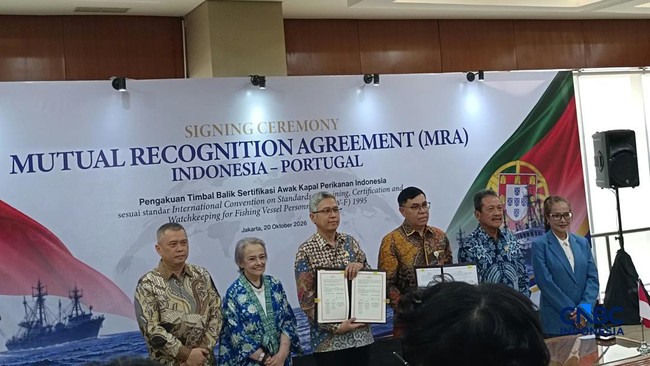
Indonesian fishing-vessel crew members who want to work in Portugal must hold internationally recognised competency certificates. Recognition of this certification is one of the key points in the Mutual Recognition Agreement (MRA) between Indonesia and Portugal.
Maritime Affairs and Fisheries Minister Sakti Wahyu Trenggono stressed that certification is essential to ensure fishing-vessel crew have the skills needed to work at sea.
“If someone has no certificate to go to sea, the challenges are severe, because the sea is dangerous. It is like someone driving on a motorway without a driving licence. If you have no certificate or skills, it is dangerous. That is roughly the idea,” Trenggono said at the signing of the Indonesia-Portugal MRA at his office in Jakarta on Tuesday (20 October 2026).
I Nyoman Radiarta, head of the Agency for Marine and Fisheries Human Resources Development and Extension, explained that crew competency certification is based on the 1995 Standards of Training, Certification and Watchkeeping for Fishing Vessel Personnel (STCW-F). The provisions are also set out in Presidential Regulation No. 18 of 2019.
The certificate serves as proof that crew members are competent for their roles and areas of expertise, from officers and captains to engineers and ratings, or non-officer crew.
Prospective crew members can obtain certification by studying at marine and fisheries education institutions. The Ministry of Maritime Affairs and Fisheries (KKP) has 11 higher education institutions and seven secondary education institutions, which equip students with skills in their respective fields.
During their studies, students undertake training and coursework before receiving a professional competency certificate in addition to their academic diploma. Certification is issued in accordance with requirements based on international standards.
“Alongside formal education, we also have training centres that improve the competencies of not only students but also members of the public. The training programmes naturally have curricula tailored to international standards,” Nyoman said.
The general public can also improve their competencies through KKP training centres, which use curricula aligned with international standards.
However, the two countries will still hold technical meetings to discuss which professional certificates will be recognised following the signing of the MRA.
Nyoman said KKP graduates around 2,000 cadets each year across programmes including fishing, aquaculture, fisheries product processing and marine engineering. The ministry also plans to support around 7,000 members of the public through its training centres.
Nyoman added that protecting workers was also a priority for KKP, to ensure that crew members with the required competencies are protected while at work.
“I think the protection of crew members is part and parcel of what concerns us at the Ministry of Maritime Affairs and Fisheries. We want to ensure that those who have the required competencies are covered by protection,” he said.
Source: jawawa.id (https://jawawa.id/newsitem/indonesia-and-portugal-reach-agreement-why-crew-members-must-be-certified-1792482682)
Originally published by CNBC Indonesia (https://www.cnbcindonesia.com/news/20261020130817-4-777836/ri-portugal-sudah-sepakat-ini-alasan-abk-harus-bersertifikat), translated from Indonesian