
Indonesia and Norway Build Performance-Based Climate Diplomacy Model
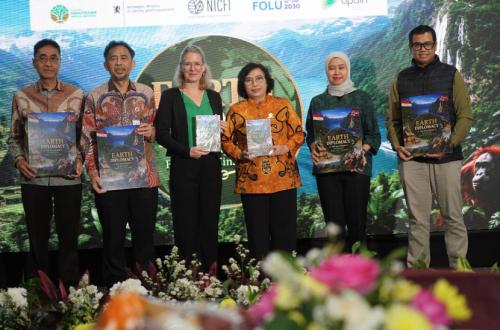
The partnership between Indonesia and Norway is regarded as having established a new model for performance-based climate diplomacy through the Results-Based Payment (RBP) mechanism. This scheme implements payments based on the actual verified reduction of greenhouse gas emissions from the forestry and land-use sectors, as confirmed by independent verification.
Haruni Krisnawati, Expert Staff to the Minister of Forestry for Climate Change, stated that this cooperation model fosters a relationship that is more equitable, transparent, and results-oriented. According to her, this approach demonstrates that international climate cooperation is no longer positioned as development aid, but rather as a partnership based on measurable achievements.
“Payments are made based on actual verified emission reductions, not as development aid,” said Haruni during the launch and book review of ‘Earth Diplomacy: The Story Behind Indonesia’s FOLU Net Sink 2030’ at the Manggala Wanabakti Building, Jakarta, on Thursday.
Haruni explained that the partnership between the two nations began with the signing of a Letter of Intent (LoI) in May 201 scale, which opened opportunities for results-based contributions of up to US$1 billion, depending on Indonesia’s emission reduction achievements in the forestry sector. After facing various implementation challenges, both countries agreed to terminate the LoI in September 2021 and establish a new cooperation framework through the signing of a Memorandum of Understanding (MoU) in September 2022.
According to Haruni, the end of the LoI served as a momentum to build a more mature partnership. The new scheme emphasises the principles of mutual respect, mutual trust, and payments based on independently verified emission reduction results.
Through this mechanism, Indonesia has received performance-based payments worth approximately US$216 million. These funds are managed by the Environmental Fund Management Agency (BPDLH) to support forest protection, ecosystem rehabilitation, forest and land fire control, the strengthening of social forestry, and the empowerment of communities living around forest areas.
Agus Justianto, Project Director for FOLU Norway Contribution Phase 1, noted that Indonesia’s FOLU Net Sink 2030 is one of the most ambitious national strategies in the forestry sector. The programme aims for the forestry and land-use sector to absorb more emissions than are produced by 2030 through reduced deforestation, peatland and mangrove restoration, forest rehabilitation, sustainable forest management, and biodiversity conservation.
Mahfudz, Secretary General of the Ministry of Forestry, stated that the success in reducing deforestation rates and improving forest governance has strengthened international confidence in Indonesia’s commitment to meeting Paris Agreement targets. He added that the experience of the Indonesia-Norway partnership can serve as a reference for other tropical nations in building international cooperation that is equitable, transparent, and oriented towards real results.