
Indonesia and India to Collaborate on Restoration of Prambanan's Perwara Temples
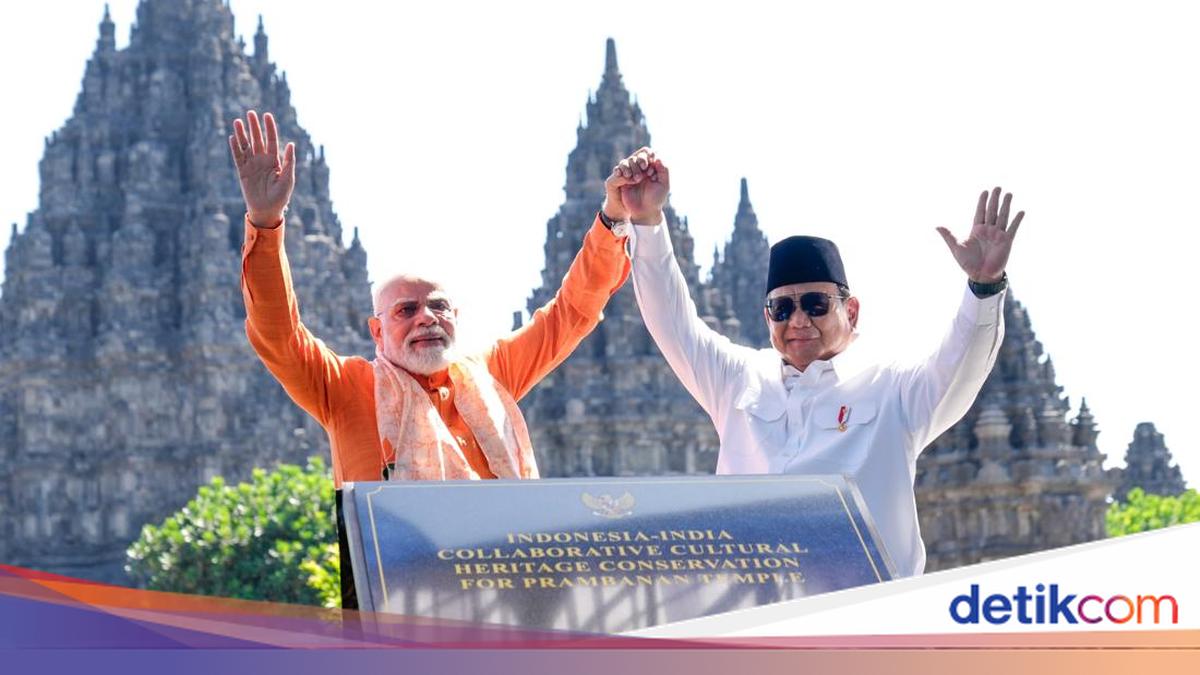
The Government of the Republic of Indonesia, through the Ministry of Culture, together with the Government of the Republic of India has strengthened cooperation on preserving world cultural heritage through a conservation and restoration programme for the Perwara temples of the Prambanan Temple Complex.
The collaboration, titled the Indonesia India Collaborative Culture Heritage Conservation programme, was presented by the Indonesian Minister of Culture, Fadli Zon, whilst accompanying President Prabowo Subianto during the state visit of Indian Prime Minister Narendra Modi to the Prambanan Temple area in Sleman, Special Region of Yogyakarta.
The initiative forms part of the strengthening of the Indonesia-India Comprehensive Strategic Partnership, set out in the Letter of Intent for the Conservation and Restoration of Prambanan Temple Complex, one of the cooperation agendas previously announced by President Prabowo Subianto in his address at the State Palace on 7 July 2026. The Letter of Intent serves as the foundation for enhanced Indonesia-India collaboration in the conservation and restoration of the Prambanan Temple Complex.
The programme will be carried out by the Indonesian Heritage Agency together with the Archaeological Survey of India (ASI), prioritising a scientific approach, the exchange of expertise, and the use of the latest conservation technology. Indonesia and India will run the conservation programme over ten years. The first phase will focus on 54 Perwara temples in the north-east quadrant of the Prambanan Temple Complex.
Indonesian Minister of Culture Fadli Zon explained the spiritual significance, values, history and civilisation, conservation, preservation and universal values of Prambanan.
“Prambanan is the largest Hindu temple complex in Indonesia and one of the masterpieces of Hindu architecture in Southeast Asia. The Ramayana and Krishnayana reliefs are tangible evidence that relations between the archipelago and India have endured for centuries through the exchange of ideas, knowledge, art and cultural values,” he said in a written statement on Wednesday (8/7/2026).
The primary focus of the cooperation is the conservation and restoration of 224 perwara temples, the small companion temples arranged in four rows encircling the main temples of Prambanan. Of the 224 perwara temples, only 6 have been fully restored, whilst the remaining 218 are still in ruins.
“Thousands of original andesite stone blocks also remain scattered, buried, or mixed at various points across the site. The lack of comprehensive documentation methods, the mixing of stones from different temple structures, and the loss of a number of original components make the restoration of Prambanan’s perwara temples one of the most complex anastylosis projects,” Fadli Zon explained.
The first phase of the conservation programme will focus on the north-east area of the Prambanan complex, encompassing 54 perwara temples. This area is expected to serve as a model for subsequent conservation phases, whilst upholding scientific standards and the principles of authenticity and integrity of Prambanan as a UNESCO World Heritage Site.
“We hope this visit will accelerate the realisation of the restoration programme, whilst maintaining scientific standards, authenticity and the integrity of Prambanan as a World Heritage Site,” he said.
Beyond physical conservation, the programme also includes digital documentation using LiDAR and photogrammetry technology, archaeological research, structural, hydrological and geotechnical studies, human resource capacity building, and the use of artificial intelligence (AI) to support digital reconstruction and technical analysis.
According to Fadli Zon, the restoration of Prambanan is a complex scientific undertaking. The process encompasses documentation, archaeological studies, structural analysis, identification of original stones, and reassembly based on the principle of authenticity.
“For this reason, Indonesia greatly values this cooperation, which brings together Indonesia’s commitment to safeguarding its cultural heritage with India’s internationally recognised expertise in the field of heritage conservation,” he explained.
During the visit, President Prabowo Subianto and Prime Minister Narendra Modi personally reviewed the plans for the conservation of the Prambanan Perwara temples. The review symbolises both nations’ commitment to strengthening the protection of cultural heritage whilst deepening the friendship between Indonesia and India.
In the joint statement delivered after the visit to Prambanan Temple, President Prabowo Subianto affirmed that Prime Minister Narendra Modi’s state visit represents an important moment for deepening Indonesia-India bilateral relations, whilst strengthening cooperation that delivers tangible benefits to both countries.
“On behalf of the government and people of Indonesia, I extend my deepest gratitude to Prime Minister Narendra Modi for his state visit to Indonesia. May the friendship between Indonesia and India grow ever stronger and closer, and continue to produce tangible, mutually beneficial cooperation for both our nations and peoples,” said President Prabowo Subianto.
The Prime Minister of the Republic of India, Narendra Modi, also expressed his appreciation to the government and people of the Republic of Indonesia for their cultural preservation efforts, which serve as a bridge for diplomatic relations between the two countries.
“I hope this cooperation will strengthen ties between India and Indonesia, not only for the two nations, but also for the peoples of India and Indonesia,” Modi said.
In closing his remarks, Minister of Culture Fadli emphasised that the conservation and restoration of Prambanan is a significant achievement within the Indonesia-India Comprehensive Strategic Partnership, particularly Paragraph 6 concerning History, Archaeology and Anthropology. According to him, the project demonstrates how the two nations’ historical relationship can be translated into concrete cooperation in safeguarding world cultural heritage for future generations.
“We hope this cooperation will become a shared legacy of Indonesia and India, and serve as an example of how two nations can work together to preserve world heritage for future generations,” the minister concluded.
Those in attendance included the Minister of Tourism, Widiyanti Putri Wardhana; the Minister of Foreign Affairs, Sugiyono; Cabinet Secretary Teddy Indra Wijaya; the Deputy Governor of the Special Region of Yogyakarta, KGPAA Paku Alam X; InJourney Director Maya Watono; and Director of PT Taman Wisata Candi, Febrina Intan.
The conservation of Prambanan is understood not merely as the preservation of archaeological remains, but also as an effort to safeguard living heritage that continues to thrive through cultural practice, education, tourism and the creative economy. Through this cooperation, Indonesia and India are expected to pass on Prambanan Temple as a space for learning, dialogue between civilisations, and a symbol of the friendship between the two nations for generations to come.
Source: jawawa.id (https://jawawa.id/newsitem/indonesia-and-india-to-collaborate-on-restoration-of-prambanans-perwara-temples-1783526080)
Originally published by detikcom (https://news.detik.com/berita/d-8565974/ri-india-kerja-sama-restorasi-kompleks-candi-perwara-prambanan), translated from Indonesian