
Indonesia and India agree cooperation to strengthen technology and communications
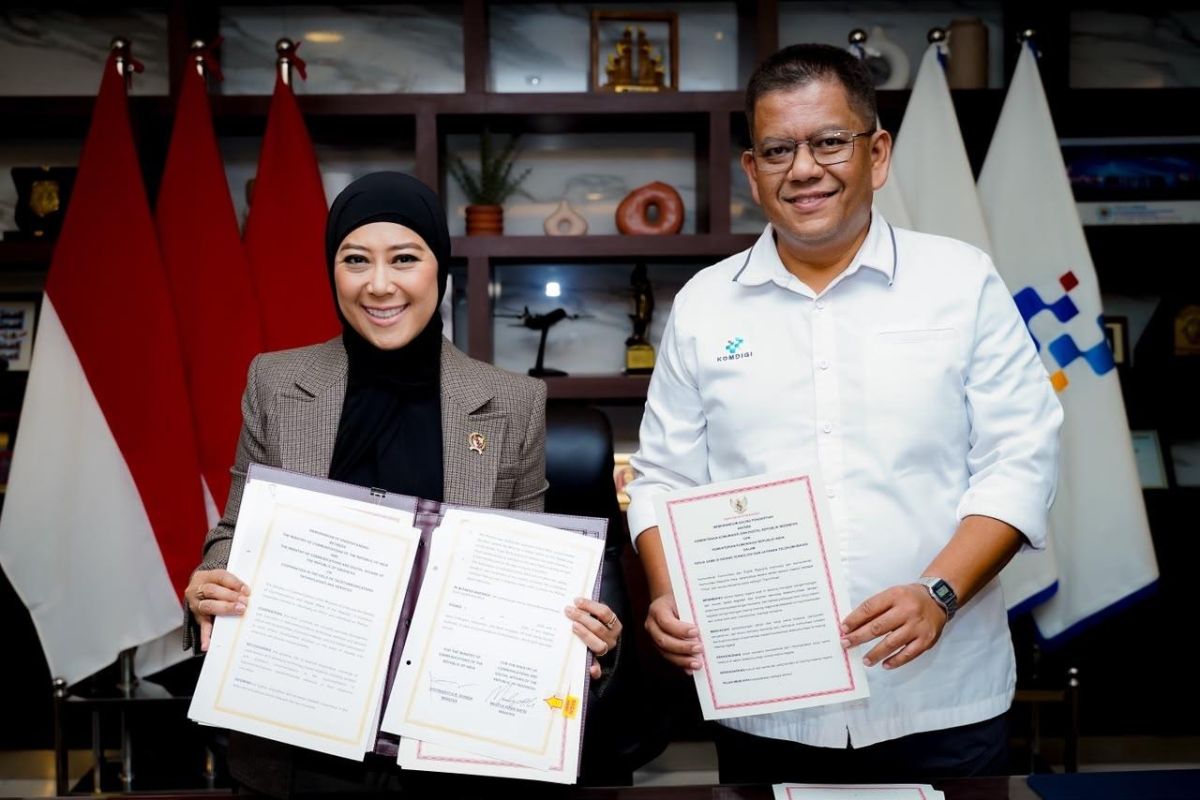
Jakarta (ANTARA) - Indonesia and India have agreed to strengthen cooperation in the field of telecommunications technology and services, providing a foundation for both countries to reinforce innovation and future digital ecosystems.
The cooperation is a follow-up to the Joint Leaders’ Statement issued during the Indian Prime Minister’s state visit to Indonesia, received directly by President Prabowo Subianto.
“Indonesia wants to ensure that digital transformation enables Indonesian society to master, develop and create future technologies. Cooperation with India is one of the strategic spaces to strengthen that capacity,” said Minister of Communication and Digital Affairs Meutya Hafid in a statement in Jakarta on Tuesday.
The final draft of the cooperation document was also exchanged in an exchange of documents ceremony before the leaders of both countries. To cement the cooperation, Indonesian Minister of Communication and Digital Affairs Meutya Hafid and Indian Minister of Communications Jyotiraditya M Scindia agreed to sign a memorandum of understanding.
The agreement affirms both countries’ commitment to developing telecommunications services through equitable and mutually beneficial cooperation.
Meutya said the Indonesia-India cooperation is directed not only at strengthening the telecommunications technologies currently in use, but also at mastering next-generation technologies.
Joint development and research will cover 4G and 5G technologies, exploration of 6G, and future technologies such as quantum and state-of-the-art wireless communications.
“We are talking about 4G and 5G, but also about the technologies that will determine connectivity and digital competitiveness in the future. That is why research, human resource development and industrial collaboration must be prepared from now,” said Meutya.
According to Meutya, mastery of telecommunications technology is becoming increasingly important as public demand grows for fast, reliable and resilient connectivity.
The cooperation also covers strengthening communications for disaster management. Indonesia and India will explore the development of emergency communication systems and disaster risk reduction solutions to maintain telecommunications services during crises or natural disasters.
“For Indonesia, connectivity is also about resilience. When a disaster occurs, communication networks must remain the link between communities, government and emergency services,” said Meutya.
Implementation of the cooperation will take place through a number of programmes, including human resource capacity building through training, upskilling and reskilling.
Both countries will also open opportunities for research and development cooperation involving academia and industry, while strengthening public-private partnerships (PPP).
Space for cooperation is also open to businesses from both countries. Through business-to-business (B2B) partnerships, Indonesian and Indian telecommunications and technology companies can develop joint projects and complement one another’s industrial capacities and strengths.
To ensure the cooperation remains sustainable, Indonesia and India will establish an annual Indonesian-Indian Telco Dialogue.
The forum, led by senior officials from both countries, will be held alternately to evaluate programme progress, discuss challenges and draw up follow-up work plans.
The memorandum of understanding is valid for five years from the date of signature and may be extended by written agreement between the two parties.
Through this cooperation, Indonesia hopes to accelerate mastery of future telecommunications technologies, improve the resilience of communications infrastructure, and extend the benefits of digital transformation to society.
“The Indonesia-India partnership must deliver concrete benefits to the public. We want this cooperation to open more space for Indonesian talent, researchers and industry to take part in technology development, so that the benefits of digital transformation can be felt ever more strongly by society and the national economy,” said Meutya.