
Indonesia and Germany Strengthen Partnership, Push for IEU-CEPA Acceleration
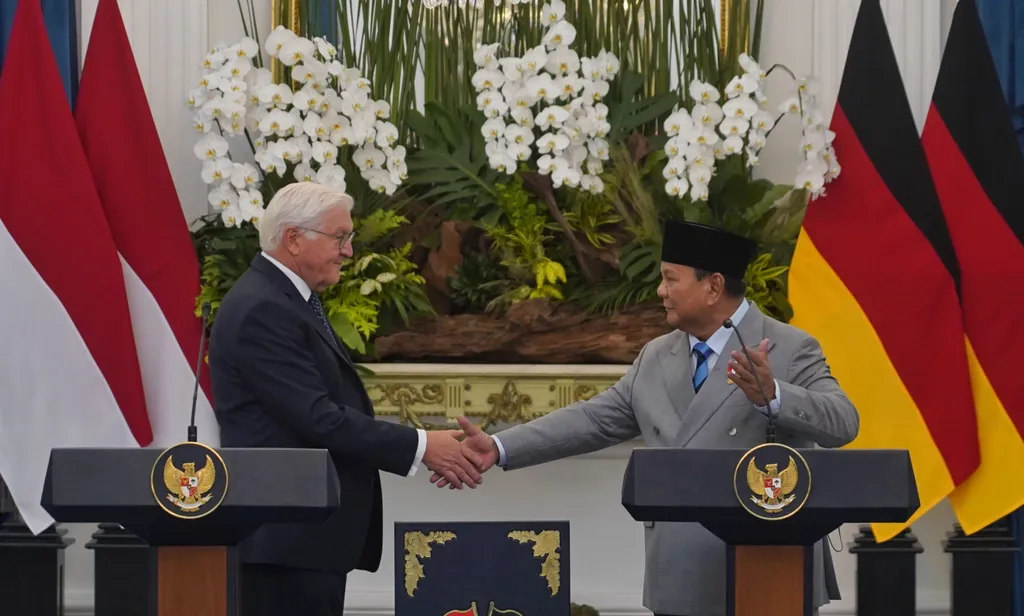
JAKARTA, KOMPAS — Amid global uncertainty, Indonesia and Germany have reaffirmed their commitment to strengthening their strategic partnership, particularly in the economy, investment, energy transition, education, and employment sectors. Both countries agreed to push for the acceleration of the Indonesia-European Union Comprehensive Economic Partnership Agreement (IEU-CEPA) negotiations as a concrete step to expand market access and reinforce the economic foundations of both nations.
These points emerged during a bilateral meeting between President Prabowo Subianto and President Frank-Walter Steinmeier at Merdeka Palace in Jakarta on Monday. The statement was delivered in a joint press conference following a four-eye meeting and delegation-level talks.
President Prabowo was accompanied by several ministers from the Merah Putih Cabinet, including Foreign Minister Sugiono, Coordinating Minister for Economic Affairs Airlangga Hartarto, Minister of Energy and Mineral Resources Bahlil Lahadalia, and State Secretary Minister Prasetyo Hadi. Also present were Finance Minister Purbaya Yudhi Sadewa, Minister of Investment and Downstreaming/Head of BKPM Rosan Roeslani, Health Minister Budi Gunadi Sadikin, Minister for the Protection of Indonesian Migrant Workers Mukhtarudin, and Cabinet Secretary Teddy Indra Wijaya. The German delegation included Minister of State Florian Hahn, German Ambassador to Indonesia Ralf Beste, and Head of the Foreign Policy Department at the Presidency Wolfgang Silbermann.
In the joint press statement, President Prabowo expressed his respect and gratitude for President Steinmeier’s visit, calling it a symbol of the close relationship between the two countries. He noted that the visit serves as a strategic momentum to mark the beginning of the 75th anniversary of Indonesia-Germany bilateral relations, which will culminate in 2027. “This visit is also an important momentum amidst increasingly uncertain global dynamics. Strengthening and sustaining the Indonesia-Germany partnership is certainly a priority,” Prabowo said.
The President stated that both countries agreed to strengthen bilateral cooperation in various strategic sectors, including the economy, investment, energy transition and security, as well as education and employment. He specifically emphasised the urgency of finalising the IEU-CEPA, hoping for a substantive conclusion in the near future. Prabowo expressed hope that Germany would continue to play an active role in encouraging the finalisation process within the European Union so that the business communities of both countries could soon reap the concrete benefits of the agreement.
Beyond trade diplomacy, economic collaboration is also being reinforced through the Competitiveness, Industrial Modernization, and Trade Acceleration (CITA) programme. The IEU-CEPA itself is a comprehensive framework designed to eliminate trade barriers, enhance market access, and promote investment between Indonesia and the 27 EU member states. Although a substantial agreement was signed in September 2025, both sides are now focusing on the ratification stages in their respective parliaments.
President Prabowo also specifically invited German businesses to expand investment in Indonesia’s strategic priority sectors, including energy transition, downstream industrialisation, the electric vehicle ecosystem, and the semiconductor industry. “We also invite Germany to participate in the critical minerals and rare earth supply chain, as well as in national infrastructure development,” he stated. The Indonesian government also welcomed the Partnering in Business with Germany programme, which targets strengthening micro, small, and medium enterprises. As a concrete step, Indonesia will host the second Joint Economic and Investment Committee meeting later this year.
In the employment sector, President Prabowo expressed appreciation for the signing of a letter of intent regarding a Global Skills Partnership in nursing. Indonesia hopes to expand opportunities for its skilled workers in Germany, including in high-technology fields. On geopolitical issues, both leaders agreed that all conflicts must be resolved through negotiations and reaffirmed their commitment to cooperate within diplomatic corridors to maintain global peace and stability.