
Indonesia and Germany Explore AI Technology Collaboration for Earthquake and Tsunami Monitoring
The Meteorology, Climatology, and Geophysics Agency (BMKG) received a visit from a delegation of Germany’s Federal Ministry of Research, Technology, and Space (BMFTR) alongside representatives from the German Embassy in Jakarta. The meeting was part of efforts to strengthen international cooperation in geo-hydrometeorological disaster mitigation, particularly the development of a tsunami early warning system in Indonesia.
The German delegation was led by Deputy Director General of the International Department at BMFTR, Sandra Lehneke. Also in attendance were Kathrin Meyer, Head of Division International Cooperation Asia/Oceania; Jens Hofmann, Department Head of Division International Cooperation Asia/Oceania; and Annisa Fitria, Head of the Science and Technology Section at the German Embassy in Jakarta.
During the bilateral meeting, both parties evaluated various achievements from the existing cooperation between Indonesia and Germany. A highlight was the success of the Tsunami Early Warning System (TEWS) project and the Joint Tsunami Risk Project with GFZ, which concluded in 2024.
Beyond reviewing past results, the meeting opened opportunities for new collaboration, including the utilisation of Artificial Intelligence (AI) technology in earthquake and tsunami monitoring operations.
Weniza, Head of the BMKG Earthquake and Tsunami Information Working Team, explained that strengthening an integrated monitoring system from upstream to downstream is currently the agency’s main focus. She noted that developing accurate prediction models and reliable field sensor support is essential to accelerate the validation of disaster information.
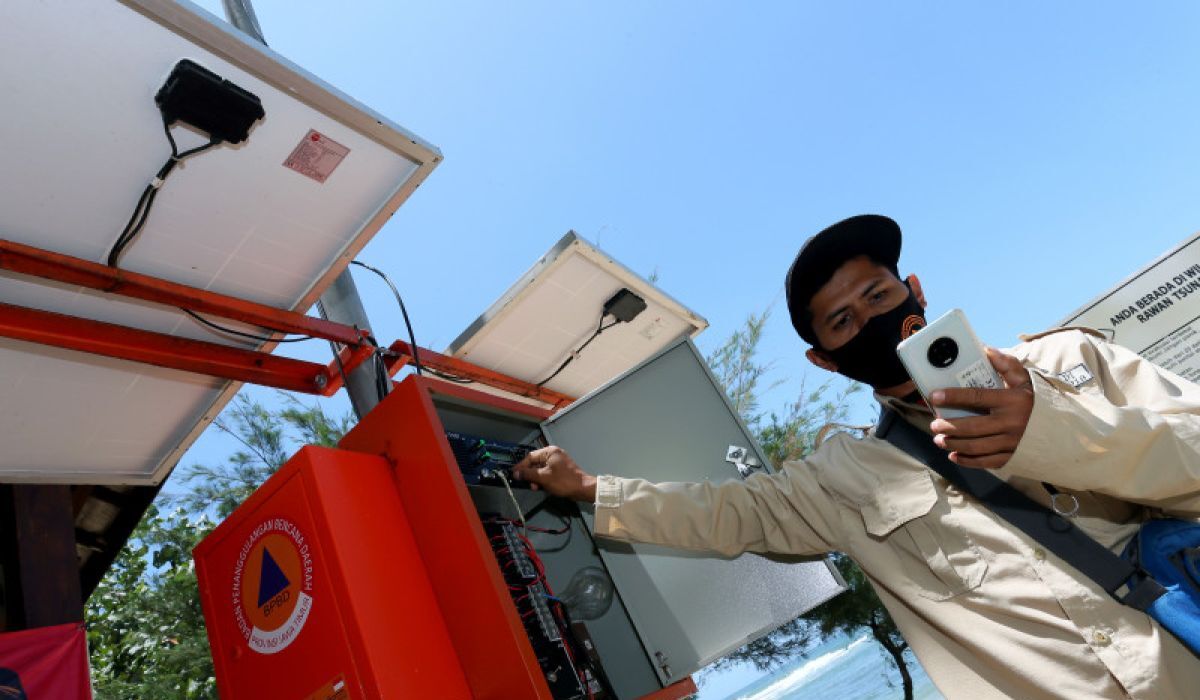
“For the first early warning, we rely on the modelling we have. We are optimising the existing Tsunami Gauges as real field confirmation and validation tools to ensure the accuracy of the model,” Weniza said in a statement on Friday (19/6).
She added that speeding up data processing is a critical factor in improving the effectiveness of the early warning system. “The speed of data validation from sensors to the modelling system is a vital aspect. Technology collaboration with Germany, including the planned adoption of AI technology, is expected to significantly cut information processing time so that the public evacuation window can be longer,” she continued.
Meanwhile, Suci Dewi Anugrah, Head of the BMKG Mitigation and Geophysical Services Governance Team, stressed that strengthening mitigation is carried out not only through technology and infrastructure development but also by enhancing community capacity. One programme of note is the Earthquake and Tsunami Field School, which has been implemented in more than 200 disaster-prone areas across Indonesia to improve the understanding of local officials and communities regarding early warning information issued by BMKG.
To date, Indonesia has 29 communities recognised by UNESCO-IOC as Tsunami Ready Communities. This number places Indonesia as one of the countries with the most globally recognised tsunami-ready communities. Through cooperation with Germany, BMKG hopes the standardisation process and development of tsunami-ready communities can be further accelerated, so that public preparedness in facing disaster threats continues to improve.
This visit also reaffirmed the commitment of Indonesia and Germany to strengthening knowledge transfer in the field of disasters. The collaboration between the two countries is expected to support the realisation of a more resilient, adaptive, and responsive society in facing various future disaster threats.