
Indonesia and Germany Collaborate to Address Waste Management Challenges in East Java
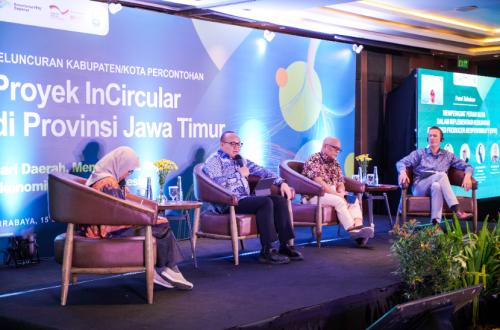
The Ministry of National Development Planning/Bappenas, together with the East Java Provincial Government and the German Federal Government through the Deutsche Gesellschaft für Internationale Zusammenarbeit (GIZ) GmbH, has formalised a joint commitment with five regencies/cities in East Java to strengthen waste management at the local level. The participating areas include Gresik Regency, Malang City, Malang Regency, Proboltinggo City, and Sidoarjo Regency. This activity serves as an initial step to translate the national circular economy vision into local action under the InCircular Project.
The InCircular Project is a technical cooperation between the Indonesian Government and the German Federal Government, implemented by GIZ Indonesia & ASEAN under the mandate of the German Federal Ministry for Economic Cooperation and Development (BMZ). It aims to support the implementation of the Indonesia Circular Economy Action Plan and Roadmap 2025-2045.
“Building a circular economy requires shared vision and action. Local governments play a vital role in translating national development directions into policies, systems, services, and innovations that suit the local context. A circular economy is not just about waste management, but also about how resources are used more efficiently, how products and materials can maintain their value for as long as possible, and how new economic opportunities can be created through cross-sector collaboration,” stated Leonardo A. A. Teguh Sambodo, Deputy for Food, Natural Resources, and Environment at the Ministry of National Development Planning/Bappenas, in Surabaya on Tuesday (15/09/2026).
Under the spirit of “From Regions, Towards Indonesia’s Circular Economy,” each pilot regency/city will have the opportunity to identify challenges, test approaches, build partnerships, and generate lessons that can strengthen circular economy implementation. This effort is carried out through cross-sector collaboration involving central and local governments, development partners, the private sector, academia, and community organisations to transform challenges into opportunities for creating sustainable economic, social, and environmental value.
“The selection of East Java as a working area for the InCircular Project is a form of trust and a strategic opportunity to strengthen the transformation towards more efficient, low-waste, and sustainable resource utilisation. Through a circular economy, we encourage more efficient resource use, reduce waste generation at the source, and strengthen reuse and recycling,” said the Vice Governor of East Java, Emil Elestianto Dardak.
Waste issues are a challenge that directly impacts community life and require systemic and collaborative solutions. Strong partnerships serve as the foundation for driving real change and delivering long-term impactful solutions. In line with this, the German Government, through GIZ Indonesia & ASEAN, has reaffirmed its support for the Indonesian Government. This support is part of the cooperation between the German and Indonesian Governments that has spanned 50 years, with the circular economy and waste management becoming priority sectors in recent years.
“The German Government has worked with the Indonesian Government to support waste management solutions, including in East Java Province. Throughout this cooperation, we have seen high commitment from local governments, at both the provincial and regency/city levels. The InCircular Project was developed from the need to strengthen the implementation of the Indonesia Circular Economy Roadmap. Therefore, we welcome the five regencies/cities that have joined hands today to participate in the InCircular Project as pilot areas,” said Thomas Foerch, Director of the Urban Development Cluster at GIZ Indonesia & ASEAN.
Plastic waste remains a significant challenge requiring attention. According to data from the National Waste Management Information System (SIPSN) in the Ministry of Environment and Forestry’s performance report, plastic accounted for approximately 19 per cent of the national waste composition in 2023. Meanwhile, SIPSN 2024 recorded that waste generation in East Java reached approximately 4.34 million tonnes per year. This data highlights both the immense need and the opportunity to strengthen resource management approaches from upstream to downstream.
The Indonesian Government continues to strengthen waste management through the implementation of Extended Producer Responsibility (EPR) regulations. In its implementation, local governments play a vital and strategic role in strengthening waste management systems and preparing for the application of EPR in their respective regions.
“Moving forward, the technical support of the InCircular Project in these five pilot regencies/cities will focus on strengthening waste management system capacity to prepare for EPR implementation,” added Thomas.
Launched in November 2025, the InCircular Project focuses on strengthening regulatory frameworks, increasing capacity, enhancing cross-stakeholder coordination, and improving waste management systems in selected provinces and regencies/cities. This technical collaboration, which will continue until 2029, encourages the creation of evidence-based policies that strengthen economic resilience and sustainable resource management.