
Indonesia and FAO launch 2026-2030 sustainable food framework
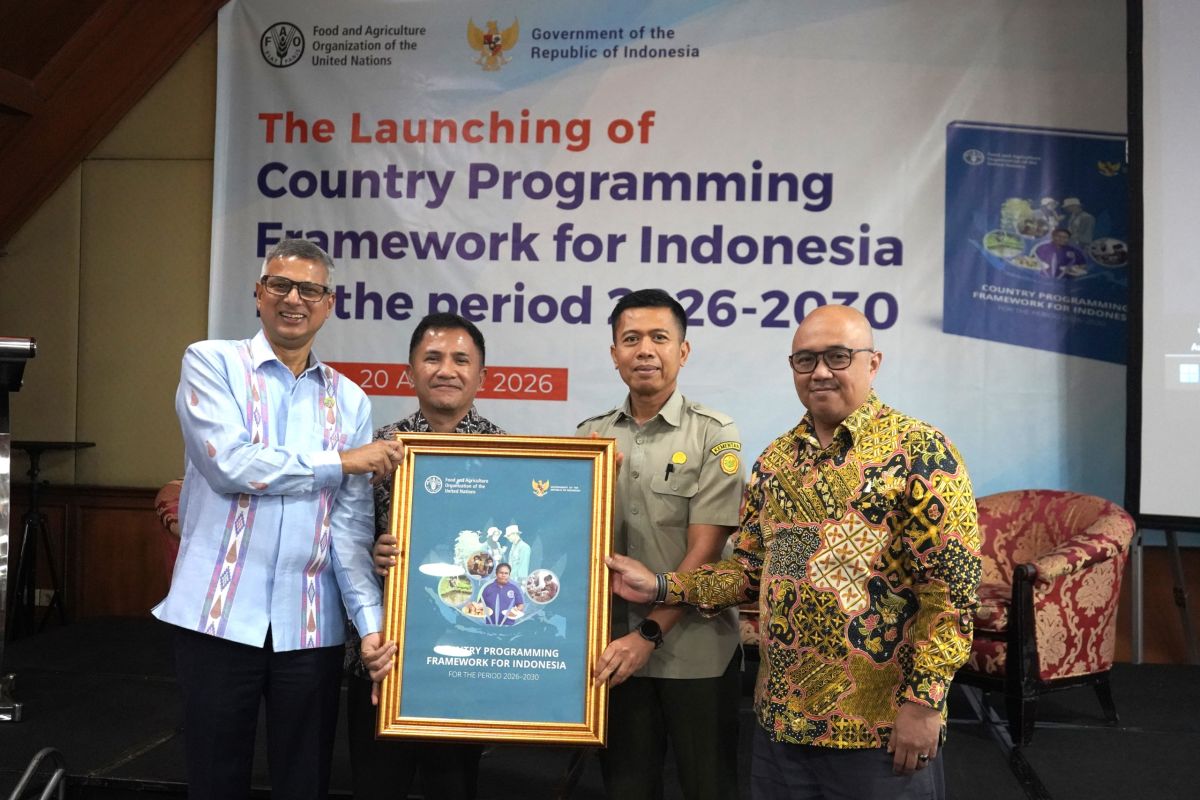
The Indonesian government and the United Nations Food and Agriculture Organization (FAO) have launched the Country Programming Framework (CPF) 2026-2030 to strengthen the transformation of sustainable food and agricultural systems.
Deputy for Food, Natural Resources and Environment at the Ministry of National Development Planning/National Development Planning Agency (PPN/Bappenas) Leonardo Adypurnama Alias Teguh Sambodo said the CPF is aligned with the National Medium-Term Development Plan (RPJMN) 2025-2029.
“In general, the CPF 2026-2030 covers FAO support in all key aspects to transform our agri-food system, advance climate resilience, and adapt to risks that will strengthen our foundation in the long term,” Teguh said in an official statement received in Jakarta on Friday.
The CPF, launched in Jakarta on Thursday (20/8), serves as the cooperation framework between Indonesia and FAO for five years, focusing on strengthening sustainable, resilient and inclusive food and agricultural systems.
The framework contains three main areas of cooperation: transformation of sustainable and inclusive food and agricultural systems, biodiversity conservation and sustainable natural resource management, and strengthening integrated systems responsive to risks based on the One Health approach.
Secretary General of the Ministry of Agriculture Suwandi said the government wants the Indonesia-FAO partnership to develop into a two-way relationship, including through knowledge and experience exchange.
“We want the Indonesia-FAO relationship to grow into a two-way partnership. Indonesia not only receives knowledge and technical support, but can also share experiences, innovations and lessons through knowledge exchange as well as South-South and Triangular Cooperation,” Suwandi said.
In addition to the RPJMN, the CPF 2026-2030 is aligned with the Sustainable Development Goals (SDGs) and the United Nations Sustainable Development Cooperation Framework (UNSDCF) 2026-2030.
The document was prepared through consultations with the Ministry of Agriculture, Bappenas, relevant ministries and agencies, and other stakeholders, drawing on lessons from the implementation of the previous CPF period.
FAO Representative in Indonesia and Timor Leste Rajendra Aryal said the CPF approach is designed by looking at the interconnections between agriculture, food security and nutrition, natural resource management, climate action, social protection, health, and economic development.
“This holistic view is essential in addressing complex and interrelated challenges,” Rajendra said.
According to FAO, Indonesia still faces a number of challenges in its food and agricultural systems, including climate change, unequal access to healthy food, and poverty among farmers, most of whom are smallholders.
The State of Food and Agriculture 2026 report states that around 68 percent of Indonesia’s population is still unable to afford a healthy diet.
FAO said the support is aimed at strengthening food security and nutrition, environmental health, resilient and inclusive economic growth, and the sustainability of Indonesia’s food and agricultural systems.
“FAO remains steadfast in its commitment to support Indonesia in accelerating transformative change in the agri-food system, with the goal of not only improving food security and nutrition, but also environmental health, resilient and inclusive economic growth, and a sustainable future for all Indonesians,” Rajendra said.