
Indonesia and EU Sign IEU-CEPA, with Indonesian Exports to Europe Projected to Rise 14%
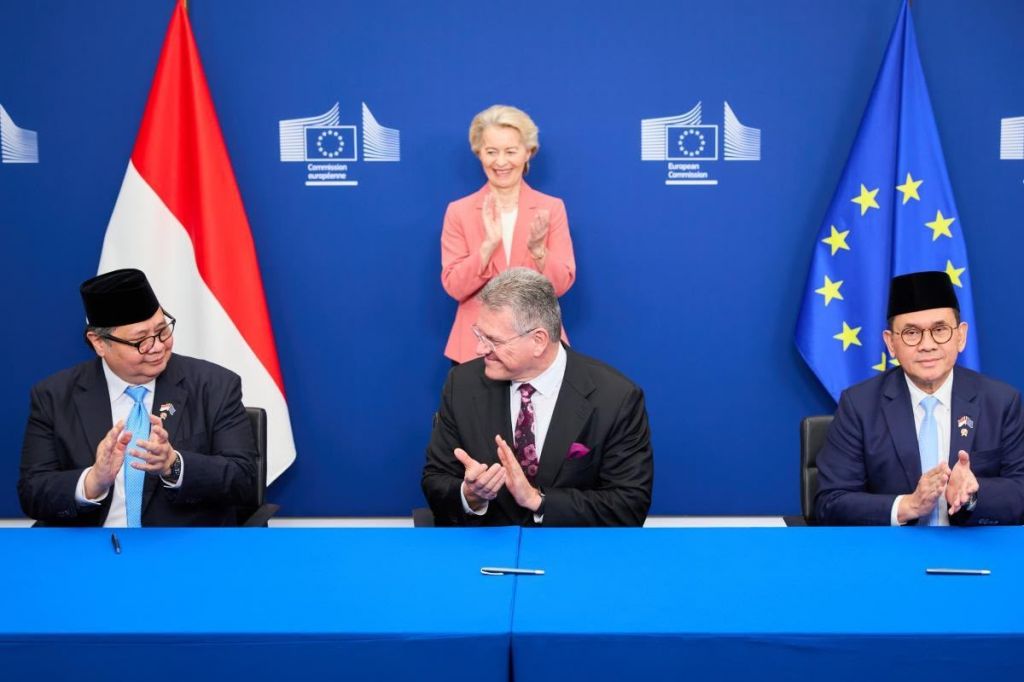
Brussels: The European Union (EU) and Indonesia have officially signed the Indonesia-EU Comprehensive Economic Partnership Agreement (IEU-CEPA) and the Investment Protection Agreement (IPA).
The agreements mark an important step in strengthening economic ties between the two sides and expanding the EU’s partnership with South-east Asia.
Through the agreements, the EU and Indonesia aim to reinforce rules-based trade and create a stable, predictable framework for trade and investment. They are also expected to support more secure and resilient energy and raw-material supply chains.
According to information published on ec.europa.eu on Saturday, 21 November 2026, the agreements are expected to create new opportunities for businesses on both sides and deliver significant economic benefits.
EU goods exports to Indonesia are forecast to rise by almost 40% in the 15 years after the agreement comes into force, particularly in machinery, motor vehicles and other metal products.
Indonesian exports of goods and services to the EU, meanwhile, are expected to increase by more than 14% over the same period.
The agreements are also projected to boost economic growth. The EU’s gross domestic product (GDP) is forecast to be €16 billion higher, while Indonesia’s GDP could rise by €27 billion compared with the scenario without the agreements.
Tariff removal and investment protection
Under the CEPA and IPA, the two sides have agreed on several key provisions.
First, tariffs will be eliminated on 98.5% of tariff lines, and procedures for EU goods exports to Indonesia will be simplified, including for food and agricultural products and key industrial goods. The measures are expected to save EU exporters more than €600 million a year in customs duties.
Second, the agreements will open up new investment opportunities for EU companies in Indonesia, particularly in strategic sectors such as electric vehicles, electronics and pharmaceuticals.
Third, EU companies will be able to provide services with full ownership in several key sectors, including computer and telecommunications services.
Fourth, European investment in Indonesia and Indonesian investment in the EU will be protected against unjustified discrimination, asset expropriation and denial of justice in local courts. These provisions will continue to respect each side’s right to regulate within its territory.
Fifth, the agreements guarantee respect for and fair compensation for intellectual property rights, including protection for 221 EU geographical indications.
Sixth, they will strengthen supply chains to make them more stable, reliable and sustainable. This includes reducing tariffs, facilitating exports of critical mineral raw materials, assessing environmental impacts and expanding co-operation.
Seventh, the agreements support sustainable growth through a dedicated Trade and Sustainable Development chapter. It includes commitments on climate, the environment and workers’ rights, as well as enforcement mechanisms.
The Paris Agreement is also designated as an essential element of the agreements, alongside mechanisms for co-operation and dialogue on regulation and sustainability, including a dedicated protocol on palm oil.
Awaiting European Parliament approval
Following their signing, both agreements still require approval by the European Parliament. In parallel, the Indonesian government is carrying out its domestic ratification procedures.
Once both sides have completed their respective domestic procedures, the CEPA and IPA will begin to apply provisionally. This is expected to happen in early 2027.
Source: jawawa.id (https://jawawa.id/newsitem/indonesia-and-eu-sign-ieu-cepa-with-indonesian-exports-to-europe-projected-to-rise-14-1795377017)
Originally published by metrotvnews.com (https://www.metrotvnews.com/read/kBVCleyY-indonesia-ue-resmi-teken-ieu-cepa-ekspor-ri-ke-eropa-diproyeksi-naik-14-persen), translated from Indonesian