
Indonesia and China Seek Broader Cooperation as Bilateral Trade Jumps from $8bn to $154bn
Indonesia, China Seek Broader Cooperation as Bilateral Trade Jumps from $8B to $154B
Jakarta. Economic cooperation between Indonesia and China has expanded dramatically over the past two decades, with bilateral trade reaching $154 billion, as the two countries strengthen their partnership in investment, technology and sustainable development, speakers at a recent forum in Jakarta said.
Former Indonesian Ambassador to China Sudrajat highlighted the rapid growth in bilateral trade, recalling how economic relations between the two countries had transformed since his diplomatic posting in Beijing.
“When I served as ambassador, bilateral trade between Indonesia and China was only around $8 billion. By 2010, it had risen to $20 billion, and this year it has reached $154 billion,” Sudrajat said at the China-Indonesia Roundtable Forum.
China has become not only Indonesia’s largest trading partner but also a major economic partner for Southeast Asia as a whole, he said.
Trade between China and the Association of Southeast Asian Nations (ASEAN) exceeded $1 trillion last year, underscoring the growing economic integration between the world’s second-largest economy and the regional bloc.
Sudrajat stressed that expanding trade and investment should be accompanied by stronger people-to-people ties and practical cooperation in areas that directly benefit communities.
He identified disaster management as one area where the two countries could deepen their partnership.
China has developed extensive disaster mitigation and emergency response capabilities that could benefit Indonesia, which frequently experiences floods, forest fires, earthquakes and landslides, he said.
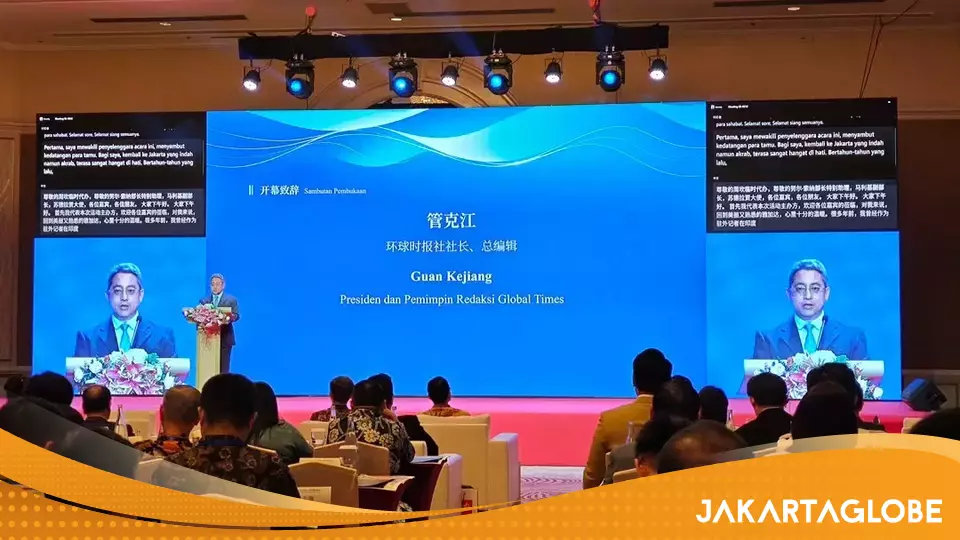
The forum was organized by the Global Times, a Chinese newspaper that publishes content in both English and Mandarin.
Cooperation Expands Beyond Traditional Trade
Global Times Chief Editor Guan Kejiang said cooperation between Indonesia and China was increasingly extending beyond traditional trade and investment into the digital economy, green development, new energy and artificial intelligence.
“Today, China is advancing its development and national rejuvenation through Chinese modernization, while Indonesia is steadily moving toward its Golden Indonesia 2045 Vision,” Guan told the forum, referring to Indonesia’s ambition to become a developed nation by the centenary of its independence.
Guan said the two countries’ growing economic ties were unfolding against a backdrop of mounting geopolitical uncertainty and challenges to international cooperation.
“Today’s world is marked by mounting turbulence and uncertainty. Geopolitical conflicts persist, while protectionism and unilateralism are on the rise. Against this backdrop, we must cherish the peaceful and stable environment that has enabled Asia to achieve decades of remarkable development,” he said.
Drawing on his experience working in Indonesia as a journalist earlier in his career, Guan also emphasized the country’s historical significance to the Global South.
“More than 70 years ago, the Bandung Conference enabled Asian and African nations to assert themselves more confidently on the international stage. The Bandung Spirit of ‘solidarity, friendship, and cooperation’ continues to resonate today. As the Global South grows in strength and influence, history has entrusted us with even greater responsibilities,” he said.
“We must not only promote a fairer and more equitable international order but also contribute more global public goods and practical solutions for international cooperation.”
Shared Role in the Global South
Zhou Kan, chargé d’affaires ad interim at the Chinese Embassy in Indonesia, described the two countries as major developing economies and influential members of the Global South.
Both countries participate in major international forums, including BRICS, the G20 and the Asia-Pacific Economic Cooperation (APEC) forum.
Zhou also noted that Indonesia was among the 29 founding members of the World Artificial Intelligence Cooperation Organization (WAICO), an initiative proposed by China.
“Under the strategic guidance of the two heads of state, China-Indonesia relations have maintained a high level of development, exerting an ever-growing influence both regionally and globally. In recent years, political mutual trust between the two countries has deepened, economic integration has expanded, and people-to-people exchanges have become increasingly close,” Zhou said.
Noor Sona Maesana Mushonnif, an adviser to Indonesia’s investment minister, invoked a Chinese proverb to emphasize the importance of cooperation.
“A single piece of wood cannot form a forest,” he said.
Noor Sona said the comprehensive strategic partnership between Indonesia and China had supported the development of Indonesia’s mining and electric vehicle industries while helping modernize traditional manufacturing.
He expressed hope that the two countries would further expand cooperation in renewable energy, agriculture, maritime industries and high-value-added manufacturing.
Tags: Keywords:
Source: jawawa.id (https://jawawa.id/newsitem/indonesia-and-china-seek-broader-cooperation-as-bilateral-trade-jumps-from-8bn-to-154bn-1792579811)
Originally published by jakartaglobe.id (https://jakartaglobe.id/news/indonesia-china-seek-broader-cooperation-as-bilateral-trade-jumps-from-8b-to-154b)