
Indonesia and China Discuss Technology Transfer to Strengthen Industry
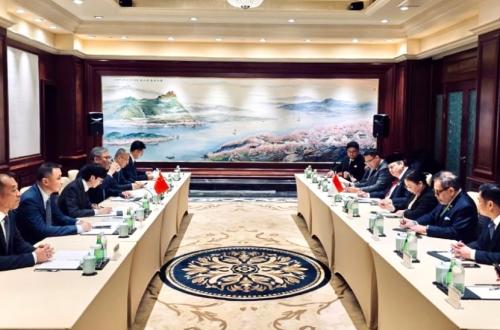
Indonesia is encouraging economic cooperation with China not to stop at increasing trade and investment, but also to strengthen technological mastery and national industrial capacity. This push emerged during a bilateral meeting between Coordinating Minister for Economic Affairs Airlangga Hartarto and Chinese Commerce Minister Wang Wentao in Shanghai in mid-July.
Senior Advisor on Global Technology Cooperation at the Coordinating Ministry for Economic Affairs and Chairman of Anak Muda Amankan Nusantara (AMAN), James Karnadi, accompanied Airlangga at the meeting, which took place on the sidelines of the World Artificial Intelligence Conference (WAIC) 2026.
The meeting discussed strengthening trade and investment relations, industrial cooperation, the digital economy, and supply chain development between Indonesia and China. Both parties also discussed the progress of the Two Countries, Twin Parks programme, including opportunities to strengthen connectivity between Indonesian industrial estates and production and technology centres in China.
James said that investment cooperation needs to deliver broader benefits for the domestic economy, particularly through technology transfer, talent development, job creation, and industrial capacity building.
“Indonesia welcomes partnerships that are open and mutually beneficial. However, every strategic investment must also strengthen Indonesia’s production capabilities, technological mastery, and the quality of its human resources. We must not merely become a market, but must grow as a centre of industry and innovation,” James said in a press release on Wednesday (12/8/2026).
According to James, the government’s economic diplomacy direction needs to be translated into cooperation that yields concrete benefits for the national economy. He also believes that the business community, young people, and the Indonesian diaspora need to be involved in following up high-level agreements into business projects, productive investment, and talent development.
“Economic diplomacy does not end at the meeting table. Its success is determined by our ability to translate political agreements into real projects, job opportunities, market access, and improved national industrial capacity,” he stressed.
China is one of Indonesia’s main economic partners. In 2025, bilateral trade between the two countries reached approximately 167.48 billion US dollars, with Indonesian exports growing by 16.7 percent.
When combined with Hong Kong, total Chinese and Hong Kong investment in Indonesia in 2025 reached approximately 18 billion US dollars.
Beyond trade and investment, the meeting discussed digital economy cooperation, supply chains, and industrial estate development. Both parties also evaluated the implementation of a memorandum of understanding on investment worth approximately 2.5 billion US dollars, including opportunities to strengthen industrial estates in Batam.
Amid global technology competition, James believes Indonesia needs to maintain room to cooperate with various countries while ensuring that national interests remain the foundation of every partnership.
“Indonesia can cooperate with all parties without losing its independence in determining the direction of development. Our position must be clear: open to collaboration, yet still sovereign over technology, data, resources, and the future of national industry,” James said.