
Indonesia and China Agree to Strengthen Agricultural Cooperation
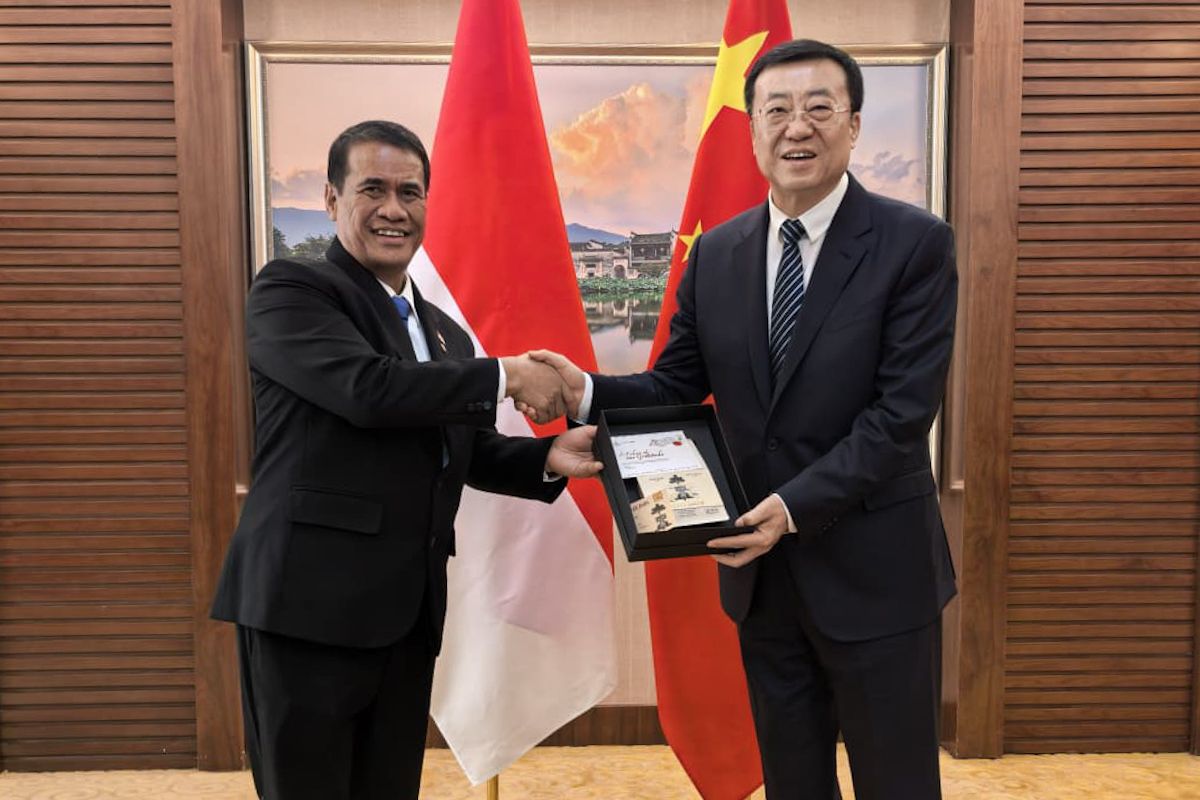
Jakarta (ANTARA) - Agriculture Minister Andi Amran Sulaiman and China’s Agriculture Minister Zhang Zhu have agreed to strengthen agricultural cooperation to boost production, transfer technology, attract investment and develop strategic commodities, thereby strengthening both countries’ production capacity.
“The cooperation is intended to strengthen domestic production capacity, raise productivity and create broader trade and investment opportunities for both countries,” Amran said in Jakarta on Wednesday.
The agreement was reached during a bilateral meeting between Amran and Zhang on Monday (2 November).
The meeting discussed garlic development from upstream to downstream, research collaboration and modern agricultural technology, stronger trade in leading commodities, and investment opportunities in the processing industry.
“Cooperation with China must deliver concrete benefits for Indonesia’s agricultural sector,” Amran said.
He said the partnership should do more than ensure smooth trade: it should also strengthen national production capabilities, accelerate agricultural modernisation and increase the added value of leading commodities.
“We want to strengthen this cooperation. For commodities we need, such as garlic and soybeans, we hope supplies will improve. At the same time, we want to expand Indonesia’s exports of leading commodities to China,” Amran said.
Amran said one of the key proposals was to develop garlic production comprehensively, from seed provision and cultivation technology to agricultural machinery and the establishment of production clusters in Indonesia.
The initiative is aimed at strengthening domestic production capacity while reducing dependence on overseas supplies.
China currently supplies about 90 per cent of Indonesia’s garlic needs. Amran therefore urged the two countries to develop their relationship into a partnership that also supports increased garlic production in Indonesia.
“We want upstream-to-downstream cooperation on garlic, from seeds, technology and agricultural machinery to building clusters in Indonesia,” Amran said.
Alongside garlic, Amran called for the development of clusters for Indonesia’s leading commodities, particularly coconut, coffee and durian. The cooperation is expected to broaden market access, maintain product quality and increase the added value of Indonesian commodities.
On investment, the minister offered Chinese companies opportunities to develop processing industries in special zones prepared by the government. The sectors on offer include coconut and its derivative products, seaweed, and agricultural vaccine manufacturing.
Amran said the availability of land, legal provisions and incentive support in the zones was expected to make it easier for investors to establish industries in Indonesia.
“The land is ready and the legal arrangements are being prepared. Investors just need to come. We want to build processing industries, such as coconut and seaweed factories, so that our resources can generate greater added value,” he said.
Technology transfer was another important item on the meeting’s agenda. Amran called for cooperation in mechanisation, artificial intelligence (AI) and the use of modern technology to improve agricultural efficiency and productivity.
Amran also proposed expanding cooperation in dairy products, noting that Indonesia needs about four million tonnes of milk a year.
He also proposed research into wheat as part of efforts to meet domestic demand, which remains dependent on imports.
The Indonesia-China partnership is expected not only to strengthen trade but also to increase national production capacity through technology transfer, research, investment and the development of downstream industries.
Zhang said agricultural cooperation between Indonesia and China had developed positively since 2019.
He also highlighted the scale of trade between the two countries, describing it as an important foundation for expanding their agricultural partnership.
Zhang expressed support for the development of garlic production in Indonesia. China is ready to pursue further technical discussions on production technology, planting methods and other areas of cultivation that could be covered by cooperation.
“We strongly support the development of garlic production in Indonesia. We are ready to deepen discussions, particularly on production technology, planting and other technical matters on which the two countries can cooperate,” Zhang said.
For coffee, cocoa and palm oil, Zhang said his ministry would promote the formation of working groups to discuss cooperation on Indonesia’s leading commodities.
Zhang also offered to strengthen technical discussions and research collaboration, including the use of unmanned drones, agricultural robots and AI. China is also ready to organise a delegation of companies to explore investment opportunities in Indonesia.
Source: jawawa.id (https://jawawa.id/newsitem/indonesia-and-china-agree-to-strengthen-agricultural-cooperation-1793796767)
Originally published by Antara (Indonesian) (https://www.antaranews.com/berita/5831955/indonesia-dan-china-sepakati-penguatan-kerja-sama-pertanian), translated from Indonesian