
Indonesia and Australia Develop AI to Improve Healthcare Efficiency
Indonesia and Australia are strengthening collaboration on the use of artificial intelligence (AI) to support primary healthcare services. The technology development is focused on managing maternal and child health data, monitoring pregnancy risks, and delivering health information to the public.
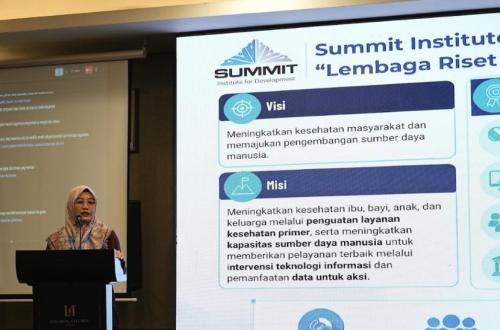
Lessons from the development and application of AI at the primary care level were discussed at the National Dissemination Seminar for the AI in Health Care Project, held in a hybrid format at Lombok Astoria, Mataram, West Nusa Tenggara.
The seminar brought together government representatives, academics, researchers, health workers, and development partners to discuss experiences in applying AI technology to maternal and child health services.
The AI in Health Care Project is a collaboration between the Summit Institute for Development (SUMMIT), the National Research and Innovation Agency (BRIN), CSIRO Australia, and the University of Mataram (UNRAM), with support from KONEKSI – the Australia-Indonesia Knowledge Partnership.
The project arose from needs at the primary care level, particularly the management of maternal health data, some of which is still recorded manually. The data is then developed so that it can be used to support service delivery and decision-making by health workers.
In this project, the partners developed three interconnected technology components: Bunda Optical Character Recognition (OCR), AI Predictive Dashboard, and AI Personalized Message.
Bunda OCR was developed to help midwives digitise information from the Maternal and Child Health (KIA) book. The technology converts information recorded in health documents into digital data, reducing the need for manual data transfer.
The available data can then be used through the AI Predictive Dashboard as a decision-support tool for health workers.
The dashboard presents pregnancy information and risk prediction results so that midwives can monitor patient conditions, identify patients who need more attention, determine service priorities, and support follow-up actions.
Meanwhile, AI Personalized Message is used to extend the use of the technology to pregnant women. Using WhatsApp as a communication channel, the system can deliver information, education, and health messages based on the available information about pregnant women.
The three technologies were developed in a single flow, from data digitisation and data processing into service-supporting information, to health communication with pregnant women.
The webinar also shared experiences of technology implementation by health workers from four focus districts: West Lombok, East Lombok, Central Lombok, and Garut.
These experiences provided an overview of the use of technology in daily services as well as various matters that need to be considered in applying AI in primary healthcare.
Participants were also able to see demonstrations of the three technologies, from data digitisation using Bunda OCR and use of the AI Predictive Dashboard, to the delivery of health messages through AI Personalized Message.
The forum also presented the results of an impact assessment study conducted during the project, including user experiences, use of the technology in service delivery, and lessons from its application in the field.
Through panel discussions and question-and-answer sessions, participants discussed the opportunities and challenges of applying AI in Indonesia’s health system. Topics covered included the readiness of digital infrastructure and ecosystems, human resource capacity, data quality and governance, and the need for cross-sector collaboration.
The discussion also emphasised the importance of ensuring that the use of AI continues to support health workers and respond to community needs in service delivery.
Summit Institute for Development CEO Yuni Dwi Setiyawati said the technology development arose from the need to make better use of existing health data.
“A lot of health data is scattered, but it is often not used optimally. This is what motivated us to find ways to digitise manual data so that it can be processed and used to help health workers respond more quickly,” Yuni said on Friday (28/8/2026).
Through collaboration between research institutions, universities, technology partners, government, and health workers, the project is expected to provide lessons for developing AI solutions that suit the needs of primary healthcare services in Indonesia.
Experiences from implementation in several regions can also serve as evaluation material for the wider development and use of AI technology in the health sector.