
Indonesia and Airbus Sign Agreement: The Reasons and Targets
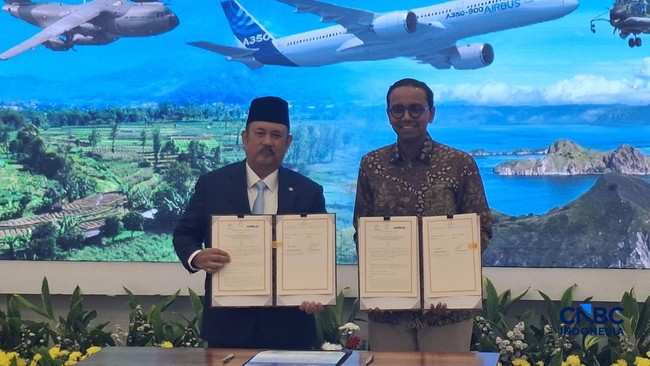
The Indonesian government, through the Ministry of National Development Planning (PPN) or the National Development Planning Agency (Bappenas), has signed a cooperation agreement with aircraft manufacturer Airbus to support the realisation of Indonesia’s aerospace industry ecosystem.
The signing was attended by the Minister of PPN/Head of Bappenas, Rachmat Pambudy, the Minister of Industry, Agus Gumiwang Kartasasmita, and the President of Airbus Asia Pacific, Anand Stanley.
Stanley stated that Indonesia’s aerospace market potential is substantial, given that Indonesia is an archipelagic nation comprising around 17,000 islands, thus requiring robust air transportation with the rapid advancement of technology.
“Indonesia’s aerospace market is quite promising, with 17,000 islands, making aircraft an important and fastest mode of transportation,” said Stanley during his presentation at Bappenas’ office on Wednesday (6/5/2026).
He further noted that Indonesia’s aerospace market could grow up to four times by 2045, necessitating a more advanced and integrated ecosystem.
“But the important thing is that the market will grow fourfold by 2045, with annual component growth of 7.4%,” he explained.
Meanwhile, Minister of PPN/Head of Bappenas Rachmat added that demand for air transportation in Indonesia is increasing annually, in line with the rising middle class and the need for faster and safer public transport.
“Indonesia has around 17,000 islands; now many people choose faster inter-island transport, making air transport a mainstay, also driven by the growing middle class,” said Rachmat.
Moreover, Indonesia’s aerospace industry has actually grown rapidly. However, its potential has not been fully maximised, so efforts will be made to revive the industry’s prowess.
“We have grown with a very advanced manufacturing industry, namely in the aerospace sector. This means we have levelled up. The highest industry so far has been aerospace, which is often hard to reach,” Rachmat explained.
Furthermore, the number of flights in Indonesia, both domestic and international, is predicted to increase. Currently at 0.4 trips per capita per year, it is expected to rise to 1.4 trips per capita per year in the next 20 years, thus requiring fleet capacity expansion.
“Currently, the number of flights in Indonesia reaches 0.4 trips per capita per year, expected to increase to 1.4 trips per capita per year in 20 years. Accordingly, air passenger traffic is projected to grow at an average of 7.4% per year, reaching around 477 million passengers. This means air fleet capacity expansion is needed to meet that demand,” Rachmat stated.
Therefore, collaboration with Airbus will fulfil Indonesia’s aerospace industry ecosystem, covering components, human resources (HR), and aircraft maintenance.
“For that, improvements in standardisation, service quality, operational efficiency, technology utilisation, and importantly, strengthening human resources are required. This is continuously encouraged so that industry growth is sustainable,” he concluded.