
Indonesia Already Has Bioethanol Fuel, Here's the Price at Petrol Stations
President Prabowo Subianto is currently stepping up the development of plant-based bioethanol fuel. Indonesia is even targeted to follow in the footsteps of India and Brazil in utilising ethanol as a petrol blend.
Prabowo made the remarks while leading a simultaneous nationwide harvest celebration with the Indonesian military (TNI) in Malang, East Java, some time ago.
Prabowo said Indonesia now has the capability to move towards E10 — petrol with a 10% ethanol blend. Indonesia even has the potential to raise the ethanol content to E20.
“From the exhibition I saw earlier, we are already able to move towards E10, ethanol 10, so petrol will later be blended with 10% ethanol, but the officials said we can reach E20. It requires factories — we currently only have one, and I have decided we will build at least 30 factories, or even 50 if necessary,” he said at the harvest event.
Prabowo then compared bioethanol development in several countries. According to him, India has implemented E20, while Brazil even uses E100, or fuel based on pure ethanol.
“India is already at E20, India is at E20, Brazil is at E100. How can Indonesia not manage it? Indonesia can, right? Can it? It can,” he said.
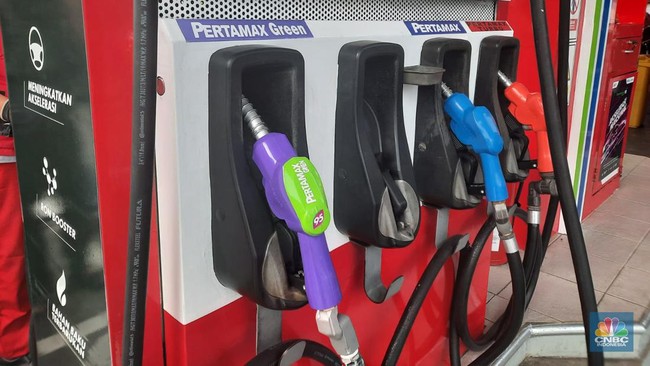
Amid the push towards E10, Indonesia in fact has already commercially applied E5 fuel — petrol blended with 5% bioethanol — through Pertamax Green 95 (equivalent to RON 95) at Pertamina petrol stations.
Pertamax Green 95 is currently priced at Rp16,600 per litre as of 1 August 2026, down from Rp17,000 per litre in July 2026.
Previously, the CEO of Pertamina New & Renewable Energy (Pertamina NRE), John Anis, affirmed the company’s readiness to support the government’s target of accelerating bioethanol development.
“So perhaps you are asking why Pertamina is here, Sir, but you can see that we want to contribute to bioenergy. We also want to congratulate you on B50 — we share the same aspiration and spirit for E20,” John said while accompanying Prabowo.
He revealed that Indonesia currently applies E5 on a limited basis at around 170 Pertamina stations in East Java and Jakarta. In India, implementation has already reached E20.
“We don’t want to be left behind, Sir, we must catch up with them. We are only at E5, Sir. That’s E5 at 170 of our outlets in East Java and Jakarta,” he said.
John explained that Pertamina is also developing bioethanol using various feedstocks, not only sugarcane but also palm sap (aren), cassava, maize and sorghum.
According to John, to meet national demand Indonesia needs around 20 to 30 new bioethanol plants over the next two years. Building factories across various regions, he said, would improve farmers’ welfare.
“So rather than importing and the money going abroad, Sir, let’s give it to the farmers,” John stressed in response to Prabowo’s question about the policy’s impact on reducing imports.
To realise this target, Pertamina emphasised the importance of mandatory regulation and certainty of feedstock prices. These are needed so that Indonesia’s bioethanol ecosystem can get up and running quickly.