
Indonesia Agrees to 'Major Defence Cooperation' with US Amid Aggression Towards Iran
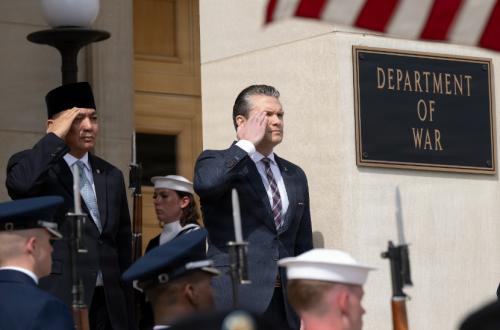
Indonesia and the United States (US) have reportedly agreed to a Major Defence Cooperation Partnership between the two countries. This agreement was reached during a meeting between Indonesian Defence Minister Sjafrie Sjamsoeddin and US Secretary of War Pete Hegseth in Washington last night.
According to the US Department of War, this partnership will serve as a framework to advance bilateral defence cooperation between the US and Indonesia in order to maintain peace and stability across the Indo-Pacific region.
“Your visit demonstrates the importance of the Department of War in developing our security relationship – and this relationship is active and growing – with Indonesia,” said Hegseth to Sjamsoeddin, before noting that the two countries conduct more than 170 joint military exercises each year.
“[The partnership] signifies the strength and potential of our security relationship… strengthening regional deterrence, and advancing our shared commitment to peace through strength,” Hegseth added.
It is worth noting that Hegseth has recently come under scrutiny regarding his rhetoric throughout the US attacks on Iran since last February. He has frequently described those attacks as a religious war and pledged to crush America’s enemies from both Sunni and Shia groups.
In his brief remarks, Sjamsoeddin echoed Hegseth’s sentiments regarding the strength of US-Indonesia relations. “Today, we are here as the Indonesian delegation… with great enthusiasm to continue developing our defence relationship, which must be preserved by our future generations in Indonesia and the United States,” said Sjamsoeddin.
“We work on the basis of mutual respect and mutual benefit to enhance our national interests.”
According to the US Department of War, the new cooperation agreement features three “core pillars” based on each country’s national sovereignty and mutual respect: military organisation and capacity enhancement; professional military training and education; and exercises and operational cooperation.
Under the agreement’s framework, the two countries will seek to explore cutting-edge initiatives, “including jointly developing advanced asymmetric capabilities, pioneering next-generation defence technologies in the maritime, subsurface, and autonomous systems domains, and collaborating on maintenance, repair, and overhaul support to enhance operational readiness,” according to the joint statement on the new partnership.