
Indonesia Accelerates Solar Power Development, China's Strength Already Astonishing
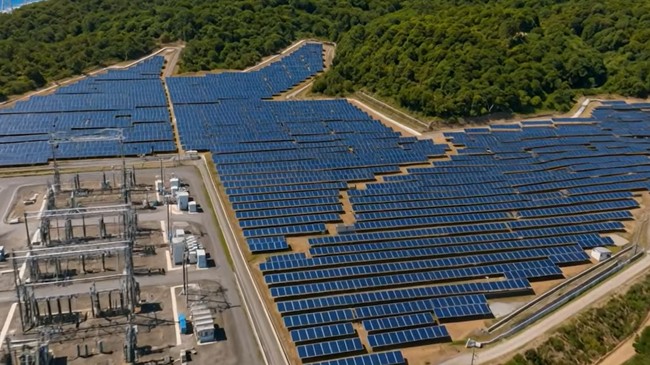
Indonesia has officially entered the large-scale solar energy race. President Prabowo Subianto launched the 100 gigawatt peak (GWp) Solar Power Plant Programme on 25 August 2026.
The programme began with the launch and groundbreaking of 14 solar power plants across six provinces: West Java, Central Java, East Java, Bali, the Bangka Belitung Islands, and the Riau Islands. The total initial phase capacity reaches 5.3 GWp.
“Our target is 100 gigawatts within three years,” Prabowo said at the programme launch at the Gilimanuk Solar Power Plant site in Jembrana Regency, Bali, on Tuesday (25/8/2026).
The government estimates the total investment for the programme at around US$73 billion, or more than Rp1,140 trillion. The 100 GWp solar development is also claimed to have the potential to create around 5.52 million jobs and generate electricity subsidy savings of approximately Rp73.9 trillion per year.
However, the 100 GWp figure is a national development target, not a capacity that has been fully installed and operational.
The 14 first-phase projects with a capacity of 5.3 GWp represent only 5.3% of the overall target.
Data from the Ministry of Energy and Mineral Resources shows Indonesia’s installed solar capacity reached 1,494.1 MW, or approximately 1.49 GW, at the end of 2025. The figure is recorded in the 2025 Performance Report of the Directorate General of New, Renewable Energy and Energy Conservation. Overall, Indonesia’s new and renewable energy generation capacity at the end of 2025 reached 15,630 MW.
Thus, the 100 GWp target announced by Prabowo is nearly 67 times the national solar capacity at the end of 2025.
To achieve the target, Indonesia needs an additional approximately 98.51 GWp. If the target is to be completed within three years, the average construction required would be around 32.84 GWp per year.
Meanwhile, the first phase consisting of 14 solar power plants with a capacity of 5.3 GWp represents only about 5.3% of the overall target. The initial phase capacity is also approximately 3.5 times the national solar capacity recorded at the end of 2025.
The programme is not only aimed at increasing electricity supply. The government also wants to build energy self-sufficiency down to the village level, replacing diesel power plants, reducing dependence on fuel imports, and strengthening the domestic solar panel and battery industry.
Before the 100 GWp programme was launched, national solar development had already involved state-owned and private companies.
Based on a compilation of data on companies owning solar power plants in Indonesia, PLN is the entity with the largest portfolio. The portfolio includes the Cirata Floating Solar Power Plant and a number of new projects in the pipeline.
Several private companies have also begun building and acquiring solar energy assets, including Indika Energy, TBS Energi Utama, Medco Energi Internasional, and Chandra Daya Investasi.
The table is a portfolio compilation that mixes existing assets with project pipelines. Therefore, all the figures cannot be directly considered as operational capacity.
The infographic lists a total capacity of approximately 1.33 GW. However, if all the figures in each row are added together, the result is approximately 1.346 GWp. Meanwhile, official data from the Ministry of Energy and Mineral Resources records national solar capacity at 1.4941 GW at the end of 2025.
The difference may arise due to data dates, ownership coverage, pipeline projects, and other national assets not listed in the company table.
The scale of Indonesia’s target becomes even more apparent when compared with the solar portfolios of the world’s largest energy companies.
The company with the largest verifiable solar capacity through official disclosures is State Power Investment Corporation, or SPIC. The Chinese state-owned energy company disclosed a solar capacity of 83.65 GW at the end of 2024.
If Indonesia’s target reaches 100 GWp, its scale would be approximately 16.35 GW larger, or nearly 20% greater, than SPIC’s last separately disclosed solar capacity.
However, the comparison is illustrative. Indonesia’s 100 GWp programme is a national target that will be spread across PLN, other state-owned enterprises, cooperatives, local governments, and private investors. Meanwhile, the global company figures represent capacity under corporate ownership or control.
The following are the ten companies with the largest solar portfolios based on figures in verifiable official reports and publications.
The figures in the list follow the latest disclosures that explicitly provide capacity. Because not all companies publish technology breakdowns in the same year, the data dates range from December 2024 to December 2025.
The majority of Chinese companies use controlled or consolidated capacity. NextEra Energy uses capacity based on net ownership, while China Resources Power uses capacity attributable to the company.
The list demonstrates the strength of China’s dominance in the global solar energy industry. Nine of the ten companies are from China. NextEra Energy is the only non-Chinese company on the list.
China’s dominance is supported by the construction of large-scale solar energy zones, access to financing, control of the solar panel supply chain, and integration between technology producers and power generation companies.
SPIC ranks first with a solar capacity of 83.65 GW. Below it are CHN Energy with a “solar and other” category of 71 GW, China Huaneng Group at 57.44 GW, and Huadian New Energy at 52.866 GW.
These four groups show that the solar capacity of Chinese companies is already on a scale of tens of gigawatts.
In contrast, Indonesia’s solar capacity at the end of 2025 was only around 1.49 GW, equivalent to 1.49% of the government’s target.
The 100 GWp target could transform Indonesia’s position in the global solar energy industry. However, its realisation requires an acceleration unprecedented in the history of the national electricity sector.
Beyond funding, the government must ensure the readiness of transmission networks, energy storage facilities, panel and battery supplies, land acquisition, certainty of electricity buyers, and clarity on who will own and operate each project.
The government must also distinguish between projects that have reached commercial operation date, are under construction, have just obtained financing, or are still in the pipeline.
If all these obstacles can be overcome, the 100 GWp programme has the potential to bring Indonesia from a country with a solar capacity of around 1.49 GW to one of the world’s largest solar energy development hubs.
Source: jawawa.id (https://jawawa.id/newsitem/indonesia-accelerates-solar-power-development-chinas-strength-already-astonishing-1787896234)
Originally published by CNBC Indonesia (https://www.cnbcindonesia.com/research/20260827105604-128-762647/ri-ngebut-bangun-plts-kekuatan-china-sudah-bikin-geleng-geleng), translated from Indonesian