
Independent Village Cares for Mangroves: Government Programme Strengthens Coastal Community Empowerment
To protect its 3.45 million hectares of mangrove ecosystems, the government enacted Government Regulation Number 27 of 2025 concerning the Protection and Management of Mangrove Ecosystems (PPEM). According to Puji Iswari, Director of Inland Water Ecosystem Protection and Management at the Ministry of Environment/Environmental Control Agency (KLH/BPLH), mangrove protection must be integrated and data-based. The government’s sustainability strategy now focuses on strengthening institutional capacity at all levels, from national to village communities, making community engagement and development a fundamental element. Through solid integration between community institutions and local government, cross-sector collaboration is expected to respect local socio-cultural values to realise independent mangrove management.
To this end, KLH/BPLH initiated a public participation-based programme designed to empower coastal village communities to actively and independently preserve mangrove ecosystems as a vital renewable resource. One of its activities is community empowerment through the Desa Mandiri Peduli Mangrove (DMPM) programme. “Through the DMPM programme, villages will be formed that have independence, resilience and commitment to maintaining the sustainability of the mangrove ecosystem and its surrounding environment,” said Puji. The DMPM aims to strengthen the community’s role as the main subject of resource management at the site level, encouraging capacity building, institutional strengthening and responsible utilisation practices. The government provides assistance implemented through a self-managed scheme, giving community groups broad scope in planning, implementation and supervision.
Puji stated that various parties contributed to the implementation of DMPM, including central and regional governments, village administrations, universities and community groups. Multi-party synergy is a prerequisite to ensure the programme’s sustainability and its positive impact. “We return it to the community; whatever form they want to develop, please go ahead. Our task is community strengthening,” she said. In the 2025 programme, fifteen community groups across Indonesia were selected, with diverse programmes including fish farming, mangrove nurseries and rehabilitation, derivative products, silvofishery and the revitalisation of conservation-based tourism infrastructure.
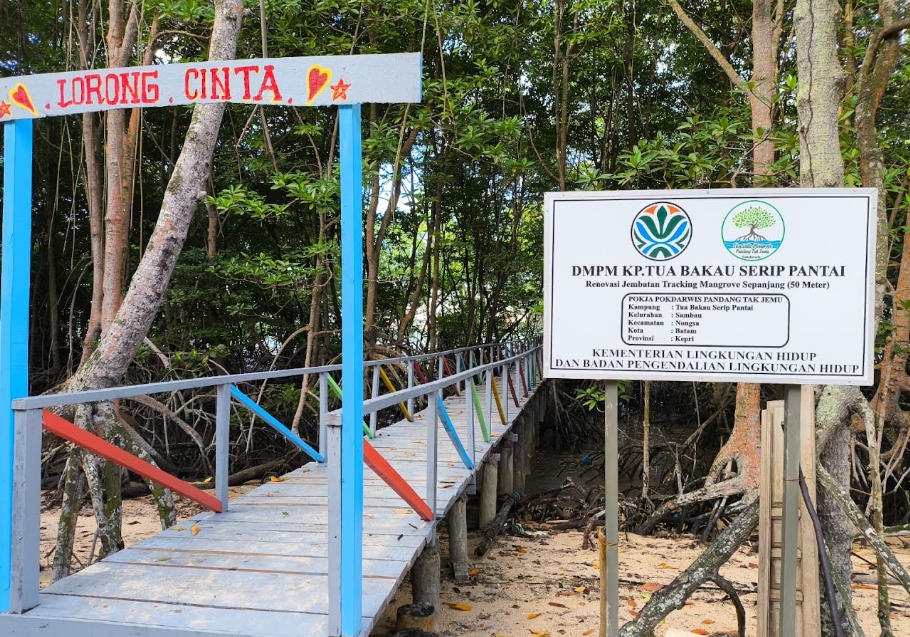
One selected area is the “Pandang Tak Jemu” Tourism Village in Kampung Tua Bakau Serip, Nongsa District, Batam City, Riau Islands Province. This ecotourism site was transformed from a community landfill into a tourist destination, pioneered since 2018. Gary David Semet, a representative from the local tourism awareness group (Pokdarwis), said many tourists from Malaysia, Singapore, Korea, Hong Kong and China now visit to learn about mangrove ecosystem conservation and the regenerative tourism concept applied there. With the central government’s assistance, physical revitalisation was carried out, focusing on renovating a 50-metre trekking bridge and repairing gazebos to ensure visitor safety.