
INDEF Urges Bahlil to Accelerate 100 GWp Solar Projects and Downstreaming
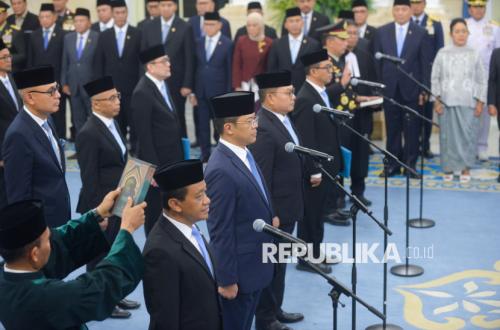
The Institute for Development of Economics and Finance (INDEF) is urging the Ministry of Downstreaming and Energy Transition to immediately establish work targets, deadlines, and cross-ministerial coordination mechanisms. Such steps are necessary to ensure that the formation of this new ministry can accelerate the energy transition and downstreaming agendas, which have long faced regulatory hurdles and technical issues.
Imaduddin Abdullah, Director of the INDEF Green Transition Initiative, believes that the formation of the coordinating ministry reflects the government’s political commitment to accelerating energy transition, downstreaming, and green industrialisation. However, this commitment must be translated into concrete actions through the alignment of policies between agencies, from the planning stage to programme implementation.
“The formation of this coordinating ministry presents an opportunity for Indonesia to advance further in the fields of energy transition and downstreaming,” Imaduddin stated in Jakarta.
According to him, one agenda requiring urgent attention is the Solar Power Plant (PLTS) programme with a capacity of 100 gigawatt peak (GWp). Its development requires the alignment of industrial policy, energy planning, spatial planning, infrastructure, and investment to ensure national targets are realised.
Imaduddin explained that effective institutional coordination could link solar power development with industrial estates as hubs for clean energy demand. Based on studies by the INDEF Green Transition Initiative (GTI) and Systemiq, eight priority industrial estates have the potential to absorb 24–31 terawatt-hours (TWh) of clean electricity per year.
This potential is equivalent to a solar capacity of approximately 8–13 GW, or 8–13 per cent of the 100 GWp national target. However, its realisation depends on resolving bureaucratic hurdles and ensuring the readiness of the electricity grid, land, and financing.
INDEF GTI is urging the new ministry to promptly draft an acceleration agenda across ministries with clear targets and deadlines. Priorities include removing barriers to renewable energy procurement, ensuring grid access, land readiness, and developing investment and financing schemes.
A mechanism for escalation to resolve strategic projects stalled by overlapping regulations or authorities also needs to be formulated. Imaduddin believes that simplifying bureaucracy could expand the potential for renewable energy development through the concept of Renewable Energy Zones (REZs).
“The new coordinating ministry can expand this potential by simplifying bureaucracy through the Renewable Energy Zones (REZs) concept,” he said.
In addition to the energy transition, Imaduddin highlighted the need to refine downstreaming strategies so that existing investments can generate greater added value for the national economy. The success of downstreaming depends on decisions from various supporting ministries, ranging from investment licensing, raw material supply, and factory construction to energy availability and market access.
He noted that delays in any single link of the supply chain can hinder the benefits of downstreaming. This issue is evident in the development of critical mineral industries, which still face licensing constraints, energy infrastructure needs, and raw material supply risks.
Conversely, several processing stages are actually experiencing overcapacity. This condition reflects a mismatch between production capacity, raw material availability, and market demand, which must be addressed through comprehensive policy coordination.
Technological readiness and workforce skills also remain challenges for the processing industry in generating domestic added value. Imadising reminded that existing investments have not yet fully achieved expected production capacities, state revenue, job creation, and inter-sectoral linkages.
“Investments have been made, but production capacity, state revenue, and job creation have not yet met expectations. Downstreaming requires targeted cross-ministerial support, from licensing and energy to market access. When one link lags behind, the benefits are not optimised. Therefore, the role of the coordinating ministry as a policy orchestrator is vital,” Imaduddin concluded.