
INDEF Highlights Tax Policy Certainty as Key Investment Strategy
As tariff policies, protectionism and trade fragmentation create new uncertainty
Jakarta (ANTARA) - The Institute for Development of Economics and Finance (INDEF) considers that regulatory certainty in tax policy has now become the main factor in attracting investment amid mounting global economic challenges.
INDEF founder and senior economist Prof. Didik J. Rachbini said tax policy can no longer be viewed merely as an instrument for collecting state revenue, but has become an important part of strategies to strengthen competitiveness, encourage productive investment, uphold fairness, and finance sustainable development.
“When tariff policies, protectionism and trade fragmentation create new uncertainty, regional coordination is no longer merely an option but a strategic necessity,” Didik said in a statement received on Tuesday.
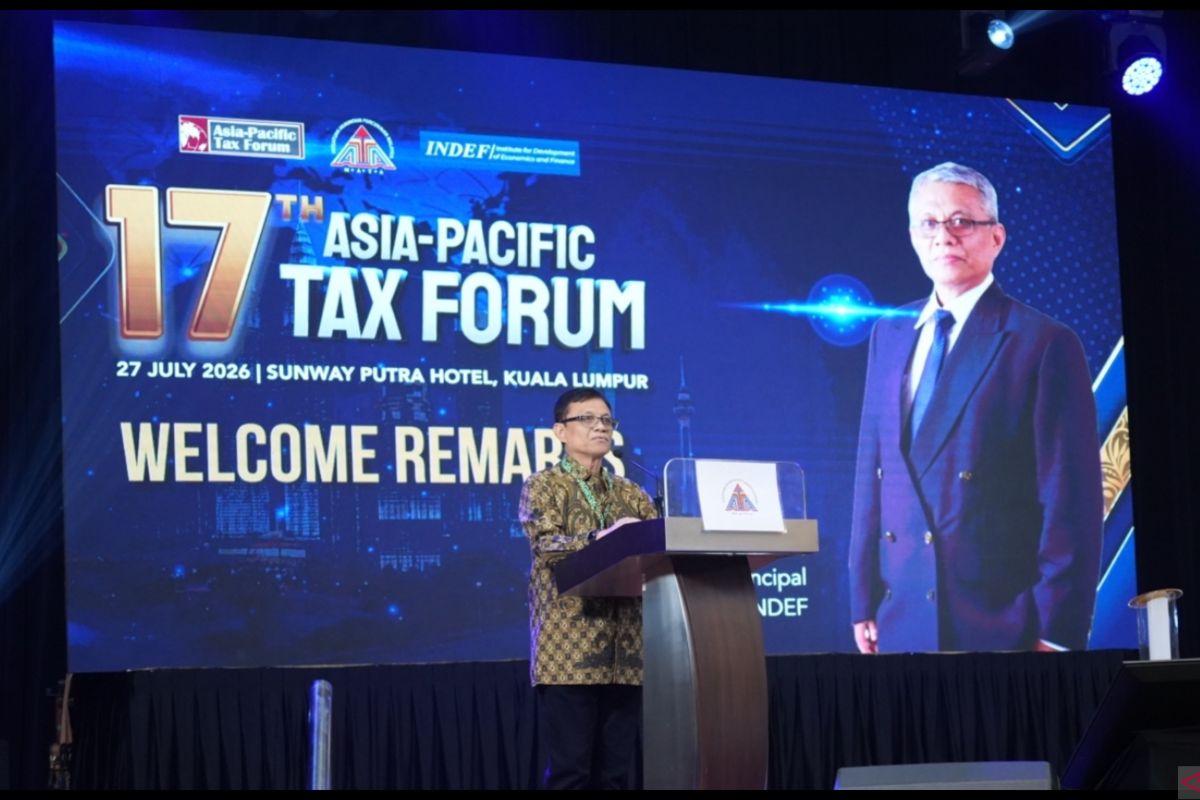
At the 17th Annual Asia-Pacific Tax Forum (APTF) 2026, Didik said that rising protectionism, tariff policies and global trade fragmentation have made coordination among countries in the Asia-Pacific region increasingly important.
He said the implementation of the Global Minimum Tax through the Pillar Two scheme has changed the landscape of investment competition between countries. According to him, tax incentives are no longer the primary instrument for attracting foreign capital if they are not supported by strong economic fundamentals.
INDEF considers that future investment appeal must be underpinned by the quality of infrastructure, policy certainty, skilled labour, technology transfer, and the strength of domestic supply chains.
Without improvements to these factors, the provision of tax incentives risks reducing state revenue without generating additional investment, productivity gains, or commensurate job creation.
In addition, Didik highlighted the need for tax administration reform in line with the rapid growth of the digital economy. Modernisation of the tax system, he argued, should not only aim to increase state revenue but must also be able to reduce compliance costs and provide certainty for the business community.
The forum also discussed the use of fiscal instruments to support the transition towards a green economy. According to INDEF, policies such as carbon taxes and green fiscal incentives can encourage low-carbon investment and technological innovation, but their implementation must take into account industry readiness and their impact on low-income communities.
“The green transition must be a just transition. Fiscal policy must not create new economic burdens or widen inequality,” Didik said.
The forum also brought INDEF together with the Malaysian Association of Tax Accountants (MATA), which is pushing for stronger tax collaboration in the Asia-Pacific region to enhance policy certainty, prevent harmful tax competition, and maintain investment competitiveness amid global economic uncertainty.
MATA Deputy President Hj. Taqiyuddin Amini Abdul Satar said APTF 2026 demonstrates the growing need to build tax collaboration across the region. The participation of cross-country delegations reflects the importance of regional cooperation in shaping the future of taxation, investment and sustainable economic development.
INDEF hopes APTF 2026 will produce recommendations that can be translated into concrete policies and cooperation. In this way, the region’s tax systems will not only be more adaptive to global change, but also capable of supporting resilient, inclusive and sustainable growth.
Source: jawawa.id (https://jawawa.id/newsitem/indef-highlights-tax-policy-certainty-as-key-investment-strategy-1785218010)
Originally published by Antara (Indonesian) (https://www.antaranews.com/berita/5668900/indef-soroti-kepastian-kebijakan-pajak-jadi-strategi-penentu-investasi), translated from Indonesian