
Indef: GDP Growth Could Slow if Middle East Conflict Persists
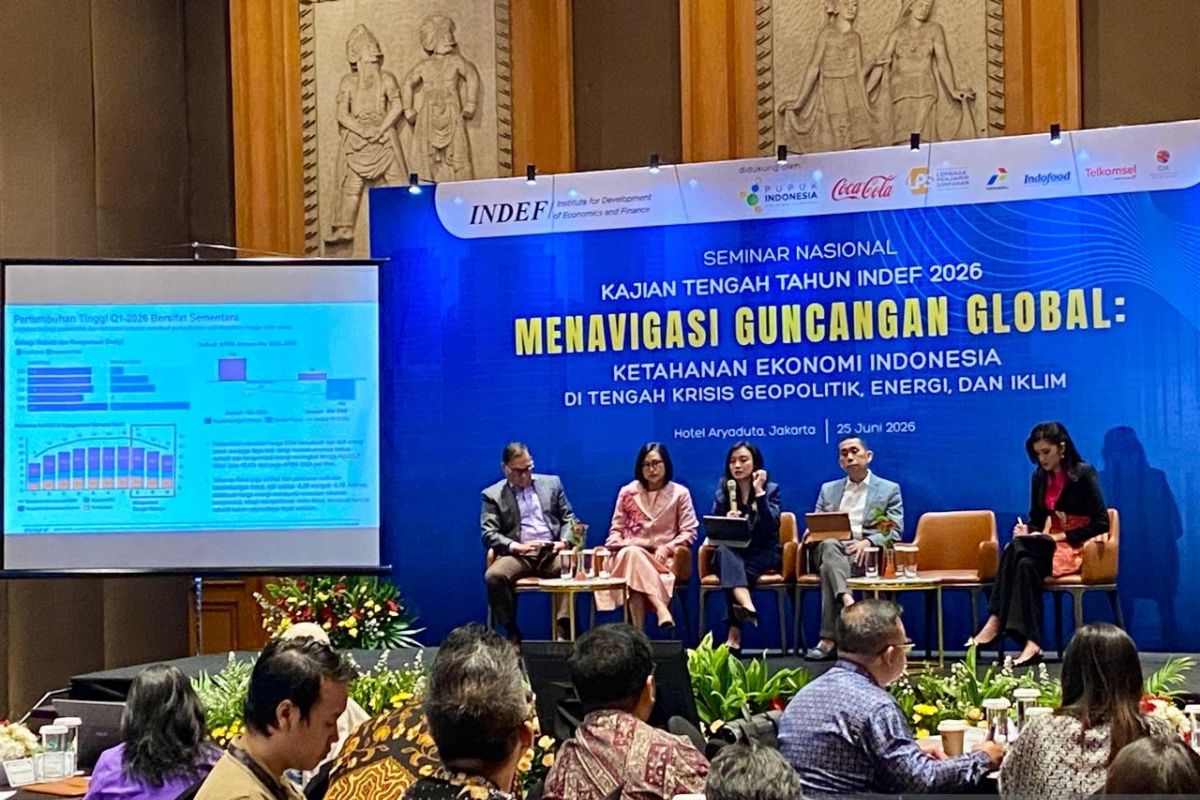
The Institute for Development of Economics & Finance (Indef) estimates that Indonesia’s economic growth could experience a slowdown of 0.21 per cent if the Middle East conflict, accompanied by a surge in global energy prices, continues until the end of this year.
Speaking at a seminar in Jakarta on Thursday, Indef Programme Director Eisha M. Rachbini stated that this projection is based on the results of a computable general equilibrium (CGE) model simulation developed by the Indef team to measure the impact of global economic shocks on the Indonesian economy.
In the first scenario, involving a prolonged Middle East conflict lasting until the end of 2026 that triggers a surge in global energy prices—assuming world oil prices rise by 30 per cent from a baseline of US$70 per barrel—the Consumer Price Index (CPI) is expected to increase by 0.28 per cent. At the same time, real wages are projected to fall by 0.26 per cent, exports are expected to contract by 2.44 per cent, while imports could surge by 7.80 per cent due to rising energy needs and costs.
“Because when oil prices rise, purchasing power is eroded, inflation increases, and consequently, real wages fall. Exports will also decrease because imports will increase significantly. Although we have export commodities that may rise, there will be a contraction due to the very high volume of fuel imports,” he explained.
Furthermore, while investment is expected to increase by 1.20 per cent, economic growth would still slow by 0.21 per cent.
The second scenario depicts an economic slowdown in major partner countries. Assuming import demand from Indonesia’s export destinations falls by 5 per cent, the CPI is expected to rise by 0.11 per cent, real wages to fall by 0.29 per cent, and investment to increase by 0.36 per cent. On the other hand, exports are projected to decline most sharply at 5.05 per cent, while imports would decrease by 0.23 per cent. This condition would cause economic growth to correct by 0.24 per cent.
In the third scenario, involving trade fragmentation and global supply chain disruptions due to increased tariffs or non-tariff barriers, the CPI is expected to rise by 0.18 per cent and real wages to fall by 0.23 per cent. Investment would remain almost stagnant with an increase of only 0.07 per cent, while exports and imports would decrease by 1.16 per cent and 0.30 per cent, respectively. In this scenario, economic growth is estimated to slow by 0.17 per cent.
“We conclude that if geopolitical risks, supply chain disruption and fragmentation, as well as climate change are not anticipated by sufficient economic fundamentals and good policy, this will result in growth contraction,” said Eisha.
Given these various challenges, Indef also predicts that Indonesia’s economic growth in the second quarter of 2026 could potentially slow to around 5 per cent year-on-year, alongside the normalisation of consumption post-Eid, energy and food price pressures, the weakening Rupiah, and rising production costs.