
Indef: Export structure must shift to industrial value-added basis
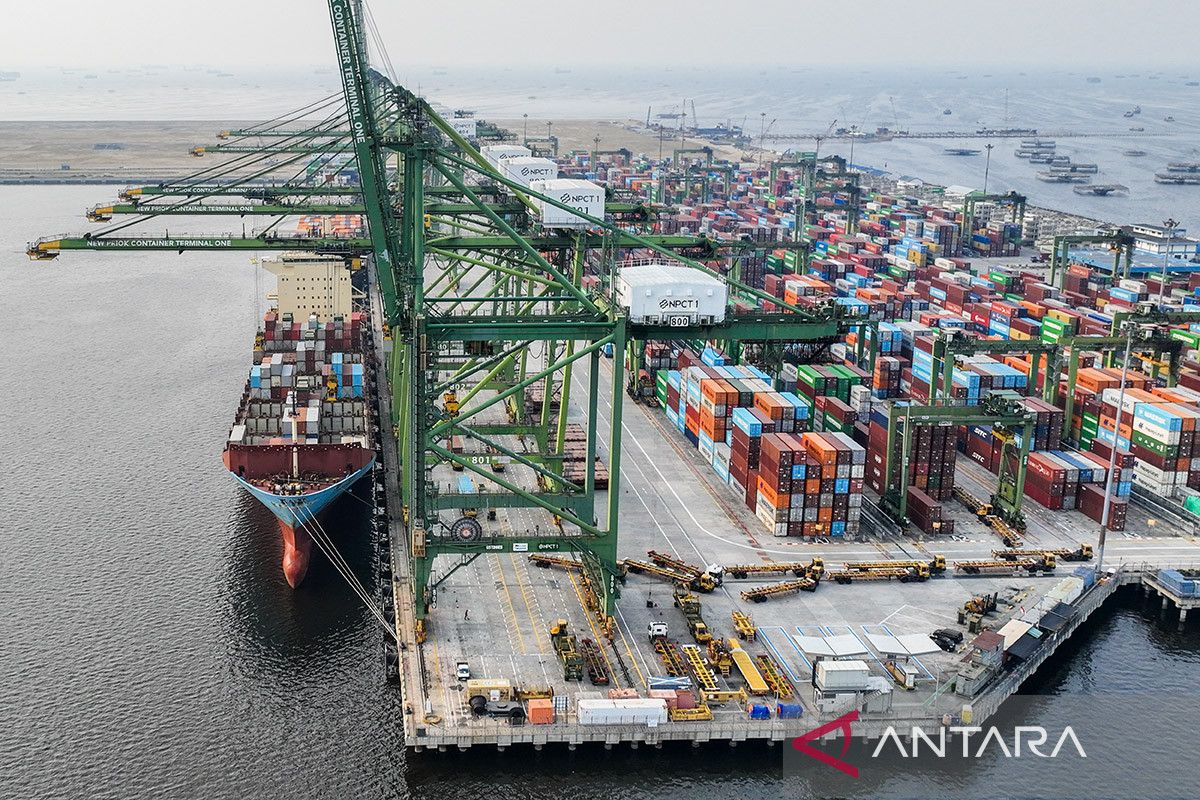
The Head of the Macroeconomics and Finance Centre at the Institute for Development of Economics and Finance (Indef), M. Rizal Taufikurahman, stated that Indonesia’s export structure needs to be transformed from being based on raw commodities to being based on industrial value-add.
This statement is in response to Indonesia’s trade balance performance, which experienced a deficit of $1.61 billion in May 2026, ending a continuous surplus record of 72 months since May 2020.
“The key is not just to increase export volumes, but to change the export structure from being based on raw commodities to being based on industrial value-add. Otherwise, every time commodity prices fall or energy imports surge, Indonesia’s trade balance will become fragile again,” Rizal told ANTARA in Jakarta on Sunday.
Rizal argued that the trade deficit serves as a signal that Indonesia’s exports remain vulnerable to weakening commodity prices and rising imports.
Potential future commodities must continue to rely on non-oil and gas sectors, as their contribution reached $110.19 billion, or 9t95.5 per cent of total exports from January to May 2026.
However, Rizal emphasised that the export focus needs to shift away from coal and crude palm oil (CPO).
Exports need to be driven through value-added products such as nickel downstreaming, iron and steel, palm oil derivatives, agriculture-based basic chemicals, semi-finished aluminium, fisheries, coffee, cocoa, spices, furniture, technical textiles, footwear, automotive, and electronic components.
“BPS (Statistics Indonesia) also noted an increase in non-oil and gas exports from January to May 2026, primarily driven by the processing industry, including processed nickel, palm oil, agriculture-based organic basic chemicals, inorganic chemicals, and semi-aluminium,” he added.
On the other hand, Indonesia’s export market strategy needs to be expanded from traditional markets towards South Asia, the Middle East, Africa, Latin America, and intra-ASEAN.
Rizal noted that Indonesia’s non-oil and gas export targets are currently still concentrated on China, Japan, and Australia, making them vulnerable to demand slowdowns or geopolitical disruptions in these major regions.
“The government needs to strengthen trade diplomacy, accelerate PTAs/FTAs, export financing, ESG and traceability standardisation, as well as the aggregation of export-oriented MSMEs so that Indonesian products can enter new supply chains forming due to global fragmentation,” said Rizal.