
Increasing the Middle Class from 17% to 70%, Is It Possible? (Part 2)
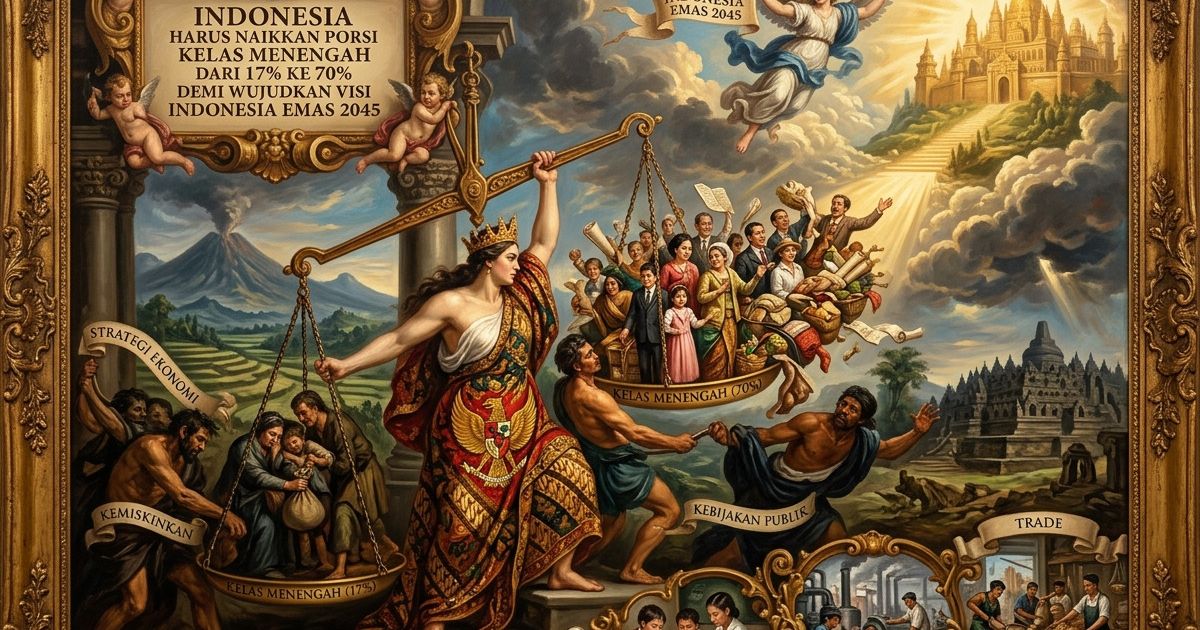
Indonesia aspires to become a developed nation by 2045. However, this ambition will be difficult to realise if only about 17% of the population is classified as middle-class, while the majority remain in the aspiring middle-class, vulnerable to poverty, or impoverished. A developed nation is not merely defined by a large Gross Domestic Product, numerous skyscrapers, or an increasing number of wealthy individuals. A developed nation requires a large, productive middle class with decent incomes, savings, social security protection, and the capacity to act as the primary driver of consumption, investment, and state revenue.
Indonesia’s challenge is actually moving in the opposite direction. Data from the Indonesian Central Statistics Agency (BPS) shows that the number of middle-class citizens fell from 5-7.33 million people, or 21.45% of the population in 2019, to 47.85 million people, or 17.13% in 2024. Using these two official figures, the middle class has shrunk by 9.48 million people in five years.
Some estimates for 2025–2026 place Indonesia’s middle class in the range of 42 million to 46.7 million people. If the lowest figure of approximately 42 million is used, Indonesia has lost about 15.33 million middle-class citizens compared to its 2019 position. However, this decline of 15 million should be referred to as an estimate, rather than the latest official BPS figure. Official data released by BPS up to 2024 shows a decrease of 9.48 million people.
This distinction is important so that the public does not misinterpret the figures. A decrease in the number of middle-class citizens does not mean that everyone leaving this group immediately becomes poor. Most are shifting into the ‘aspiring middle class’ group. They sit above the poor and vulnerable-to-poverty groups, but their financial condition is not yet robust enough to withstand layoffs, serious illness, rising food prices, education costs, mortgage payments, or economic crises.
BPS uses a per capita expenditure approach to categorise the population based on welfare levels. The middle class is defined as residents with expenditures between approximately 3.5 to 17 times the poverty line. Below them is the aspiring middle-class group, with expenditures between 1.5 to 3.5 times the poverty line, while the vulnerable-to-poverty group sits just above the poverty line.
Because these thresholds are calculated based on poverty lines that vary by region and change over time, the middle class cannot be determined by a single income figure applicable across all of Indonesia. The cost of living for a family in Jakarta, for example, differs from that of a family in a small town or rural area. The number of family members also significantly determines a household’s economic capacity.
The decline of the middle class warrants serious attention because this group holds a strategic position in the economy. The World Bank refers to Indonesia’s middle class as one of the main drivers of growth. Consumption within this group has previously grown at an average of 12% per year and contributes nearly half of national household consumption. Expanding the middle class can also broaden the tax base and strengthen public demands for better public services and governance.
The middle class generally purchases more value-added goods and services, ranging from housing, vehicles, education, healthcare, insurance, and tourism to electronic products and financial services. This expenditure creates demand for industry, trade, transport, banking, and the service sectors. When the middle class shrinks, consumption is stifled, businesses lose their market, tax revenues weaken, and economic growth becomes increasingly difficult to accelerate.
Why is the Middle Class Shrinking?
The Covid-19 pandemic was one of the initial causes of this decline, but it was not the only factor. The pandemic caused many companies to reduce activities, close businesses, or implement layoffs. Not all workers who lost formal jobs were able to secure employment of the same quality and income level once the economy recovered.
A more fundamental issue is the limited creation of formal jobs with decent wages. Indonesia’s economic growth has indeed remained around 5%, but the structure of this growth has not produced a comparable number of productive formal jobs to match the increase in the labour force. Some investment flows into capital-intensive sectors, including mining and commodity-based industries, which involve large investment values but have relatively limited labour absorption.
At the same time, several labour-intensive industries such as textiles, textile products, footwear, furniture, and light manufacturing are facing heavy pressure. Weakening demand, competition from imported goods, production costs, technological changes, and industrial relocation have triggered factory closures and layoffs. When factory workers lose their jobs, many transition into becoming online transport drivers, small traders, freelancers, or micro-entrepreneurs with unstable incomes.
Economists assess that the limited creation of formal jobs is one of the primary causes of the middle-class shrinkage. Most new jobs created since 2019 are in the informal sector. In such a situation, while the economy continues to create jobs, it does not necessarily produce the quality of employment capable of elevating workers into the middle class.
The pressure of the cost of living is also accelerating this ‘downward mobility’ phenomenon. General inflation may appear controlled…