
Inaugurated by Ahok 10 Years Ago, This Jakarta Market is as Silent as a Grave
On 21 September 2016, Pasar Nangka Bungur, located on Jalan Kalibaru Timur, Utan Panjang, Kemayoran, Central Jakarta, was officially inaugurated. At the time, the Governor of Jakarta, Basuki Tjahaja Purnama, known as Ahok, attended the ceremony personally.
Ahok recalled a personal connection to the market, as his father had once lived nearby. “I am pleased with Pasar Nangka Bungur because it provides additional space to accommodate street vendors (PKL),” he stated during the inauguration.
At the time, the market spanned 1,523 square metres and featured 163 business units, divided into 127 shops and 36 stalls. Traders had flocked to fill the kiosks, and customers frequently visited the facility, which was designed to be modern and clean.
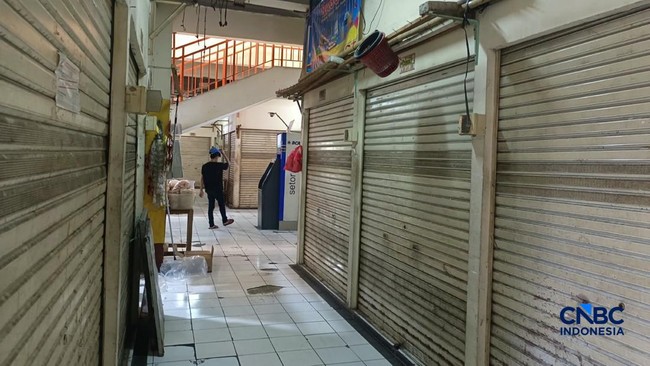
However, that was ten years ago. Today, the condition of Pasar Nangka Bungur is as silent as a grave. Closed iron doors greet visitors upon entering the market. The sounds of bargaining, which typically define a traditional market, are rarely heard.
In the market aisles, only a small fraction of traders still operate their kiosks. At a glance, it is estimated that only about a quarter of the shops are active, while the majority appear closed.
Trading activity is actually more prevalent outside the market building. Along the surrounding streets, traders have set up stalls using simple tables or semi-permanent structures. Various daily necessities are sold along the roadside, alongside parked motorcycles and passing vehicles.
This situation has caused the roads around the market to become increasingly narrow. Pedestrians must share space with motorcyclists, and both parties often find themselves waiting for each other amidst the heavy flow of commerce.
Observations by CNBC Indonesia reveal a stark contrast between the interior and exterior of Pasar Nangka Bungur. Inside, the aisles are relatively deserted with many closed shops, whereas outside, vendor stalls have expanded along the roadside, becoming the primary shopping point for customers.
Sugi (a pseudonym), one of the traders selling outside, said he chose to set up his stall on the street because customers inside the market have dwindled. “It is quiet inside. Parking is difficult and cramped, so no one comes. It is so quiet that goods do not sell,” Sugi told CNBC Indonesia on Wednesday (7/10/2026).
He admitted that this situation has persisted for quite some time. “It has been like this for a long while. I forget exactly when it started; this is just how we sell now,” he said.
According to Sugi, the issue is not high rental prices. He is more concerned with the presence of customers. “It is not because the rent is expensive, just that it is quiet. There is no point in being here if it is quiet and nothing sells; it results in a loss,” he explained.
Another trader, Tono (a pseudonym), has also chosen to sell outside the market. He admitted he is merely continuing the business previously run by his brother. “It is alright. I am just continuing my brother’s business. I do not know why [they chose] to sell outside. It has been like this for a long time, and I am just carrying on,” Tono said.
While he does not know the original reason traders moved outside, Tono noted one clear factor: the emptiness of the market interior. He believes poor parking access discourages customers from entering. “I am not sure, as I am just continuing the business. But certainly, it is quiet inside. People might be lazy because parking is a hassle, or perhaps they do not want to dismount their motorcycles. Here, they can shop while staying on their bikes,” he noted.
This roadside shopping pattern is even likened by him to a drive-thru. Customers simply stop their motorcycles in front of the stall, select their items, and continue on their journey. “Yes, it is like buying food at McDonald’s, shopping while driving,” he remarked.
However, not all traders have moved out. Some still persist inside the market, despite acknowledging the low level of trade. Reni (a pseudonym), a trader still operating inside a kiosk, described the current atmosphere as extremely desolate, as if there were no commercial activity at all. “Yes, it is quiet; it is so quiet, it feels like there is no life (trading activity),” said Reni.
Nevertheless, she chooses to remain inside because her goods are stored in the kiosk. For her, this is more practical than having to transport and set up her wares every day. “Because I store my goods here and I close in the afternoon. Rather than the hassle of setting up outside, where I would have to pack everything up when I go home,” she explained.
“Inside, I just have to close [the kiosk],” she added.
Regarding turnover, Reni admitted her income might not be as high as those trading outside, but she sees an advantage in having longer operating hours. “My turnover might not be as large as those trading outside. But if those outside have closed, like people looking for goods from midday to late afternoon, I am still open,” she said.
The situation at Pasar Nangka Bungur tells a unique story. Inside the market building, most kiosks are closed and the aisles are empty. Meanwhile, outside, stalls have grown to fill the roadside. For some traders, moving outside is not just a choice of location; it is about being more accessible to customers, even if it means the surrounding public space becomes increasingly congested.
Source: jawawa.id (https://jawawa.id/newsitem/inaugurated-by-ahok-10-years-ago-this-jakarta-market-is-as-silent-as-a-grave-1791352377)
Originally published by CNBC Indonesia (https://www.cnbcindonesia.com/news/20261007112404-4-774025/10-tahun-lalu-diresmikan-ahok-pasar-di-jakarta-ini-sepi-bak-kuburan), translated from Indonesian