
In Xinjiang, the Heavenly Lake Keeps Its Silence
A Tianshan red deer lowers its head beneath the shade of spruce trees. It chews grass calmly, seemingly undisturbed by the footsteps of tourists wandering through the surrounding forest.
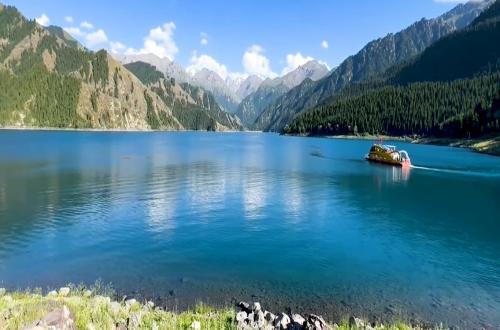
Not far away, turquoise water stretches between the mountains. Its surface is calm, like a sheet of jade deliberately placed at the foot of the mountain.
This is Tianchi, a lake that Chinese people call the ‘Heavenly Lake’. It lies in the Bogda Mountain Valley, part of the Tianshan Mountains, about 110 kilometres from Urumqi, the capital of Xinjiang.
But Xinjiang is not merely a story about a tranquil lake. The region is a vast geographical space where snow-capped mountains, scorching deserts, grasslands, forests, and lakes meet in a single landscape.
Xinjiang covers an area of 1.66 million square kilometres. The largest administrative region in China encompasses nearly one-sixth of the country’s total land area.
It is also a place where global geopolitics often collide. The region, officially named the Xinjiang Uighur Autonomous Region, has repeatedly drawn the attention of international human rights organisations regarding the treatment of ethnic Uighurs and other Muslim communities.
Beijing firmly denies these accusations. The debate over Xinjiang continues to move far beyond the region’s borders.
According to the 2020 census, ethnic Uighurs are the largest population group in Xinjiang. Their population reaches 11.62 million, or about 44.96 percent of the total population.
Yet behind the political debates that never truly subside, Xinjiang has another, quieter face. That face is shaped by mountains, sand, forests, and water.
Three Mountains, Two Basins
Viewed through its geographical structure, Xinjiang appears to be designed on a gigantic scale. Three mountain ranges flank two large basins that define the character of the region.
In the north stand the Altai Mountains and the Junggar Basin. In the middle of that basin lies the Gurbantünggüt Desert, the second-largest desert in China.
In the south are the Kunlun Mountains, which form Xinjiang’s border with the Tibetan Plateau. Not far away stretches the Tarim Basin, home to the Taklamakan Desert, the largest desert in China.
Between north and south, the Tianshan Mountains stretch from west to east. The mountain range divides Xinjiang into two major parts, north and south.
It is in one part of the Tianshan Mountains that a lake resides. Its name has lived in Chinese landscape and mythology for centuries: Tianchi Lake.
Water That Changes Colour
The journey to Tianchi takes visitors to the administrative area of Fukang City. The lake sits at an altitude of about 1,910 to 1,980 metres above sea level.
Its shape resembles a crescent moon with an area of about 4.9 square kilometres. At its deepest point, it reaches about 105 metres.
But those figures quickly lose their dominance when one stands at the lake’s edge. The eye is first captured by the colour of the water, which shifts with the light.
From one angle, Tianchi appears light green like jade. From another, the colour turns turquoise against a backdrop of mountains, spruce, and pine.
That beauty is protected by a number of prohibitions. Visitors are not allowed to swim or fish in Tianchi’s waters.
‘Visitors are not allowed to swim or fish here. Visitors simply enjoy the beauty of the lake from the shore or sail using the electric boats that have been provided,’ said He Xianglan, Head of the Ecology and Environment Section of the Tianshan Lake Management Committee, when met by ANTARA in the Tianshan Lake area on Saturday (29/8).
Tianchi is therefore not offered as a place to be conquered. The lake instead asks visitors to look, walk, and simply enjoy.
Source: jawawa.id (https://jawawa.id/newsitem/in-xinjiang-the-heavenly-lake-keeps-its-silence-1788141088)
Originally published by Republika (https://ameera.republika.co.id/berita/tklzdx451/di-xinjiang-danau-surgawi-menjaga-sunyi), translated from Indonesian