
In This Economy: The Struggle to Make Ends Meet
Amid continuing economic uncertainty, Indonesians from all walks of life face the same struggle: making ends meet as the cost of everyday necessities puts pressure on household budgets. Rising prices for some essentials, competition for jobs and incomes that do not always keep pace with spending mean lower- and middle-income households must manage their finances ever more carefully.
For some people, putting food on the table, paying for accommodation and providing for their families are daily challenges.
For informal-sector workers such as online motorcycle taxi (ojol) drivers, earning a living means working from morning until night. Angga Yudistia, 38, an ojol driver with three children, said he earns about Rp 100,000 a day. That is gross income, before deducting fuel, food and other operating costs.
Economic pressure has also led some office workers to seek extra income by driving for ojol services after work. After spending the day in the office, they take to the streets to accept orders and supplement their earnings. They sacrifice time to rest and be with their families to keep up with living costs.
These efforts to earn a living come amid challenges in the national labour market. Statistics Indonesia (BPS), citing its May 2026 National Labour Force Survey, recorded 7.22 million unemployed people in Indonesia, with an open unemployment rate of 4.65 per cent.
The labour force numbered 155.41 million, of whom 148.19 million were employed. Compared with February 2026, the number of unemployed people fell by about 24,000, while employment rose by around 522,000.
Despite this improvement, millions of people have yet to find work. For some, ongoing living costs mean they must seek additional income, take informal jobs or work longer hours to support their families.
The Ministry of Manpower’s Labour Market Centre also recorded 2,052,460 job vacancies posted on its Pasker ID platform between January 2025 and September 2026, with demand for 2,737,793 workers. These figures cover only vacancies listed on Pasker ID, not all job openings in Indonesia.
Amid competition for jobs, limited opportunities mean some people must keep searching for ways to earn an income. For those who have not found work, every opportunity offers hope of building a better life again.
Economic pressures are also visible in traditional markets, where people buy their daily necessities. Rising prices for some staples have made shoppers more cautious. They compare prices, reduce the amount they buy, or abandon plans to purchase certain goods for fear of their spending rising further.
Traders are feeling the effects too, as customers become more selective with their spending. With essential needs still to be met, households face difficult choices between buying food and saving money for other expenses.
BPS recorded annual inflation of 3.28 per cent in Indonesia in September 2026, while monthly inflation stood at 0.30 per cent. Inflation measures the general change in the prices of goods and services; it does not mean that every commodity rose in price by the same amount.
Even so, changes in the prices of everyday necessities remain a concern for households that spend most of their income on consumption. For families on limited incomes, changes in food spending can affect their ability to cover other needs, from transport to their children’s education.
Middle-income households, which have generally enjoyed relatively stable earnings, are also feeling the squeeze. Some are changing their spending habits and scaling back a standard of living they had previously been able to maintain. Workers who used to eat in office canteens are switching to warung Tegal (warteg), which offer more affordable meals.
People are also trying to make their belongings last longer. Torn or damaged shirts and trousers are repaired so they can still be worn, rather than replaced. Even small savings matter if they help cover other, more urgent needs.
The scale of economic hardship is also reflected in national poverty data. BPS recorded 22.93 million people living in poverty in Indonesia in March 2026, or 8.07 per cent of the population. The national poverty line for the same period was Rp 669,235 per person per month. The poverty line is the minimum expenditure threshold for meeting basic needs, not a measure of the cost of a decent standard of living for everyone.
Nevertheless, the figures show that millions of people continue to live with economic hardship. For low-income families, food often takes priority, while spending on education, healthcare, housing and other needs must be adjusted to what they can afford.
For people at the bottom of the income scale, the struggle to survive is often harsher because they have fewer options. The money earned today is frequently spent straight away on food and the most basic necessities. There is little room to save, plan for the future or cope with unexpected expenses.
The ‘in this economy’ reality shows how people are adapting to economic pressure: ojol drivers chasing orders, office workers taking extra jobs after hours, market traders waiting for customers and low-income families struggling to put food on the table. Behind these routines are stories of sacrifice, hardship and hope. For them, economic struggle is not just a matter of figures and statistics, but an everyday reality: finding money today so the family can eat today.
A trader waits for customers at a quiet shopping centre in Jakarta.
Aini and Dinda study in a small rented room. They both left school because they could not afford the costs.
John and his wife, Ana, prepare lunch to take to work, as they do regularly to save money.
John says goodbye to his wife, Ana, and their two children before leaving for work. He works in an office and drives for an ojol service in the evenings.
Eko, 36, an ojol driver, takes a lunch break by a roadside in Jakarta.
Angga Yudistia, 38, shows his gross daily earnings as an ojol driver.
Romi, 44, has been a victim of layoffs since last July.
Commuters return from work on the KRL commuter train at Bekasi Station.
A worker at a shopping centre buys a meal at a warteg with a damaged wall in Kemang, South Jakarta.
A trader waits for customers at Bekasi Traditional Market.
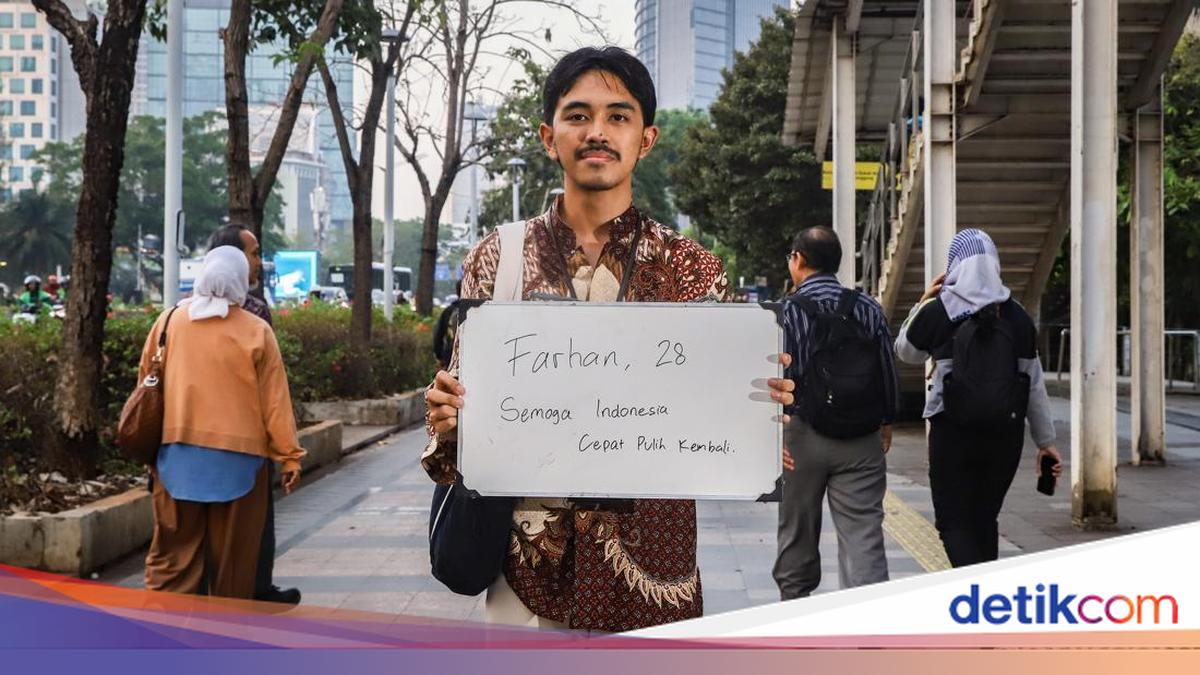
Kayla, 24, writes down her hopes amid the current economic conditions.
A photo collage of portraits of jobseekers in Jakarta.
Source: jawawa.id (https://jawawa.id/newsitem/in-this-economy-the-struggle-to-make-ends-meet-1792896667)
Originally published by detikcom (https://news.detik.com/intermeso/d-8722465/in-this-economy-perjuangan-warga-bertahan-hidup), translated from Indonesian