
In Scientific Oration at PTIK, Riau Police Chief Promotes Police as Guardians of Civilisation
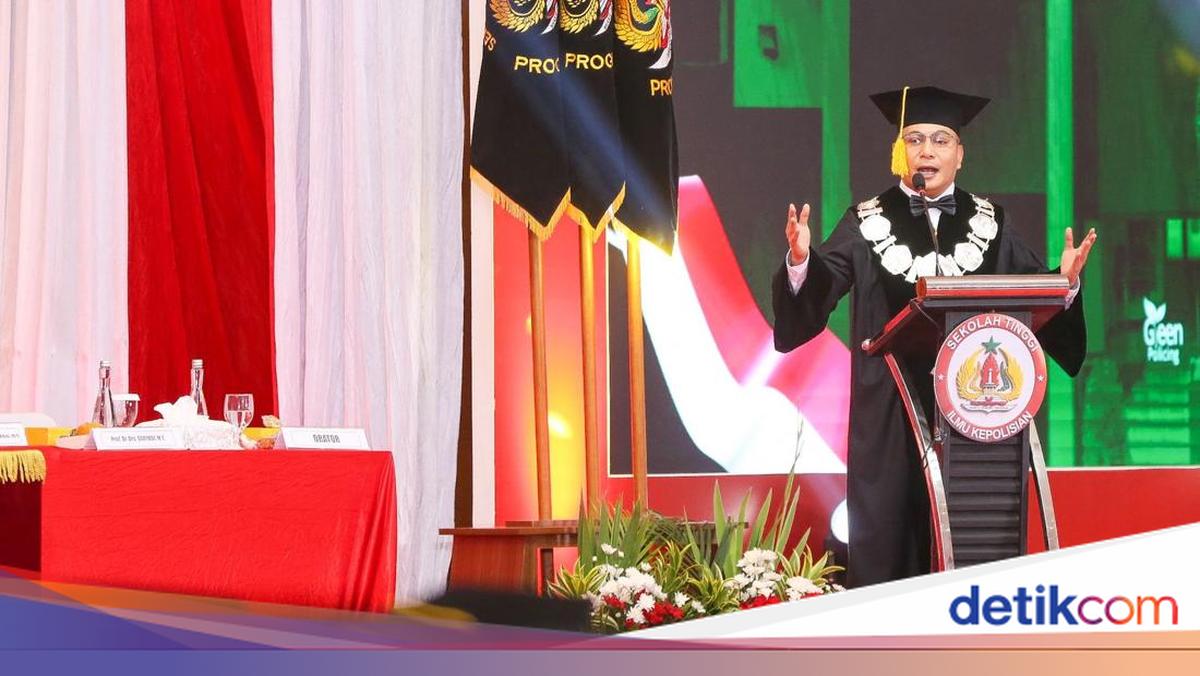
Riau Police Chief Inspector General Herry Heryawan has advocated for the police to act as guardians of civilisation during a scientific oration titled ‘Green Policing: Police as Guardians of Civilisation’ at the 80th Anniversary of the Police Science Institute (STIK) Lemdiklat Polri. In this academic forum, which focused on ‘Democratic Policing and Cultural Reform to Achieve Public Trust in the Digital Era’, the Riau Police Chief proposed Green Policing as a future development of policing that focuses not only on state and human security but also on ecological security as the foundation for the sustainability of civilisation.
The oration was delivered before several high-ranking National Police officials, professors, the STIK academic community, and graduates. During the event, Inspector General Herry emphasised that the police institution can no longer view security threats solely through a conventional framework. Green Policing serves as an elaboration of the ‘Presisi’ concept introduced by the National Police Chief, General Listyo Sigit Prabowo.
Before discussing Green Policing, the two-star general addressed the fundamental question of ‘who the police are and the basis of their existence’. In modern state theory, the police are essentially a manifestation of the state’s monopoly on the legitimate use of force to maintain order and ensure the rule of law.
“From this function, the police mandate is born, such as maintaining security, enforcing the law, and protecting the community. However, policing is not always static; policing is always dynamic, following the changing forms of threats faced by society,” said Herry Heryawan.
Herry Heryawan, who earned his doctorate from STIK, stated that climate change, environmental degradation, forest and land fires, river pollution, and the loss of biodiversity have evolved into real threats to human life and social stability that cannot be addressed by conventional policing alone.
Citing Ulrich Beck’s concept of the ‘risk society’, he noted that modernity brings new systemic, invisible, and transboundary risks that threaten the foundations of life. The impacts of climate change, such as peatland degradation, forest and land fires (karhutla), river pollution, ecological conflicts, and the loss of Sumatran elephants and tigers, are directly felt in Riau Province.
“We live in a situation full of paradoxes. The more advanced a civilisation becomes, the greater the threats to the existence of life,” he said.
Quoting Antonio जीएस (referring to the paradox of modernity) regarding how humans often fail to address ecological threats, and quoting Plato, Herry Heryawan stated that ‘justice is born when every element exists in harmony’.
“The ecological crisis is not merely an environmental crisis; it is a moral crisis for human civilisation. It shows that our greatest problem is not a lack of technology, but a lack of wisdom; not a lack of ability to master nature, but a loss of the ability to live in harmony with nature,” he said.
Green Policing as an Ethical Transformation
According to him, the answer to the ecological crisis is not enough through regulation, law enforcement, or technological innovation alone, but also requires an ethical transformation—a revolution of consciousness that places humans as part of nature. This is the point where the future of human civilisation is determined.
“Nurturing nature is, in fact, nurturing our own sustainability,” he said.
He argued that there is no human security without ecological security. This is where Green Policing finds its theoretical foundation.
“Green Policing is an evolution of the concept of security itself. From state security that protects the state, to human security that protects humans, and now evolving towards ecological security that protects civilisation, humans, and nature simultaneously,” stated Inspector General Herry during his oration.
Inspector General Herry explained that his experience serving in Riau provided direct lessons regarding the complexity of ecological threats. Riau Province, which possesses one of the largest peatland ecosystems in the world, faces various environmental issues, ranging from forest and land fires, forest encroachment, illegal logging, and the hunting of protected wildlife to river pollution and illegal mining.
He believes these conditions demand a paradigm shift in policing. The police must not only arrive after a crime or disaster has occurred but must also be able to read various environmental indicators as part of an early security detection system.
“Peat moisture levels can serve as a security signal. Changes in vegetation can be risk indicators. Ecological data must be viewed as being just as important as criminal data,” said the 1996 Police Academy graduate.
ways, the Riau Police Chief mapped Green Policing into three main pillars. First, a preventive approach through building collective awareness and ecological literacy in the community, including through ‘Green Community Policing’ (Satkamling Hijau), environmental education in schools, public campaigns, and strengthening the capacity of police officers.
Second, a repressive approach through strengthening law enforcement against environmental crimes such as forest fires, illegal mining, and forest encroachment, as well as tracing the economic actors behind ecological crimes. Third, a restorative approach through various environmental recovery programmes such as reforestation, river basin rehabilitation, the construction of canal blocks, and the ‘Green Harmony Fund’ programme.
He also mentioned the JALUR Programme (Exploring Riau for the People) as a concrete implementation of Green Policing. This programme treats rivers as living spaces that must be protected through cross-sector collaboration, providing health services, education, environmental education, and strengthening social relations for communities along river basins.
Source: jawawa.id (https://jawawa.id/newsitem/in-scientific-oration-at-ptik-riau-police-chief-promotes-police-as-guardians-of-civilisation-1781675674)
Originally published by detikcom (https://news.detik.com/melindungi-tuah-marwah/d-8535162/orasi-ilmiah-di-ptik-kapolda-riau-gaungkan-polisi-sebagai-penjaga-peradaban), translated from Indonesian