
In Meeting with DPR, Home Affairs Minister Pushes for PPPK Restructuring and Highlights Personnel Expenditure
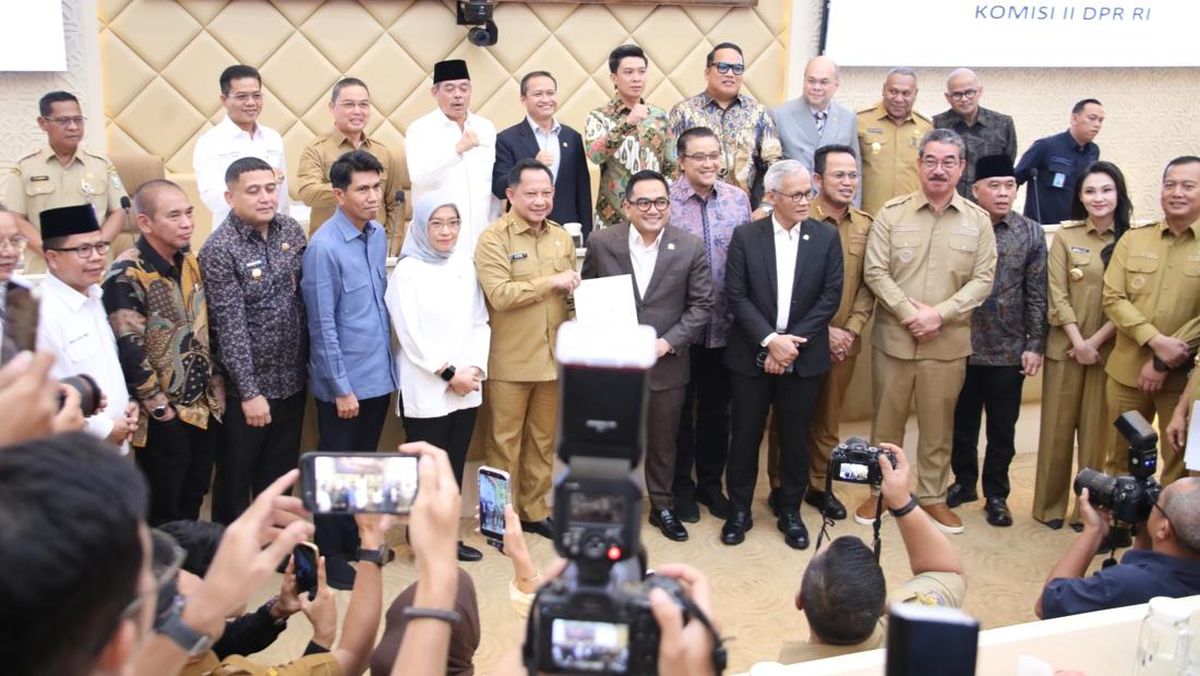
The Minister of Home Affairs, Muhammad Tito Karnavian, presented several solutions for the restructuring of Government Employees with Work Agreements (PPPK) and honorary staff in regional areas during a working meeting with Commission II of the House of Representatives (DPR RI) at the Parliament Complex on Monday (8/6).
The meeting was also attended by the Minister of State Apparatus Empowerment and Bureaucratic Reform, Rini Widyantini, as well as regional government representatives from various regional head associations.
Tito explained that the discussions focused on the dynamics of regional personnel management and the impact of implementing the HKPD Law, which limits personnel expenditure to a maximum of 30 per cent of the Regional Budget (APBD).
“We are here to discuss the issues surrounding PPPK and honorary staff. We are also discussing the relaxation of policies regarding the regulation of personnel expenditure amounts in governments that exceed 30 per cent of the APBD,” said the Minister of Home Affairs.
The Minister explained that one of the primary concerns for regional governments relates to the provisions on personnel expenditure as regulated in Article 146 of the HKPD Law. This regulation requires local governments to allocate personnel expenditure, excluding teacher allowances allocated through Regional Transfers (TKD), at a maximum of 30 per cent of the total Regional Budget (APBD).
Furthermore, local governments are required to adjust their proportion of personnel expenditure in accordance with these provisions within a maximum of five years from the enactment of the HKPD Law, meaning the policy will fully take effect in 2027. According to the Minister, this situation is creating dynamics in several regions where fiscal capacity remains limited.
To address these issues, the Minister offered several strategic solutions. One of them is to ensure that regional heads act decisively by no longer recruiting new honorary staff. “I urge all local governments to be firm; there must be no new honorary staff,” the Minister stated.
Regarding regional revenue, the Minister emphasised the importance of optimising Regional Original Income (PAD) without burdening the public. This can be achieved through various steps, including encouraging ease of business licensing to increase regional economic activity. Additionally, local governments are encouraged to optimise digital tax and levy collection systems to increase regional revenue.
During the same session, the Minister revealed that his office has held meetings with the Minister of State Apparatus Empowerment and Bureaucratic Reform and the Minister of Finance to discuss the 30 per cent maximum limit on personnel expenditure as regulated in the HKPD Law. The results of the meeting led to an agreement that the transition period for implementing these provisions will be extended.
According to the Minister, this policy will be included in the revision of the State Budget (APBN) Law. “This will be included. We also remind the leadership and members of Commission II to ensure that the article states the 5-year transition period is extended—for example, to one or two years later—within this Law,” he said.
“Thus, the principle of lex posterior derogat legi priori shall apply. The later rule overrides the previous rule,” he concluded.
Also present at the meeting were the Chairman of Commission II of the DPR RI, M. Rifqinizamy Karsayuda, along with the leadership of Commission II, the Minister of State Apparatus Empowerment and Bureaucratic Reform, Rini Widyantini, regional heads from APPSI, APEKSI, and APKASI, and other relevant parties.