
In Assisi Speech, Religious Affairs Minister Stresses the Importance of Concrete Humanitarian Action
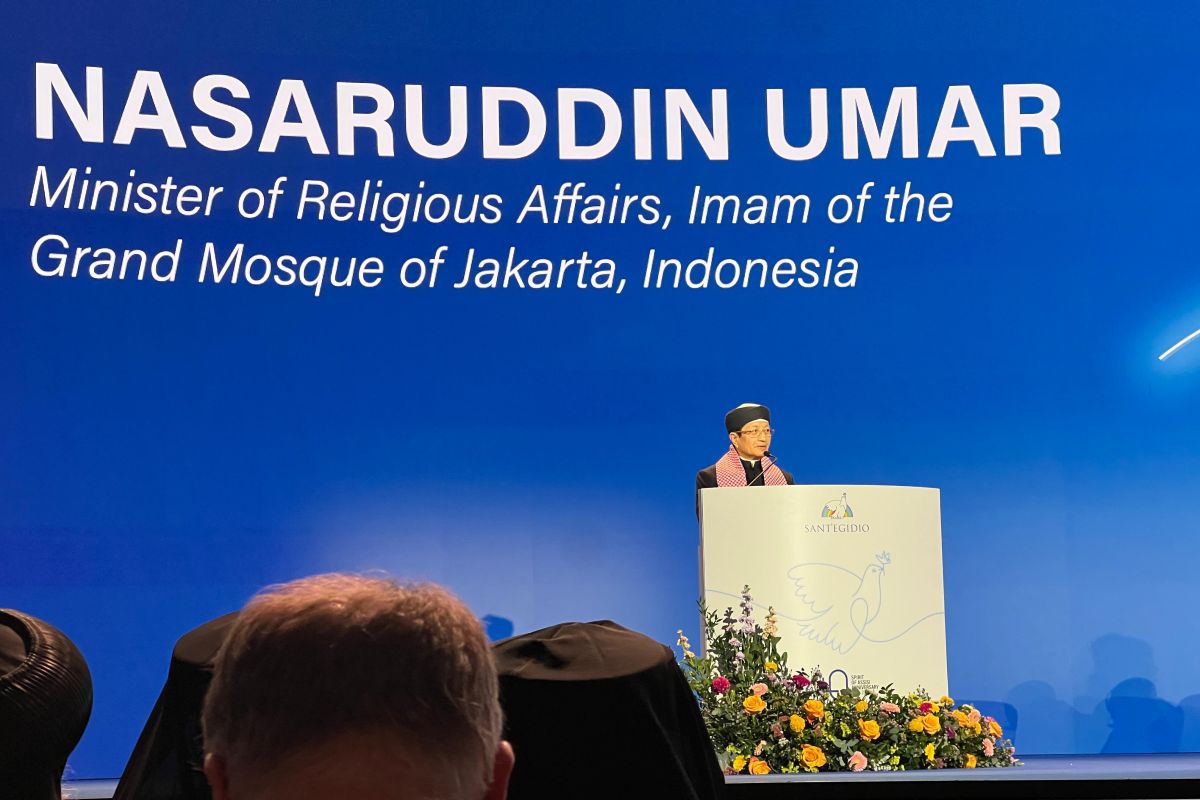
Jakarta (ANTARA) — Religious Affairs Minister Nasaruddin Umar stressed the importance of prioritising concrete humanitarian action when he spoke at the opening of the high-level session of the Sant’Egidio international peace meeting in Assisi, Italy.
“True peace requires dialogue to be actively transformed into practical action and environmental conservation efforts that directly ease the burdens of grassroots communities,” the minister said in a statement in Jakarta on Tuesday.
Umar called for a shift in global diplomacy, urging that relations between religious communities be expressed through concrete steps with a direct impact on people’s lives.
At the forum, attended by hundreds of delegates from various countries, he highlighted the limitations of traditional interfaith summits, which often become trapped in symbolic gestures. Global harmony, he said, requires tactical measures that have a direct impact on communities.
“Interfaith dialogue must not stop at formal joint declarations, signatures or agreements on paper,” he said.
Umar urged world leaders to adopt the “language of religion” as a central mechanism in international relations. He said a spiritual framework could reduce deeply rooted psychological hostility, at a time when conventional political and military manoeuvres often reach an impasse.
As a practical example, the minister presented Indonesia’s model of pluralism and social harmony as a case study in managing diversity to maintain stability and peaceful coexistence in everyday life.
The emphasis on this idea further underlined Indonesia’s active role in promoting religious moderation (Wasaṭiyyah Islam) and cross-border harmony globally.
The minister’s call for practical diplomacy was welcomed and reinforced by the religious leaders attending the meeting.
Cardinal Matteo Zuppi, president of the Italian Episcopal Conference, backed the view that rigid, aggressive or conflict-driven mindsets must be overcome. He also agreed that religious institutions should actively dismantle hostility by speaking across borders in defence of human dignity.
Similar support came from Haïm Korsia, Chief Rabbi of France, who stressed the importance of moving beyond ceremony. Cooperation among religious leaders on local humanitarian projects, he said, creates a far stronger foundation for peace than political agreements alone.
Delegates from the Eastern Orthodox and ecumenical Christian communities also welcomed Indonesia’s pluralism model. They pointed to the 2024 Istiqlal Declaration, signed in Jakarta by the minister and Pope Francis, as a blueprint showing that profound theological differences need not lead to conflict.
The opening session concluded with a shared commitment by all panellists to carry forward the “Spirit of Assisi 1986”, transforming dialogue into a practical instrument of international diplomacy focused on humanitarian action, environmental conservation and sustainable world peace.
Source: jawawa.id (https://jawawa.id/newsitem/in-assisi-speech-religious-affairs-minister-stresses-the-importance-of-concrete-humanitarian-action-1793101998)
Originally published by Antara (Indonesian) (https://www.antaranews.com/berita/5814991/pidato-di-assisi-menag-tekankan-pentingnya-aksi-nyata-kemanusiaan), translated from Indonesian