
Impressive! Grade 12 Student Successfully Empowers 126 Artisans and Protects Peatlands
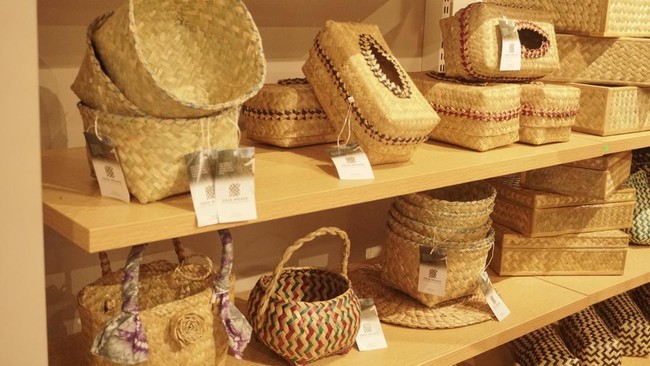
Amidst the recurring threat of forest and land fires in the peatland areas of South Kalimantan, a plant that grows naturally in wetlands has become a new source of livelihood for local villagers: Purun (Lepironia articulable).
Purun is a wetland plant that has long been used by the people of South Kalimantan as weaving material. However, for many years, purun-based products were largely confined to the traditional craft segment, with limited added value and market access.
Maintaining the ecosystem where purun grows remains vital. Peatlands that maintain their moisture levels carry a lower risk of fire compared to dried peat. Therefore, for communities living around these ecosystems, environmental preservation must go hand-in-hand with the availability of tangible income sources.
Recognising this opportunity, Alexandra Christy Untono, a Grade 12 student at ACS Jakarta, initiated the social enterprise Gaia Weave. She has developed purun into modern functional products, ranging from tech organisers and document pouches to bags and accessories for urban needs.
For Alexandra, environmental preservation must be accompanied by economic benefits for the community. Consequently, Gaia Weave develops purun into modern functional products with designs, quality standards, and functions tailored to market demands.
“Purun grows abundantly in wet environments, and by creating economic value from purun, we want to build real incentives so that the community sees the value in protecting the ecosystem where this plant grows,” Alexandra stated in an official release on Friday (2/10/2026).
This approach has opened wider market access for local skills. Currently, Gaia Weave has partnered with 126 female artisans across 15 villages in South Kalimantan, with products including tech organisers, bags, accessories, and corporate merchandise.
The impact of this partnership is clearly visible in earnings. For most of Gaia Weave’s partner artisans, income has increased by approximately 100 to 150%, rising from a range of Rp1 million–Rp1.5 million to around Rp2.7 million–Rp3 million per month.
One such person is Ibu Idang, who previously relied on seasonal farming work with an income of around Rp40,000–Rp50,000 per day. Now, after working in the rice fields, she weaves purun at home and earns an additional Rp80,000–Rp100,000 per day.
“After returning from the fields, I continue weaving at home. The skills we already possess have now become a real additional income, and our weaves are used by many people,” said Ibu Idang.
For Gaia Weave, creating economic value from purun is one way to build incentives for the community to maintain the wetland landscapes where the plant grows. Furthermore, this approach positions purun not merely as a raw material, but as a link between the local economy and ecosystem protection.
“Circular economy is not just about using environmentally friendly or biodegradable materials. The most important foundation is ensuring that people along the supply chain, especially artisans in villages, receive fair economic benefits,” Alexandra emphasised.
Thus, Gaia Wearse aims to build a model where increasing product value goes hand-in-hand with increasing benefits for the communities living around wetland landscapes.
Alexandra’s experience in various sustainability projects, including seaweed mapping research with Birufinery in East Nusa Tenggara and the EcoFunCycle recycling network, has shaped her approach to developing Gaia Weave. By 2030, Gaia Weave aims to expand its network to over 1,000 artisans in South Kalimantan, while simultaneously expanding export markets and partnerships with the premium hospitality sector.
The company is also preparing a QR-based traceability system that allows consumers to know the origin of the material and the product’s journey. Ultimately, Gaia Weave seeks to demonstrate that environmental preservation and the improvement of community welfare can progress together. When local skills and wetland resources achieve higher economic value, the benefits can return to the community while supporting efforts to protect the ecosystems they inhabit.