
Impossible but True: China's Taklimakan Desert Now a Premium Seafood Industry
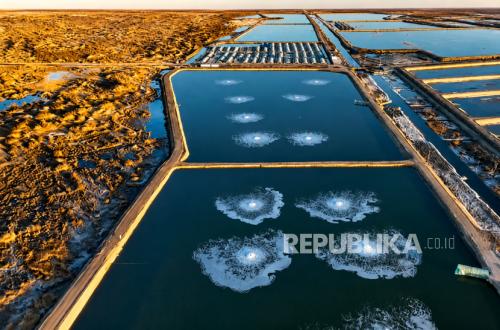
In the middle of the barren and arid Taklimakan Desert, an unusual breakthrough has occurred in Aral City, Xinjiang Uighur Autonomous Region. The area, located far from the sea, is now capable of cultivating various seafood products, allowing local residents to enjoy locally produced fresh prawns and fish. This success was achieved through the development of aquaculture in saline-alkali waters that were previously considered difficult to utilise. Xinjiang has many rivers, lakes, and reservoirs, but the dry climate, long sunlight exposure, and vast saline-alkali land posed major challenges for the agriculture and fisheries sectors. Since 2017, the Chinese government began promoting the use of saline-alkali land for aquaculture development. However, initial efforts in Aral did not run smoothly. Local farmers suffered losses for years while trying to cultivate Pacific white prawns using recirculating aquaculture systems. “We invested 600,000 to 700,000 yuan every year since 2018, but kept losing money. I almost gave up,” said Peng Renkai, head of the Longda Aquaculture Cooperative in Aral, on Thursday (18/6/2026). The turning point came after a team of scientists and technology specialists from Zhejiang Province conducted research on the characteristics of the local underground saline-alkali water. Through sampling and in-depth analysis, they successfully identified fundamental differences between the local saline-alkali water and natural seawater, while also finding solutions to various technical obstacles that had hindered seafood cultivation in the desert. Zhejiang University researcher Shu Miao’an said saline-alkali water not only presents challenges but also potential that can be developed into a high-economic-value industry. “Saline-alkali water also has its own advantages. We hope to develop it into a prosperous industry and help increase people’s incomes,” he said. In addition to technological support, local farmers and technicians also developed a recirculating aquaculture system adapted to Xinjiang’s dry climate. The system was designed to overcome limited water resources while maintaining pond productivity. Longda Aquaculture Cooperative technician Zhao Wei said cultivation productivity has now increased significantly.