
Imports Surge Signals Indonesia's Economic Acceleration, But Rupiah May Suffer
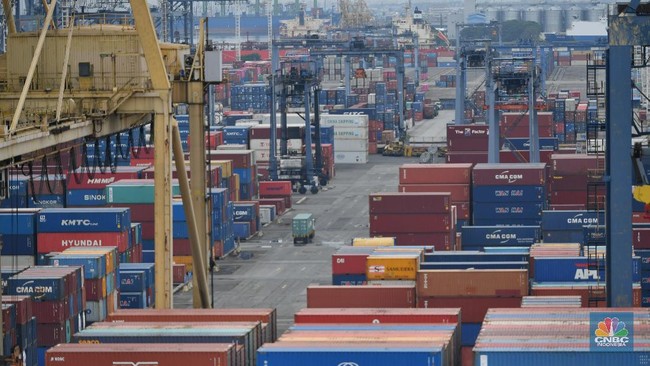
Indonesia’s import performance saw a sharp increase in May 2026, with growth reaching 22.16% year-on-year, rising from US$20.31 billion in May 2025 to US$24.81 billion. Meanwhile, exports slumped by 5.73%, from US$24.61 billion to US$23.20 billion. This condition caused Indonesia’s trade balance to record a deficit of US1.61billioninMay2026.ThismarksthefirstdeficitsinceApril2020, breakinga72 − monthconsecutivesurplusstreakintheexport − importbalance.Nevertheless, thehighimportgrowthsignalsthatIndonesia′seconomyissettoaccelerate, whichthegovernmentispushingtoreach6. This correction extended the rupiah’s weakening from the previous trading session. “This could negatively impact stability. A widening CAD without capital inflow will reduce our foreign exchange reserves. As a result, the rupiah weakens, which in turn makes imported input goods relatively more expensive,” he stressed. A similar view was expressed by Mohammad Faisal, Executive Director of CORE Indonesia. He stated that if the growth of imports, which are largely used as raw materials for the manufacturing sector, is not balanced by export performance, it could actually suppress future growth rates, as the net export portion, a component of GDP, gets eroded. “So, economic growth in the second quarter will experience a very significant weakening compared to the first quarter. This is partly because the contribution from net exports has now decreased significantly,” Faisal revealed. On the other hand, pressure on the rupiah against the US dollar will also persist, given that the demand for dollars is lifted as the portion of imports becomes higher than exports. Export growth typically supports the domestic dollar supply in the form of export proceeds. “If our rupiah exchange rate weakens, imports automatically become more expensive. Meanwhile, a weaker rupiah does not necessarily make exports stronger,” Faisal asserted. Therefore, he said, when the flow of raw material or capital goods imports rushes into Indonesia, Indonesian exports should not be solely driven by raw material exports but must be pushed towards high-value-added exports, which have been pursued through the downstreaming programme to create healthy growth. “How to drive stronger exports amidst the current geopolitical conditions, and of course, how we maximise our export potential, especially related to the current downstreaming programme. We hope it is export-oriented, not just domestically oriented,” Faisal concluded.