
Imports Reach 75%, DME Becomes Alternative Replacement for LPG
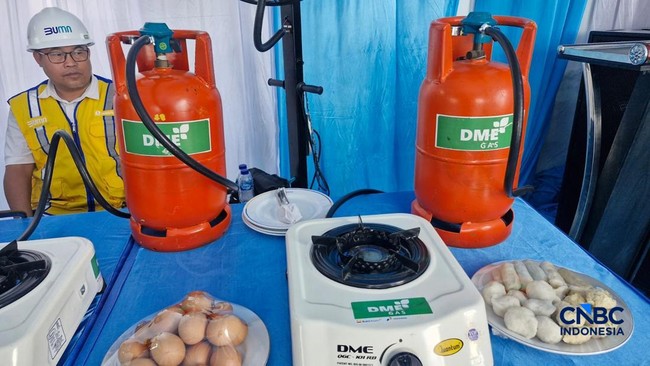
Indonesia’s dependence on imports of Liquefied Petroleum Gas (LPG) is considered to have reached a worrying level. The government is urged to accelerate household energy diversification, one of which is through the development of Dimethyl Ether (DME) as a substitute for LPG based on coal downstreaming.
Energy observer Iwa Gurniwa explained that around 75% of national LPG needs still rely on imports, with a volume of 8.3 million tonnes per year and a value of around US$4.2 billion in 2025.
This situation not only burdens the trade balance but also increases risks from global price fluctuations and subsidy pressures reaching Rp80-90 trillion per year.
“Domestic energy source diversification is no longer a choice but a strategic necessity to maintain national energy resilience,” Iwa stated in a written remark on Monday (4/5/2026).
According to Iwa, the government currently has three main options to reduce LPG dependence: city gas networks (jargas), electric stoves, and coal-based DME. Each has its advantages and challenges, so none can be forced as a single solution.
In the context of DME, Iwa assesses that this option has advantages because it can utilise existing LPG infrastructure. Additionally, Indonesia has abundant reserves of low-rank coal as raw material.
“DME allows quick substitution of LPG without major changes at the household level. This is an advantage not possessed by other options,” he said.
Furthermore, he believes the most appropriate approach is a region-based diversification strategy. Jargas is suitable for large cities with high density, electric stoves for areas with electricity surplus, while DME can be developed in coal-producing regions or non-pipeline areas.
He estimates that if these three options are implemented in parallel, the potential LPG substitution could reach 4.5 to 6.5 million tonnes or around 55-75% of current total imports.
“There is no silver bullet. What is needed is an adaptive policy portfolio according to regional characteristics,” he said.
Previously, the Minister of Energy and Mineral Resources (ESDM) Bahlil Lahadalia revealed several challenges in realising the coal downstreaming project into Dimethyl Ether (DME) developed by PT Bukit Asam Tbk (PTBA) in Tanjung Enim, Muara Enim, South Sumatra.
Initially, Bahlil stated that one of the main backgrounds for DME development is Indonesia’s high dependence on LPG imports.
He explained that the difference in gas types is the main factor why Indonesia still has to import LPG, even though it has large gas reserves.
“I was given a quick briefing by Mr Hilmi and colleagues when we were about to inaugurate his block of 25,000 barrels at that time. I once asked why we import LPG when we have a lot of gas? He explained that C3, C4 is different from most of our gas, our gas is C1, C2. C3, C4 is small, that’s why we build domestic industry, it’s small,” Bahlil said at the IPB Alumni Synergy for the Nation event on Saturday (2/4/2026).
As a substitute, the government is promoting DME development produced from low-calorie coal downstreaming. This product is designed as an LPG substitute, especially for household needs.
Although it has great benefits, Bahlil acknowledged that the DME project journey has not been easy. He mentioned that many parties once opposed or hindered the project’s realisation.
Bahlil said the project had actually already had its groundbreaking during President Joko Widodo’s administration when he was still serving as Minister of Investment. However, the project stalled midway.
“At that time, I wasn’t party chairman yet. So it could still be intercepted. Not party chairman yet, but now don’t try to intercept. I tell you. Maluku people say, brother, if I get angry, it’s broken crosswise, snapped. Ah, that,” Bahlil said.
As is known, President Prabowo Subianto recently inaugurated the groundbreaking of phase II downstreaming project in Cilacap, including the development of DME production facilities in Tanjung Enim.
This project aims to reduce LPG import dependence while increasing the added value of domestic resources. The DME factory to be built is designed to have a production capacity of 1.4 million tonnes per year, equivalent to around 1 million tonnes of LPG.
The DME product will later be absorbed by Pertamina through Pertamina Patra Niaga. This facility will utilise coal that will be processed, which is low-rank or low-calorie coal that has not been optimally utilised so far, while its availability in Indonesia is quite abundant.