
Imported Soybean Prices Rise, Impacting Tofu and Tempeh Market Prices
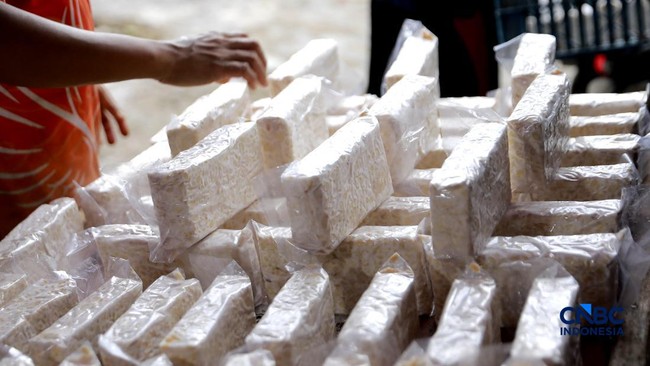
The price of soybeans, which serves as the main raw material for tofu and tempeh, is currently experiencing an increase. However, this price hike has not yet prompted tofu and tempeh producers to raise their product selling prices.
Wibowo Nurcahyo, Secretary General of the Indonesian Tofu and Tempeh Producer Cooperatives Union (Gakoptindo), stated that the selling prices for tofu and tempeh remain stable and have not yet increased.
On the other hand, the prices paid by producers for soybeans vary by region. According to Gakoptindo data as of 10 September 2026, soybean prices in several areas in Java remain below the Government Reference Price (HAP) of Rp12,000 per kg. In West Java, prices at the producer level range from Rp11,200 to Rp11,750 per kg. Central Java sees prices between Rp11,300 and Rp11,750 per kg, East Java between Rp11,250 and Rp11,550 per kg, while DKI Jakarta ranges from Rp11,400 to Rp11,850 per kg.
However, higher prices were recorded in several regions outside Java. In Aceh, for instance, the price of ‘Bola’ brand soybeans paid by producers reached Rp13,200 per kg. Meanwhile, in North Sumatra, ‘Bola’ brand soybeans reached Rp12,800 per kg and the ‘MB’ brand reached Rp12,950 per kg. In West Sumatra, ‘Bola’ brand soybeans reached Rp12,950 per kg.
Soybean prices also hit Rp12,900 per kg in East Kalimantan for the ‘Bola’ brand, while in South Sulawesi, ‘Bola Merah’ brand soybeans reached Rp12,950 per kg. Nationally, the average price of imported soybeans as of 8 September 2026 reached Rp13,762 per kg, which is Rp1,762 higher than the Government Reference Price of Rp12,000 per kg.
Prices at the importer level are rising. According to Wibowo, this increase is occurring at the importer level. Delivery order (DO) data managed by Gakoptindo as of 9 September 2026 shows several prices increasing compared to 2 September 2026. For example, ‘Bola Merah’ brand soybeans in Cigading rose from Rp10,600 per kg to Rp10,700 per kg, as did the ‘Hiu’ brand. Meanwhile, ‘3 Berlian’ and ‘Tugu Monas’ brands in Cikarang rose from Rp10,600 per kg to Rp10,900 per kg.
Wibowo noted that while these increases have occurred in recent days at the importer level, the issue is that domestic soybean prices are rising even as global commodity prices are actually falling. “There has indeed been an increase at the importer level over the last few days. Even though the US Dollar is not touching Rp18,000 and prices on the CBOT (Chicago Board of Trade) are falling,” he said.
Gakoptindo revealed the cause to be the government’s lack of soybean stock control. Consequently, the government lacks the supply necessary to control prices when market increases occur. “Because we do not control the market. The government does not have the goods,” he stated.
He confirmed that this situation allows prices to be determined by those who control the supply, namely the importers.
Nevertheless, Wibowo mentioned that soybean stocks are currently still available, based on information received by Gakoptindo from importers. “The point is, because we do not control the goods, it depends on what those who hold the goods say. If the holders say ‘stocks are available’, then the government feels everything is fine. But if one day they say there are none, that is when the commotion starts; that is usually how the situation goes,” he explained.
Therefore, Gakoptindo is urging the government to realise the Government Food Reserve (CPP) for soybeans. Wibowo noted that the regulations regarding the CPP for soybeans already exist but have not yet been implemented. “It has been determined. The CPP regulation exists. But so far, there has been no realisation. We are pushing for that. But so far, it hasn’t happened.”
With raw material prices still under pressure, tofu and tempeh producers have so far chosen not to raise their selling prices. Meanwhile, Gakoptindo is urging the government to establish soybean reserves immediately so that prices and supply do not depend entirely on importers.