
Imported Fruit Continues to Flood Indonesian Markets, Traders Reveal Primary Causes
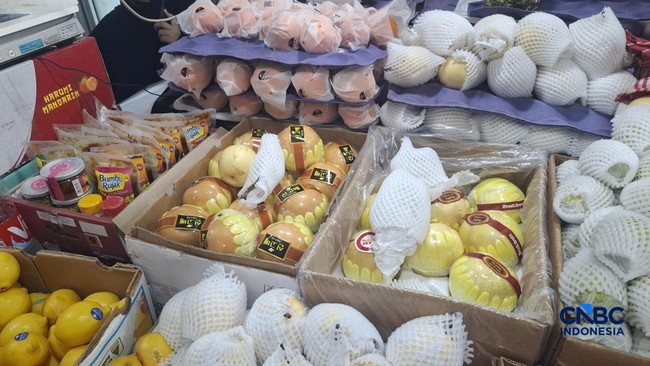
Jakarta, CNBC Indonesia - The availability of imported fruit in markets is observed to be abundant, despite prices tending to rise. This has come under scrutiny after the Indonesian Central Statistics Agency (BPS) revealed a surge in the volume of imported fruit being sold in the market.
Based on observations by CNBC Indonesia at Pasar Senen, Central Jakarta, several fruit traders were seen selling significant quantities of imported fruit, including apples, pears, oranges, grapes, and longans.
Several traders highlighted the advantages of imported fruit, noting that they are not bound by harvest seasons because they are well-preserved using advanced technology. Furthermore, the quality of imported fruit is often perceived to be superior to local varieties.
One trader, Yani, noted that stocks of imported fruit are more plentiful because the quality is maintained, even when it is not the harvest season in their country of origin. “Imported fruit is usually sweeter and looks more attractive; if a customer asks if the fruit is sweet, with imports, it is almost certainly sweet. Whereas with local fruit, the sweetness depends on the season,” Yani told CNBC Indonesia on Wednesday (3/6/2026).
Additionally, the availability of imported fruit is more predictable than local fruit, which remains dependent on seasonal harvest periods. “Imported fruit stocks are always available, such as apples, grapes, and pears. Local apples do exist, but when it is not harvest season, availability is low, so we fill the gap with imported fruit,” she explained.
Another trader, Kurnia, similarly noted that imported fruit tends to be in high demand due to more guaranteed quality compared to local options. “Besides having a more attractive appearance, imported fruit usually has a more consistent sweetness. Local fruit can sometimes be sour, especially when it is out of season,” said Kurnia.
In addition to taste, the shelf life of imported fruit tends to be longer than local fruit due to more advanced post-harvest storage technology.
Previously, BPS reported that consumption imports in Indonesia are dominated by imported fruits. The Deputy for Methodology and Statistical Information at BPS, Pudji Ismartini, explained that imports of consumer goods rose by 42.90% in April 2026, from US$1.70 billion in April 2025 to US$2.43 billion, driven by fruit imports which surged by 109.32%.
“Consumption imports rose by 42.9%, driven by fruit, which increased by 109.32%,” Pudji stated during a press conference on Tuesday (2/6/2026).