
Implementing 'Better Stand' Concept: 90% of Exhibition Booth Materials Can Be Reused
The exhibition industry is fraught with the risk of waste production, ranging from carpets, banners, and booth properties to brochures and various types of wood used in booth construction. However, the ‘Better Stand’ movement, which has been implemented globally, is now being applied to various exhibitions in Indonesia.
This effort has been implemented in the Indonesia Energy & Engineering (IEE) Series 2026, held from 9–12 September 2026 at the Jakarta International Expo (JIExpo). Various sustainability practices are being applied, from waste management to the use of electric vehicles.
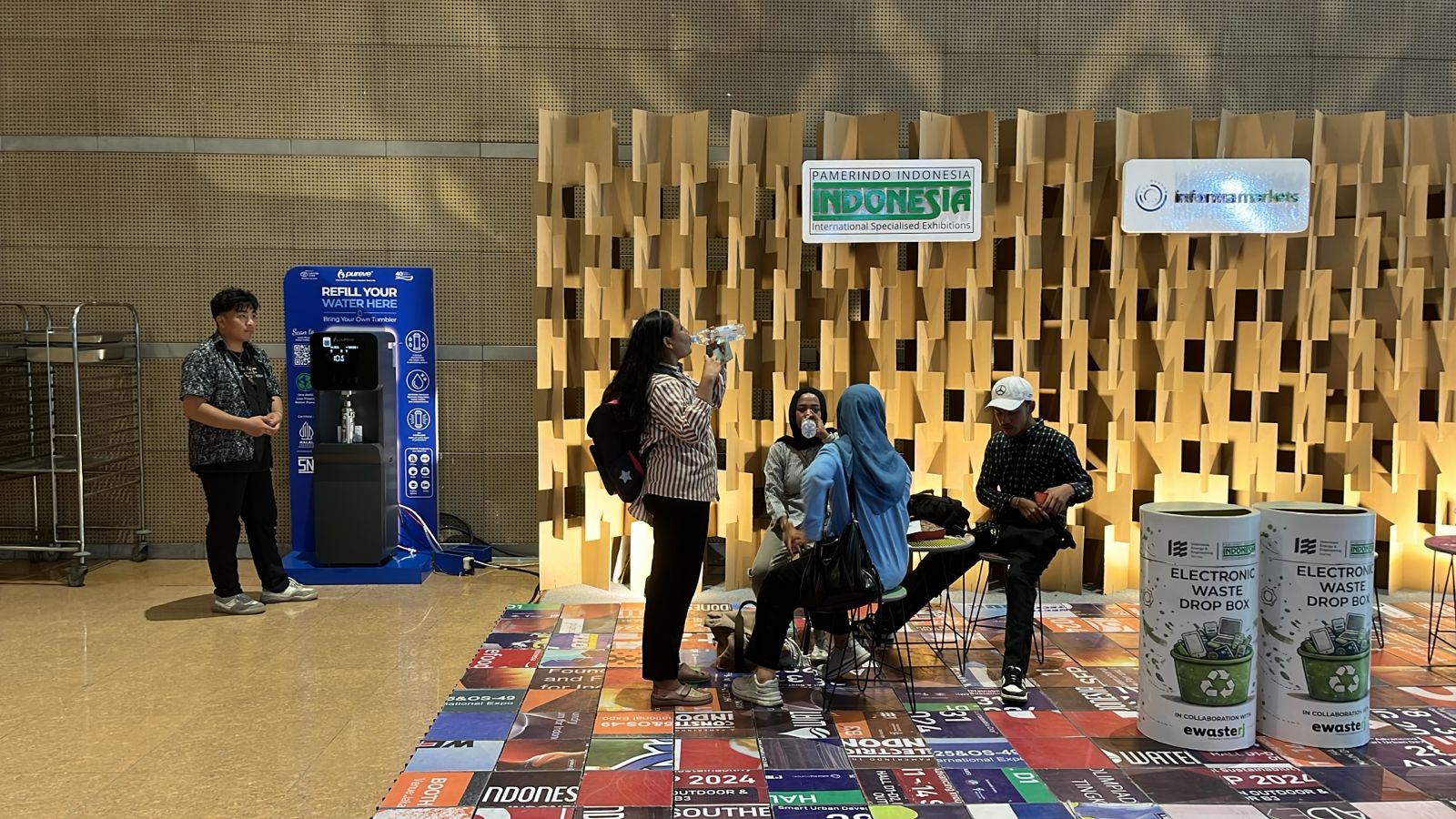
Ingrid Muljo, Marketing Communication Manager of Pamerindo Indonesia, the exhibition organiser, stated that sustainability principles are being applied by reducing carpet usage and collecting banner waste from previous exhibitions to be processed into new products for use in this year’s event.
“One example is decking tiles made from banner waste collected since the 2023 and 2024 exhibitions at the Sustainability Corner. Banner waste is also processed into bags used as souvenirs,” explained Ingrid when met at the Sustainability Corner on Friday (4/9).
According to Ingrid, the Sustainability Corner serves as an educational space for visitors, including specially invited university and vocational school students. This year, a new facility introduced at the sustainability corner is an e-waste bin to collect electronic waste such as batteries, TWS, cables, chargers, and other electronic devices.
“Exhibitors are also given space to introduce their sustainability campaigns to students and other visitors here,” said Ingrid.
Regarding the processing of exhibition waste, Ingrid continued, it is carried out in collaboration with various communities. This year, partners include the Repair Project, which creates plaques for speakers using materials sourced from various waste, including from the Cisadane River.
Sustainability efforts are also directed towards exhibitors through the ‘Better Stand’ programme. This programme encourages participants and contractors to design booths that can be reused so that materials do not immediately become waste after the exhibition ends.
According to Ingrid, approximately 90% of booth materials are targeted to be stored and reused. Consequently, materials such as booth frames do not always need to be manufactured anew for every event.
She noted that one of the challenges in implementing this concept in Indonesia is the limited number of vendors capable of providing materials or services that meet specific sustainability standards. However, booth contractors are reportedly beginning to adapt. Some used construction materials have even been developed into new products, such as reusable folding tables.
“Contractors are starting to adapt because there is demand from us,” said Ingrid.
Pamerindo is also striving to encourage participants to present attractive booths without compromising environmental aspects. Booth structures can be maintained, with appearances updated through colour, decoration, lighting, or three-dimensional elements.
“About 40% of participants are said to have implemented the Better Stand concept,” stated Ingrid.
In addition to waste, the carbon footprint arising from participant mobility and exhibition operations is also being calculated. Since 2023, Pamerindo has conducted surveys to identify the modes of transport used by visitors. Information regarding travel by plane, including long-haul flights, is also part of the carbon footprint calculation.
“So, we try to calculate everything. Whatever we can offset, we offset. For offsetting activities, Pamerindo follows global standards and uses projects that have obtained certification in accordance with regulations. For 2025, the carbon credits used will come from global projects. However, there are also several projects in Indonesia that meet certification standards and have the potential to be used, including projects in Kalimantan and Sulawesi.”
The commitment to emission reduction is also evident in the use of electric vehicles to support visitor mobility from various points in Jakarta to the exhibition venue. For mobilisation between exhibition areas, electric vehicles are also used with the support of partners.
Another step involves providing water stations and campaigning for the use of tumblers to reduce single-use packaging. The number of water stations will be increased as the exhibition area expands.
These contributions are channelled through various programmes in the fields of social welfare, education, the environment, and the development of small-scale community economies.