
Impact of Oil Prices: Bappenas Warns of Smaller Indicative Budgets for Ministries and Agencies in 2027
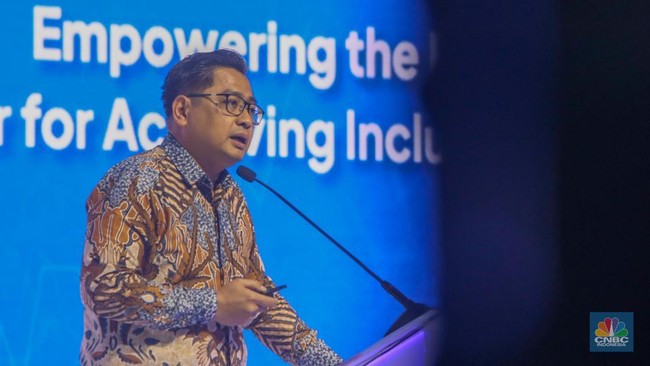
Jakarta, CNBC Indonesia - The Ministry of National Development Planning (PPN)/Bappenas is currently drafting the government’s work plan (RKP) for 2027, alongside the submission of indicative budgets for ministries or agencies (K/L) in the 2027 fiscal year.
Deputy for Macro Development Planning at the Ministry of PPN/Bappenas, Eka Chandra Buana, stated that the indicative budgets for K/L next year will be adjusted to be smaller compared to 2026.
“Of course, this is what you might receive today as the indicative budget, and it might seem small,” said Eka at the Rakorbangpus 2026 event in Preparation for the 2027 RKP at the Bappenas Office, Jakarta, on Thursday (7/5/2026).
Eka explained that the adjustment to the indicative budgets for K/L takes into account the risks from high volatility in global crude oil prices due to the prolonged war in the Middle East.
He said that Bappenas has developed three scenarios for the impact of oil price pressures on the state budget (APBN). These include optimistic, moderate, and pessimistic scenarios, depending on the duration of the war between Iran, the United States (US), and Israel.
In the optimistic scenario, the conflict is short-lived or resolved in the near term, within 1-4 months, with Indonesia’s reference crude oil price (ICP) averaging US$84 per barrel, resulting in a fiscal deficit pressure equivalent to 0.57% of GDP.
Meanwhile, in the moderate scenario, where the war lasts for 8 months with ICP pressure at US$92 per barrel, the effect on the fiscal deficit would be equivalent to 0.92% of GDP.
Finally, for the pessimistic scenario, with a prolonged war lasting more than a year and average oil prices reaching US$102 per barrel, the effect on the fiscal deficit would be equivalent to 1.2% of GDP. This serves as the basis for preparing the 2027 indicative budgets.
“This is indeed the best condition like this, but innovative steps are needed to keep moving amid uncertain conditions,” said Eka.
Eka stated that to mitigate the impact of rising oil prices, the government has implemented various anticipatory policies that can also support state spending efficiency.
These mitigation policies include implementing work-from-home (WFH) and efficiency in official travel and vehicles. Then, accelerating the B50 policy and equitable and widespread distribution of fuel, and finally, encouraging the use of public transport for mobility.
“We need to anticipate its impact on our APBN. If the war continues, there will be pressure on economic growth, the current account deficit, and so on,” Eka explained.
Throughout this year, Bappenas has noted initial signs of the geopolitical conflict’s impact on the 2026 macroeconomy. For instance, economic growth could face pressure of 0.08%-0.44%. Inflation could rise by around 0.82%-2.36%.
The current account deficit would be in the range of 0.64%-2.12% of GDP, the exchange rate under pressure between Rp16,950 and Rp17,590 per US dollar.
Foreign exchange reserves could erode by around US$9.6-31.1 billion, equivalent to 0.6-1.7 months of imports, the Gini ratio by 0.0012%-0.0041%, employment opportunities under pressure by minus 0.42%-1.37%, and poverty increase by 0.10%-0.33%.