
Impact of Malioboro Street Vendor Relocation: Only 20 Per Cent of Traders Remain
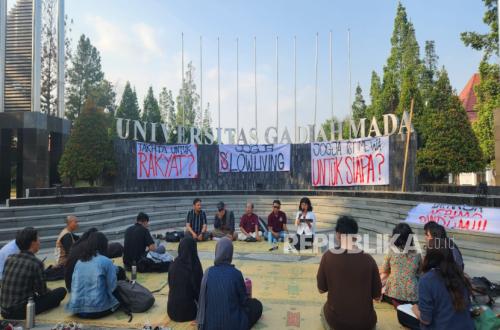
The relocation of street vendors (PKL) in the Malioboro area remains under intense scrutiny. During a discussion titled ‘Jogja Istimewa untuk Siapa?’ (Whom is Special Jogja for?) held by SEMA UGM at the Gadjah Mada University Boulevard on Friday (2/10/2026), the issues regarding spatial management between the Yogyakarta City Government and the traders were revisited.
Arif Usman, a former Malioboro street vendor who has since transitioned into a street photographer, shared his perspective on the changes in the lives of vendors relocated to Teras Malioboro. “I used to sell T-shirts in the Malioberoro alleys. There were more than 1,300 street vendors along Malioboro Street who depended on that area for their livelihoods,” said Arif.
After being moved to the new location, Arif explained that many traders are struggling to maintain their businesses. He estimates that only about 20 per cent of traders are still able to survive, while the rest have chosen to change professions. “Now, many of us who were evicted and moved to Beskalan or Ketandan… only about 20 per cent can endure. The other 80 per cent have changed professions,” he said.
According to him, the issue is not merely whether the government provides trading space, but whether that location is capable of attracting customers. He noted that some traders are finding it difficult to attract buyers because the new location is not as crowded as the previous one. “The space exists; the government has provided space. But the problem is that there are no customers entering that space. That is the real issue,” he added.
He also highlighted the lack of involvement of traders in the policy-making process. He believes that decisions regarding the rearrangement of Malioboro should consider the experience and needs of the traders who have relied on the area for many years. “As traders on the sidewalk, we were not directly involved. Whether we liked it or not, we were given this place,” said Arif.
Arif hopes that the government will re-evaluate the relocation policy. He mentioned that some traders still desire business spaces that would allow them to regain the income levels they had when trading in the Malioboro area. “Our hope as Malioboro street vendors is that the solution that allows us to survive is to return to how things were before,” said Arif.
Meanwhile, M. Rakha Ramadhan, a representative from the Yogyakarta Legal Aid Institute (LBH Yogyakarta), stated that spatial management issues must be viewed in the context of citizens’ rights and community participation in policy.
Rakha assessed that spatial management should not be understood merely as the physical arrangement of an area, but also involves who can use the space, how the community is involved in the decision-making process, and whether such arrangements continue to guarantee the rights and livelihoods of the citizens. “If we look at various events, spatial management is the most critical factor,” said Rakuna.
He noted that the various issues arising in Yogyakarta demonstrate the importance of testing every policy based on its impact on the protection and fulfilment of citizens’ rights. “To me, Jogja remains special. What is special is the people’s movement that, to this day, is still willing to fight against the dispossession of space,” concluded Rakha.
Source: jawawa.id (https://jawawa.id/newsitem/impact-of-malioboro-street-vendor-relocation-only-20-per-cent-of-traders-remain-1791176207)
Originally published by Republika (https://rejogja.republika.co.id/berita/tmf2fw291/dampak-relokasi-pkl-malioboro-hanya-20-persen-pedagang-yang-bertahan), translated from Indonesian