
IMF Cuts Indonesia's 2026 Economic Projection, Rupiah Under Pressure
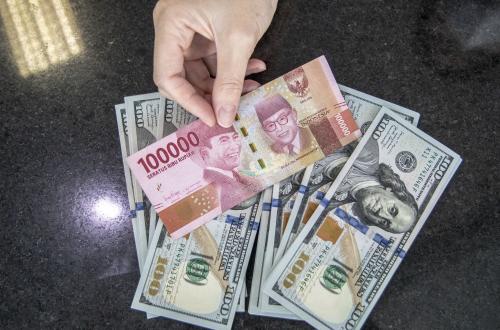
The rupiah’s exchange rate against the US dollar continued its weakening trend above the Rp17,000 per US dollar level. The Garuda currency is increasingly under pressure following the International Monetary Fund’s (IMF) outlook, which projects slower economic growth for Indonesia in 2026.
Citing Bloomberg, the rupiah weakened by 16 points or 0.09 percent to Rp17,143 per US dollar at the close of trading on Wednesday (15/4/2026). In the previous session, the rupiah was at Rp17,127 per US dollar.
Currency and commodity analyst Ibrahim Assuaibi opined that the IMF’s latest projection on Indonesia’s economic growth is one of the internal sentiments pressuring the rupiah’s exchange rate.
“The IMF projects Indonesia’s economic growth at 5 percent in 2026. This figure is lower than the IMF’s January report, which projected Indonesia’s economic growth to rise by 5.1 percent. Meanwhile, Indonesia’s economic growth in 2027 is at 5.1 percent,” said Ibrahim in a written statement to reporters on Wednesday (15/4/2026).
Not only Indonesia, the IMF also projects a slowing global economic growth to 3.1 percent in 2026. This is due to the outbreak of war in the Middle East this year, after the economy had weathered last year’s trade barriers.
“The IMF is not the only institution lowering Indonesia’s projection. Previously, the World Bank lowered its projection for Indonesia’s economic growth to 4.7 percent in 2026. This figure is lower compared to the World Bank’s projection in October 2025, which reached 4.8 percent,” he explained.
Meanwhile, the Asian Development Bank (ADB) estimates Indonesia’s economy will grow steadily at 5.2 percent in 2026 and 2027. Strong domestic demand and infrastructure spending are the main supports for economic stability in Southeast Asia, particularly Indonesia.
“This slowdown is influenced by external pressures, particularly the rise in global oil prices due to the confrontation between the US and Israel with Iran, which impacts the blockade of the Strait of Hormuz, as well as increasing investor caution in international financial markets (risk-off sentiment),” he clarified.
Ibrahim continued that the external sentiment affecting the rupiah’s weakening is none other than the dynamics of global uncertainty due to the escalation of the war in the Middle East, which is still ongoing.
He explained that the latest news indicates the US Central Command stated in a social media post that the blockade of Iran’s ports has been “fully implemented” and that US forces have “completely halted economic trade entering and exiting Iran via sea.” This step occurred just two days after the US began its naval blockade against Iran, aimed at pressuring Tehran to accept a ceasefire agreement. This follows the US-Iran ceasefire talks in Pakistan ending without agreement.