
IMF Chief Warns Energy Price Shocks Are Not Over!
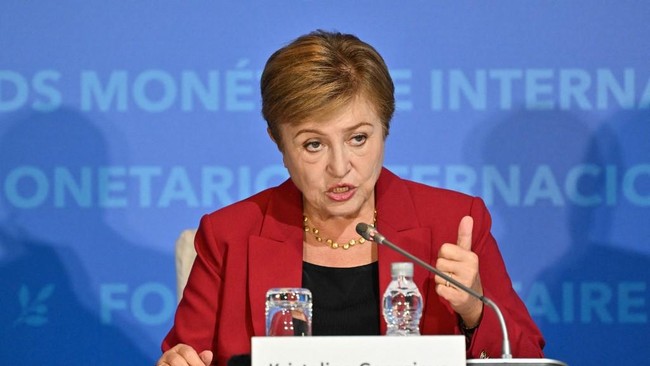
The Managing Director of the International Monetary Fund (IMF), Kristaluna Georgieva, has revealed that the global economy has managed to withstand the impact of energy price shocks resulting from the conflict between the United States and Iran in the Middle East so far.
While she considers the global economy’s ability to face energy price pressures to be better than previously estimated, she warned that the world must not become complacent, as fiscal conditions in several countries are worsening amidst the ongoing potential for global energy price shocks.
“So far, the global economy has navigated the energy shocks caused by the closure of the Strait of Hormuz better than we feared,” Georgieva stated, as reported by Reuters on Sunday (30/8/2026).
During a press conference ahead of the G20 Finance Ministers’ meeting in Asheville, North Carolina, on 25 August 2026, Georgieva noted a “tug-of-war” currently occurring between the negative pressures of energy supply disruptions in the Gulf region and the positive drivers from the surge in Artificial Intelligence (AI) investment expanding beyond the United States.
Nevertheless, she emphasised that the risks to the global economic outlook are currently more balanced compared to April’s projections, although the direction still leans towards the negative. This is due to increasing fiscal pressures and the possibility that central banks may have to maintain tight monetary policies for longer to curb inflation.
Global Economy Holds Firm Amidst Pressure
Georgieva explained that global growth has been able to withstand heavy pressure from high debt levels, persistent inflation, and international trade tensions. She noted that the world has successfully navigated the impact of the Strait of Hormuz closure thanks to a combination of factors.
These supporting factors include the utilisation of oil and gas reserves by many nations, increased energy supplies from outside the Gulf region, a decrease in energy demand, the expansion of renewable energy capacity, and the return of several countries to using coal-based power plants.
On the other hand, the wave of AI investment in the United States has helped maintain strong corporate profits and consumer spending. A similar trend is beginning to emerge in other countries that are aggressively building data centres and strengthening AI hardware supply chains.
Despite outlining the current situation, Georgieva did not provide new projections in her statement this time. Notably, the IMF slashed its 2026 global economic growth projection to just 3.0% last July, warning of additional risks from the Middle East war, trade fragmentation, and uncertainties surrounding AI. The latest projections are scheduled to be released at the IMF and World Bank annual meetings in Bangkok in mid-October.
Energy Shocks Are Not Over
Georgieva warned policymakers not to be lulled into a false sense of security, even though Brent crude oil prices have remained in the US$80-90 per barrel range since mid-June, well below the peak of US$118 seen last spring.
“These energy shocks are not over,” Georgieva asserted. She warned that a resurgence in oil prices could trigger new inflation, which in turn would force central banks to maintain tight policies, with further consequences for debt servicing costs and general economic activity.
She also called on all nations to immediately address their respective fiscal issues by developing credible plans to ensure that debt and deficits remain on a sustainable path.
While not naming specific countries, Georgieva’s statement follows closely after US 30-year Treasury yields surged to a 19-year high last week. This spike prompted US Treasury Secretary Scott Bessent to take the unexpected step of doubling the size of long-term bond buybacks to curb the rise in borrowing costs. The IMF has long urged Washington to reduce its expanding fiscal deficit, which is believed to help narrow the US trade and current account deficits.
Central Banks Must Focus on Price Stability
Georgieva emphasised that central banks in various countries must remain “fully focused” on their mandate of price stability amidst lingering inflation risks, even though she acknowledged that tight monetary policy risks slowing economic growth.
Furthermore, she highlighted the need for nations to address global economic inequality, which serves as a driver for trade tensions. Without naming any country directly, Georgieva is known for frequently urging China to shift its economic growth model from relying on massive exports to the global market towards a greater reliance on domestic consumption.
“A more balanced economy means a stronger global economy, and that is good for all parties,” said Georgieva, while acknowledging that this would be harder to achieve in an increasingly fragmented world.
The IMF is reportedly refining its external balance assessment model and will deepen its analysis regarding the drivers of global inequality, including the interaction between macroeconomic trends, trade policy, and industrial policy, which is planned for a series of upcoming studies.