
IMF Chief Highlights AI’s Major Impact on the Global Economy and the Risks
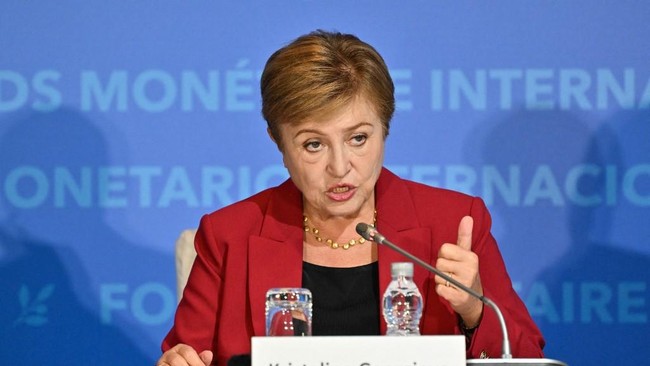
Jakarta, CNBC Indonesia — The International Monetary Fund (IMF) has highlighted the increasingly significant role of artificial intelligence (AI) in shaping differences in economic performance and prospects between countries in the global economy.
IMF Managing Director Kristalina Georgieva said AI had arrived and was rapidly becoming a key factor determining differences in countries’ economic performance and prospects worldwide.
“Global investment in AI as a share of GDP will continue to rise, and could even exceed the investment once used to build railway networks, electricity grids or telecommunications networks,” Kristalina said in a speech at the IMF Annual Meeting in Thailand, as quoted on Tuesday (13 October 2026).
Kristalina also forecast that the AI industry could account for more than a tenth of global goods trade, with its share continuing to grow alongside user demand.
“We estimate that AI hardware and related technology products currently account for more than a tenth of global goods trade, and that share is continuing to increase,” Kristalina said.
The IMF said the growth in AI-related trade reflected a surge in investment in countries integrated into AI value chains. These include the United States, China and India, which are net importers of AI hardware and are also building infrastructure to become major AI providers.
Five of the other seven countries among the top 10 are in Asia. They supply a range of components and technologies, from high-end microprocessors and memory chips to chip-making equipment and robotics.
“Unfortunately, most other countries are not benefiting much from the rapid advance of AI. This increases the risk of widening economic disparities around the world,” Kristalina said.
The IMF also suspects that AI is already affecting global private bond markets. An increase in long-term private bond issuance could intensify competition for savings and other sources of financing.
“AI affects private bond-market dynamics in two ways. First, increased issuance of long-term private bonds could intensify competition for savings or sources of financing. Second, some of the rise in benchmark bond yields may reflect expectations of faster economic growth in the future,” Kristalina said.
Kristalina added that the surge in AI infrastructure development was inflationary, tending to push inflation higher.
She also referred to Amara’s Law, which holds that people tend to overestimate the short-term impact of new technology while underestimating its long-term effects.
“Between the wave of AI infrastructure development we are seeing now and the point when the benefits of AI begin to be felt in the future, there is a transition period we must navigate. It is precisely during this transition that we will face the period of greatest risk,” she added.
The good news, she said, is that the right conditions and global policies can help maximise the benefits of AI. The main gains will not come from short-term demand generated while supporting infrastructure is being built, but from long-term productivity improvements as the technology is widely adopted.
“Our research shows that, if developed and deployed appropriately, AI could increase global economic growth by an additional 0.5 percentage points each year over the long term. Imagine growth rising from 3% to 3.5%, adding economic value equivalent to the ASEAN economy to the global economy over a decade,” she concluded.
Source: jawawa.id (https://jawawa.id/newsitem/imf-chief-highlights-ais-major-impact-on-the-global-economy-and-the-risks-1791877910)
Originally published by CNBC Indonesia (https://www.cnbcindonesia.com/news/20261013123210-4-775694/bos-imf-ungkap-dampak-besar-ai-ke-ekonomi-dunia-ini-risikonya), translated from Indonesian